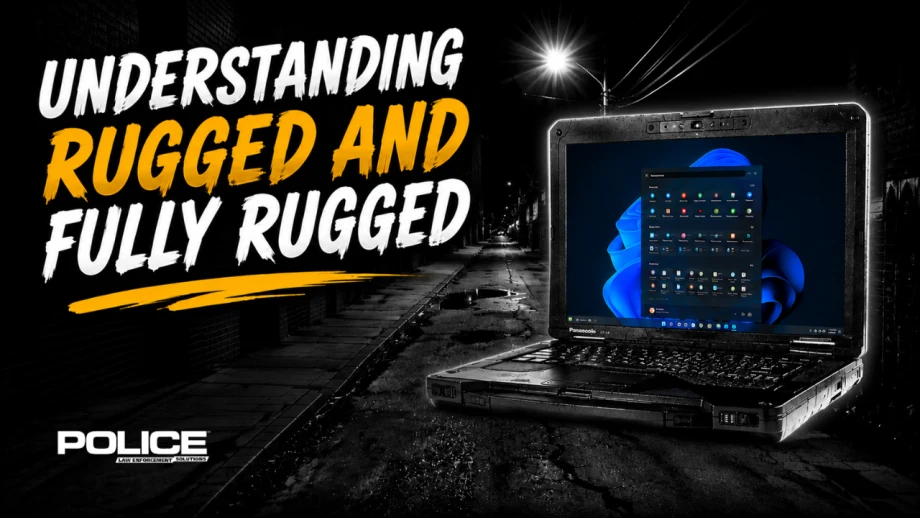
What Qualifies a Laptop as Rugged or Fully Rugged?
Police officers face a wide range of working conditions that can damage or even destroy a regular consumer laptop. Learn what qualifies a computer as rugged or fully rugged and why those devices are vital for law enforcement.
Learn about computers, rugged and fully rugged, that are designed for law enforcement.
Credit:
Panasonic Connect | POLICE | Edited with OpenAI
4 min to read
Rugged laptops are designed to operate reliably in extreme conditions, such as varied temperatures and environments.
These computers must endure and function amidst physical impacts, dust, and moisture exposure.
Fully rugged laptops often meet higher standards and certifications, making them apt for demanding roles like law enforcement.
*Summarized by AI
Day or night, rain or shine, in any environment, police officers need to depend on their gear. That also applies to computing devices. But what makes a device rugged or fully rugged?
To better understand what makes a computer rugged or fully rugged, POLICE spoke with two experts at Panasonic Connect. Here is what they shared.
Ad Loading...
Mike Sarallo, director of public sector and utility sales at Panasonic Connect North America, explained how military specs come into play.
“What separates a rugged product from a consumer product is the military standard specifications, like MIL-STD-810, which has to do with dust, shock, and vibration ratings that the device meets, and we do that by providing a single device that goes through all that testing,” Sarallo said.
He also said devices intended for the field must be engineered for water resistance, rated by their ingress protection.
“So, our rugged device has an ingress protection of IP53, and after that level you move up to fully rugged, which has higher IP ratings, which just makes it a little bit more water resistant to ingress protection,” Sarallo added.
Other protective features also come into play, like having a higher drop rating.
“We also have other features like a higher drop rating. A rugged solution has a 3-foot drop rating. Our fully rugged has a 6-foot drop rating, and we also have other certifications like HazLoc (hazardous location) certifications. So, that's really how we separate the tiering between rugged and fully rugged: it's just the demands of the environment that the device needs to be used in,” Sarallo explained.
With so many specifications and verifications, does Panasonic Connect do those in-house?
“Yes, we actually do the testing in-house, and as I mentioned, our goal is to utilize a single device to meet all those requirements, especially with all the military spec specifications and standards,” answered Sarallo.
Why Police Need Rugged Devices
With military-spec standards dictating what makes a device rugged and fully-rugged, is that level of capability needed for law enforcement? Why do police officers need these rugged devices?
“It really comes down to demands of the environment that the product is going to be used in, and we have two audiences that we have to appease when it comes to law enforcement,” he said.
Sarallo explained that these tough devices must meet the demands of the IT department and the command staff, who want to maximize the investment, and they also need to know they are purchasing equipment and technology that will last for years. He said many customers deploy Panasonic Connect products for up to 5 years.
That longevity also benefits the financials by providing a return on the investment.
“The product has to provide them a low total cost of ownership, and also a higher rate of return on investment,” Sarallo detailed. “And our products are designed to be in vehicles and also outside of vehicles. But even in vehicles, when that device is in a vehicle for five years. It's subjected to extreme temperature changes in various environments within the United States.”
“Some officers take home their vehicles at nighttime. They're parked outside in their driveway, and in winter, it could be well below zero. And then, within 15 to 20 minutes, that car gets up to temperature. And in other parts of the United States, those cars are parked outside, and the environment with that vehicle gets up to over 100 degrees. So, the device needs to be able to perform continuously over that long period of time,” he added.
So that's part of the reason why rugged and fully-rugged devices are purpose-built for those applications. In addition to temperature extremes and inclement weather, the computers are also used in varied lighting conditions. They are designed so an officer can easily view the needed information whether in bright direct sunlight or the dimmed interior of a patrol car.
But officers must be able to easily interact with the devices, no matter what the environment sends their way.
“They may be out in the rain where officers have gloves on and need to touch the screen, so we have auto-sensing screens that determine the difference between raindrops and the actual physical touch. So, these are features that we put into our devices,” Sarallo said. “They could be utilized in the elements, and we have many customers, even in other industries, that require this level of rugged ability and durability as well.”
Other Occupations That Deploy Rugged Devices
Kjeld Linsted, association director for IoT and connected vehicle products at Panasonic Connect North America, joined the conversation to share insights on who, besides police officers, needs these rugged devices.
“I think any place where you're doing something out in the field in an environment that requires you to think about something beyond just consumer (computers), I think that's where rugged is applicable,” Linsted explained. “It may well be military, it may well be police and fire that are in many of those same situations, but also oil and gas, utility, water, any of these folks out in the field doing things kind of in the real world. I think all of that's applicable to rugged, just about the same.”
The federal government is building a nationwide framework for autism-related missing-person alerts. For law enforcement, the bigger opportunity may be what happens before the public ever sees one.
Police officers face a wide range of working conditions that can damage or even destroy a regular consumer laptop. Learn what qualifies a computer as rugged or fully rugged and why those devices are vital for law enforcement.
Within your agency, are officers using e-learning platforms as a means to complete mandatory training and engaging in nothing more than ‘click through’ or ‘mindless clicking’ to get to the end of the training modules?
For years, law enforcement has worked to dispel the myth that someone must be missing for 24 or 48 hours before a report can be taken, but another problem gets far less attention. A missing-person report is not an investigation.
Pickup trucks are not new to patrol duties, but with the debut of the 2027 Ram 2500 Emergency Response Vehicle, they are getting larger and heavier. POLICE reached out to the Michigan State Police Precision Driving Unit to learn more about pickup truck handling, vehicle dynamics, and what officers need to know.
Tennessee’s new deadly force law is more limited than many may realize. Effective July 1, 2026, the law applies to a person who is not engaged in conduct that would constitute a felony or a Class A misdemeanor and who is in a place where the person lawfully resides. But it could have far-reaching influence.
Time-sensitive injuries like penetrating trauma mean a wounded officer needs to reach a trauma center as soon as possible, and in some cases, that means transporting by police vehicle rather than waiting for EMS. What are the factors to consider in making that transport decision?
What should every officer include in an IFAK? Sydney Vail, M.D., a veteran trauma surgeon and former SWAT surgeon, explains which components are needed and which are not, and stresses training.
Detective David Lee Stephens wants the public and every law enforcement agency to know there is no truth nor logic to the widely held belief that one must wait 24 or 48 hours to report a missing person.