
CA Lieutenant With Autistic Son Leads Awareness Efforts; He and Wife Design Special Patch


 MENU
 SEARCH
The federal government is building a nationwide framework for autism-related missing-person alerts. For law enforcement, the bigger opportunity may be what happens before the public ever sees one.
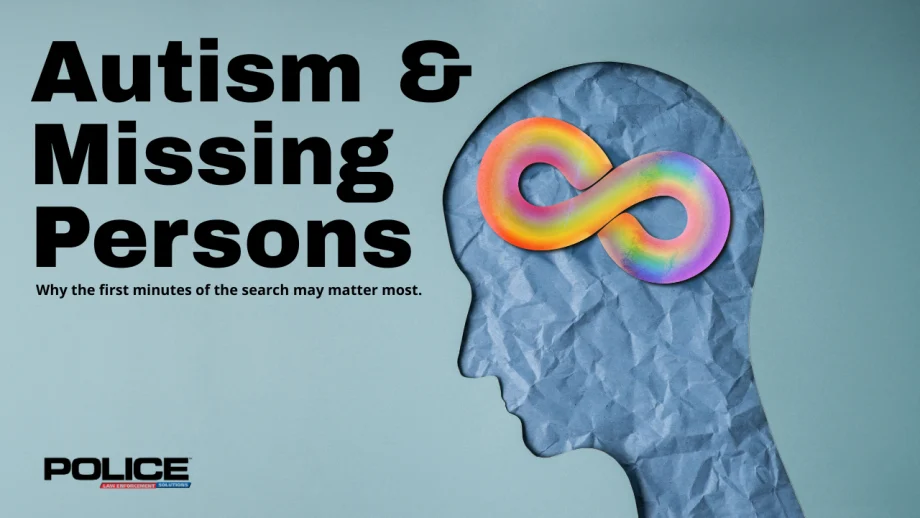
What cops need to do before the alert ever goes out, and why the first minutes of the search may matter most.
POLICE
*Summarized by AI
The alert on a phone is the part the public sees.
The search is the part that decides whether the missing person comes home.
That distinction matters even more when the missing person is autistic.
On Aug. 21, 2026, the U.S. Department of Health and Human Services announced development of the first National Autism Missing and Endangered Person Alert Initiative, working with the Department of Justice and FEMA. The initiative is intended to strengthen coordination among law enforcement, emergency managers, first responders, and community partners when an autistic child or adult goes missing.
At first glance, it sounds like another alert program. It is more important than that. HHS says the effort is intended to improve not only public notification but “the search response behind” the alert. Federal partners plan to develop model activation protocols, autism-specific response procedures, standardized alert language, evidence-informed search practices, and training covering communication differences, water searches, rapid activation, and safe recovery.
For cops, that is where this gets interesting. An alert can put thousands of eyes on a missing person.
It cannot tell the first officer where to look.
There is not currently a separate nationwide Autism Alert that an officer can activate. HHS says the initiative will build on existing Missing and Endangered Person processes and FEMA’s Integrated Public Alert and Warning System, or IPAWS.
Rather than creating a separate infrastructure, federal partners plan to promote more consistent use of the existing Missing and Endangered Persons, or MEP, category for qualifying autism-related incidents.
That distinction matters. An autistic person can face an immediate threat to life without evidence of an abduction.
Washington will build the framework. State, tribal, territorial and local agencies will still decide how it is used.
CDC surveillance data estimate that about one in 31 eight-year-old children in monitored U.S. communities were identified with autism in 2022. HHS cites research finding that 49% of children with autism had attempted to elope at least once after age four.
The real problem is what can happen after someone leaves.
The National Center for Missing & Exploited Children reports that in 2025 at least 98 children and young adults with autism were recovered deceased after wandering or elopement. Eighty-eight percent drowned. NCMEC says drowning often occurs within a few hundred feet to a half-mile of the missing location and can happen within minutes.
That should change the opening moves of the search.
An autistic child may not respond when officers call his name. A non-speaking person may hear searchers and still be unable to answer. Someone frightened by noise may move away from sirens or search teams. Others may hide, head toward roads or trains, or seek a highly specific interest that makes perfect sense to the family but means nothing to the responding officer.
And then there is water.
NCMEC has made the message blunt enough to put on a roll-call slide:
Search Water First.
That does not mean every autism-related missing-person case ends in water. It means nearby water should be identified immediately and prioritized when circumstances support it. NCMEC specifically trains officers to recognize heightened risk and prioritize water in the search response.
Before units simply expand an equal-radius search from the last-known point, somebody should be looking at the map.
Pools. Ponds. Creeks. Rivers. Retention basins. Drainage areas. Farm ponds.
Then look at roadways, railroad tracks and known places or objects of interest.
This is where the dispatcher and report-taker can change the outcome before the first cruiser arrives.
Ask whether the person is attracted to water or can swim. Ask about previous wandering episodes, communication ability, sensory triggers, favorite locations, and anything that might attract or frighten the person. Ask whether the person wears a GPS device, radio-frequency transmitter or other tracking technology.
Get a current photograph into officers’ hands quickly.
Those are not background questions.
They are search intelligence.
Tennessee has already seen just how complicated one of these cases can become.
Sebastian Rogers disappeared from his Hendersonville home in February 2024. He has autism and, according to the FBI, may be unable to return safely without assistance. His disappearance triggered a massive multiagency response involving the Sumner County Sheriff’s Office, Tennessee Bureau of Investigation, FBI, and numerous other agencies.
The FBI says the initial search covered roughly a four-and-a-half-mile radius around Sebastian’s home. About 2,000 searchers participated, using mapping technology to track searched areas. Ground teams, mounted patrols, ATVs, canines, drones, helicopters, and an airplane were used. Investigators searched homes, drained ponds, and examined waterways.
At one point during that effort, I had an opportunity to assist in the search for Sebastian.
What stays with me is not a theory about where he went.
It is the absence of an answer.
Sebastian remains missing. The FBI continues to offer a reward of up to $50,000 for information leading to his whereabouts.
His case belongs in this discussion for precisely that reason. Autism gave investigators important information about vulnerability and possible behavior. It helped inform search priorities.
It did not tell anyone what actually happened.
Autism may explain why someone wandered.
It does not prove that wandering is what happened.
The fundamentals still matter: establish the last-known point, build a timeline, identify witnesses, preserve video, check digital information when legally appropriate, determine direction of travel and look for anything inconsistent with a voluntary departure or typical elopement.
A missing-person report is the beginning of an investigation, not the completion of one.
And autism cannot become an investigative shortcut.
Missing is a status. It is not an explanation.
If everyone decides in the first five minutes that “he wandered again,” evidence of an accident, exploitation, abduction or another explanation can be missed.
Behavioral information should make the search smarter, not narrower.
The initiative also creates an opportunity for agencies to examine locating technology before an emergency occurs.
Project Lifesaver uses wearable radio-frequency transmitters for people at risk of wandering and reports average recovery times of about 30 minutes when its technology is deployed. GPS wearables, phones, drones and thermal imaging can also reduce search time when they fit the circumstances.
I have spent part of my own work evaluating both conventional and unconventional locating technologies, including the experimental Magneto-Electric Scanner developed by forensic researcher Dr. Arpad Vass.
My view is simple: new technology should neither be accepted because it sounds impressive nor rejected because it is unfamiliar.
Test it. Document it. Understand its limitations.
Most importantly, no device should delay proven investigative or search methods.
Finding the person is not necessarily the end of the problem.
An autistic person who has been missing may be frightened, overwhelmed or unable to understand what officers want. Flashing lights, shouting commands or sudden physical contact may escalate a situation that was seconds away from a safe recovery.
Use simple language. Reduce unnecessary noise and lights when circumstances allow. Bring a caregiver or familiar person into the recovery if possible. Remember that a person who does not answer may still understand you.
The mission is not merely to locate the person.
It is to bring that person home safely.
Departments do not need to wait for DOJ to finish the national guidance.
Review the questions dispatch asks when autism or another developmental disability is reported. Make sure water attraction, communication ability, previous wandering behavior, likely destinations and tracking technology are addressed early.
Know who in your jurisdiction has authority to issue an IPAWS MEP alert and what criteria must be met.
Loading data...

Patrol
What cops need to know about alpha-gal, the tick-borne allergy that can turn an ordinary exposure into a problem weeks or months later.
Investigations
The federal government is building a nationwide framework for autism-related missing-person alerts. For law enforcement, the bigger opportunity may be what happens before the public ever sees one.

Technology
Police officers face a wide range of working conditions that can damage or even destroy a regular consumer laptop. Learn what qualifies a computer as rugged or fully rugged and why those devices are vital for law enforcement.

Within your agency, are officers using e-learning platforms as a means to complete mandatory training and engaging in nothing more than ‘click through’ or ‘mindless clicking’ to get to the end of the training modules?

Investigations
For years, law enforcement has worked to dispel the myth that someone must be missing for 24 or 48 hours before a report can be taken, but another problem gets far less attention. A missing-person report is not an investigation.

Vehicle Ops
Pickup trucks are not new to patrol duties, but with the debut of the 2027 Ram 2500 Emergency Response Vehicle, they are getting larger and heavier. POLICE reached out to the Michigan State Police Precision Driving Unit to learn more about pickup truck handling, vehicle dynamics, and what officers need to know.

Patrol
Tennessee’s new deadly force law is more limited than many may realize. Effective July 1, 2026, the law applies to a person who is not engaged in conduct that would constitute a felony or a Class A misdemeanor and who is in a place where the person lawfully resides. But it could have far-reaching influence.

Patrol
Time-sensitive injuries like penetrating trauma mean a wounded officer needs to reach a trauma center as soon as possible, and in some cases, that means transporting by police vehicle rather than waiting for EMS. What are the factors to consider in making that transport decision?

Patrol
What should every officer include in an IFAK? Sydney Vail, M.D., a veteran trauma surgeon and former SWAT surgeon, explains which components are needed and which are not, and stresses training.
Procedures & Policies
Detective David Lee Stephens wants the public and every law enforcement agency to know there is no truth nor logic to the widely held belief that one must wait 24 or 48 hours to report a missing person.