

Learn More: What Should Be in Your IFAK?


 MENU
MENU SEARCH
Time-sensitive injuries like penetrating trauma mean a wounded officer needs to reach a trauma center as soon as possible, and in some cases, that means transporting by police vehicle rather than waiting for EMS. What are the factors to consider in making that transport decision?
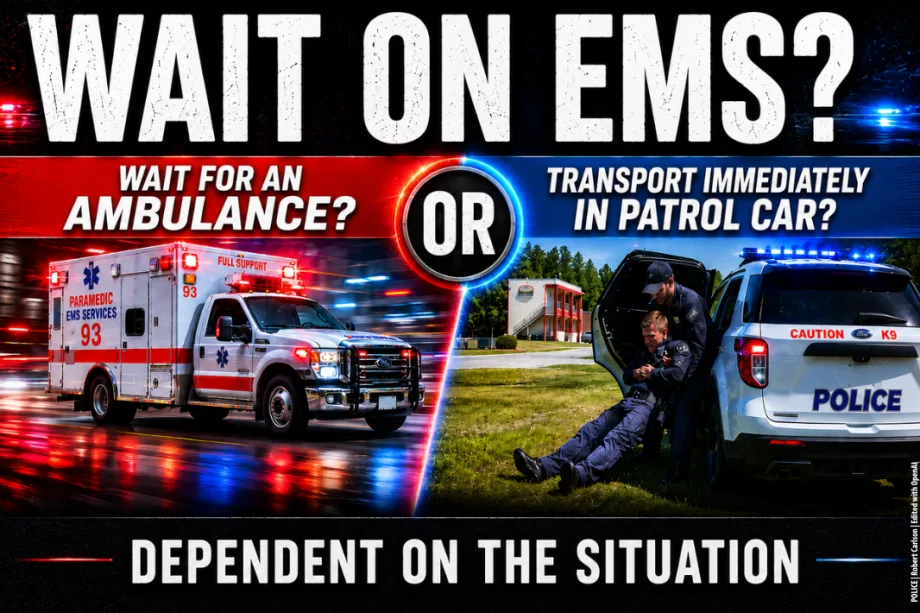
POLICE | Robert Carlson | Edited with OpenAI
*Summarized by AI
When a wounded officer goes down, and fellow officers get him or her off the X and provide lifesaving measures, what is next? Do you wait for EMS to arrive, or use a patrol vehicle to transport immediately?
Sydney Vail, M.D., a veteran trauma surgeon, former SWAT surgeon, and lieutenant colonel in the U.S. Army Reserve serving with the 628th Forward Resuscitative Surgical Detachment, provided insights into when to transport immediately rather than wait for EMS arrival.
He is also the former director and a deploying member of the SWAT Tactical Medicine Program for the Arizona Department of Public Safety State SWAT Team.
Vail shared that a study in Philadelphia, Pennsylvania, involving multiple trauma centers was conducted. The research looked at transportation directly and also reviewed old police reports about wounded officers being transported by ambulance or by patrol vehicle.
“Basically, it comes down to time,” Vail said. “Time-sensitive injuries, penetrating trauma, need to be in a trauma room as soon as possible for the best chances of a positive outcome.”
According to “Severity-Adjusted Mortality in Trauma Patients Transported by Police,” researchers conducted a large, multi-year analysis of a long-standing policy that allowed police transport of patients with penetrating trauma. The study examined the mortality rate of patients transported by police vehicles versus ambulances.
The research looked at 4,122 patients. But, those were not all police officers. In the broader analysis, researchers found no significant difference in mortality rates between those transported by police and those transported by ambulance.
However, the study reported that “patients with severe injury, patients with gunshot wounds, and patients with stab wounds were more likely to survive if transported by police.”
Vail has extensive experience with SWAT teams, in which EMS is staged nearby, coordinated, and ready to transport if needed. But for the regular patrol officer, EMS is unlikely to be nearby and on hand.
So, a fellow officer is wounded. Do you wait, or do you get that officer into a patrol vehicle and head immediately to the hospital? Well, several factors come into play when making that decision.
“If the situation allows you to leave with that officer, by all means, transport that wounded officer to the hospital. If you have the luxury of an extra person to hold pressure and be with that guy in the back, great. If not, just get there,” Vail explained. “Gasoline is the best medicine.”
But, even with a time-sensitive injury like penetrating trauma, if you can’t get off the X and get out of the situation, or you're taking cover and treating the injured officer behind a barricade, then call 911, Vail added. That gets help headed your way.
EMS will get there as soon as possible, but again, with serious penetrating injury, the veteran trauma surgeon recommends transporting the officer without waiting when possible.
“If you can get out of there and it saves time, use that time. Get to the trauma center,” he suggested.
That is the focus: reaching the trauma center quickly.
“Can EMS operate in the field? No. You can put on a tourniquet, you can hold pressure on a wound, maybe the officer can hold pressure after you fill it with combat gauze, QuikClot. But ideally, with time-sensitive injuries, you want to be on the road as fast as you can, if reasonable, to get that wounded officer to the trauma center ASAP,” Vail said.
Transporting by vehicle, instead of EMS, can be a tricky situation, Vail said. Does the situation allow you to do that, do you have the ability to go, do they have an injury that needs a set of hands?
“If you're holding pressure and stopping bleeding, don't let go. Stay there, call 911 because that way you are saving a life by controlling bleeding while you're waiting,” Vail said. “If they're in the back of your rig and no one's holding pressure and they're bleeding out in your backseat, you didn't do them a great favor. But if you're controlling it on scene, call 911, let them handle it.“
The former SWAT surgeon also said if the officer does not have a bleeding injury that requires you to apply constant pressure, say if it is a gunshot or stab wound to the chest, and the officer is having difficulty breathing, then get to the hospital as quickly as you can.
“But again, situation dependent, it is not for every patient. If the officer feels like they can handle things with the other officer in the back of the car and get to the hospital long before an ambulance will even get to them and can transport, then do it,” Vail explained. “But it's not for every case. I'm not advocating ‘just do this every time.’ That is not what I'm saying.”
“Don't just feel like you should never call an ambulance to transport an injured officer. It is case dependent.”
If you have an opportunity to put a second officer in with a wounded officer, would you take advantage of that, and how would you approach that?
“Again, situation dependent. If you have an active scene that requires that officer to stay on scene for whatever reason, then they have to stay, plain and simple. If you have the luxury of another set of hands in the back seat, then take it,” Vail said. “Again, holding pressure on that wound, and I'll use that example we talked about before, if somebody has active bleeding and you are holding pressure, and you let go of that pressure, they're going to bleed out potentially. Hold that pressure.”
Vail pointed out thatEMS will not go into an active situation. Until it's a cold scene, they will not enter, no matter what.
In cases like that, the fastest way to get a wounded officer away from the scene and to a trauma center would be through police transport.
“That is their policy. You can't convince them. They're not coming in,” Vail said. “If you have another officer, somebody drives, somebody holds pressure or does some maneuvers in the backseat with that person, sure, take advantage of it.”
When the decision is made, go or wait, Vail advises keeping dispatchers updated on the situation. Plus, details of the injury and the status of the wounded officer should be relayed in advance to the medical team at the hospital or trauma center so they can prepare for arrival.
“It's always great to have a heads up of what's coming in,” he said.
With that thought, Vail turned back to his memories of gunshot victims who would be dropped off at the ambulance bay and someone would yell, “Hey, there’s a patient out here.” That approach, which allows no advance activation time, is not preferred by Vail and other medical professionals.
Keep them informed of what you are bringing in to them.
“It's always great to have a heads up of what's coming in. Call dispatch, let them radio ahead to the trauma center that says we have an officer coming in, stab wound, gunshot wound, whatever it is, and they're being brought in by another officer versus EMS, it's good to have that heads up,” Vail suggested.
Vail said agencies should reach out to medical professionals and ask for assistance.
“It's a great idea to review with your medical directors and ideally talk to your SWAT medics, talk to your SWAT docs on your teams. If you don't have that, call your county sheriff, call your state police. They have medical people, medical assets who can educate and train anybody,” Vail added. “I used to do that all around the state. I would go to every agency that asked me to go. I never said no.”
When that wounded officer reaches the trauma center, one small step that can be done well in advance can greatly aid doctors in their treatment approach.
Vail suggested that officers always carry, on their person, a card containing medical information that can be accessed quickly by doctors.
He recommended at least two cards for every officer, one on the officer and another that can be accessible by a shift commander if the officer is wounded or injured. Those cards can be folded in half and laminated to keep personal medical information confidential and HIPPA compliant until an emergency arises to necessitate their unsealing.
Loading data...

Within your agency, are officers using e-learning platforms as a means to complete mandatory training and engaging in nothing more than ‘click through’ or ‘mindless clicking’ to get to the end of the training modules?
Investigations
For years, law enforcement has worked to dispel the myth that someone must be missing for 24 or 48 hours before a report can be taken, but another problem gets far less attention. A missing-person report is not an investigation.
Vehicle Ops
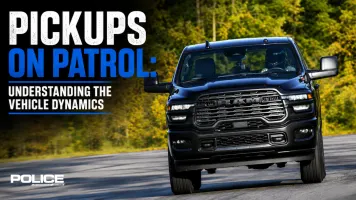
Pickup trucks are not new to patrol duties, but with the debut of the 2027 Ram 2500 Emergency Response Vehicle, they are getting larger and heavier. POLICE reached out to the Michigan State Police Precision Driving Unit to learn more about pickup truck handling, vehicle dynamics, and what officers need to know.

Patrol
Tennessee’s new deadly force law is more limited than many may realize. Effective July 1, 2026, the law applies to a person who is not engaged in conduct that would constitute a felony or a Class A misdemeanor and who is in a place where the person lawfully resides. But it could have far-reaching influence.
Patrol
Time-sensitive injuries like penetrating trauma mean a wounded officer needs to reach a trauma center as soon as possible, and in some cases, that means transporting by police vehicle rather than waiting for EMS. What are the factors to consider in making that transport decision?
Patrol
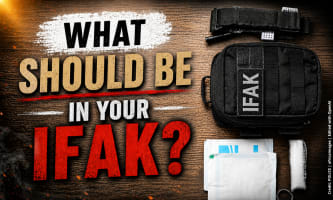
What should every officer include in an IFAK? Sydney Vail, M.D., a veteran trauma surgeon and former SWAT surgeon, explains which components are needed and which are not, and stresses training.
Procedures & Policies
Detective David Lee Stephens wants the public and every law enforcement agency to know there is no truth nor logic to the widely held belief that one must wait 24 or 48 hours to report a missing person.