

Watch Now: When Do You Transport a Wounded Officer Instead of Waiting for EMS?


 MENU
MENU SEARCH
What should every officer include in an IFAK? Sydney Vail, M.D., a veteran trauma surgeon and former SWAT surgeon, explains which components are needed and which are not, and stresses training.
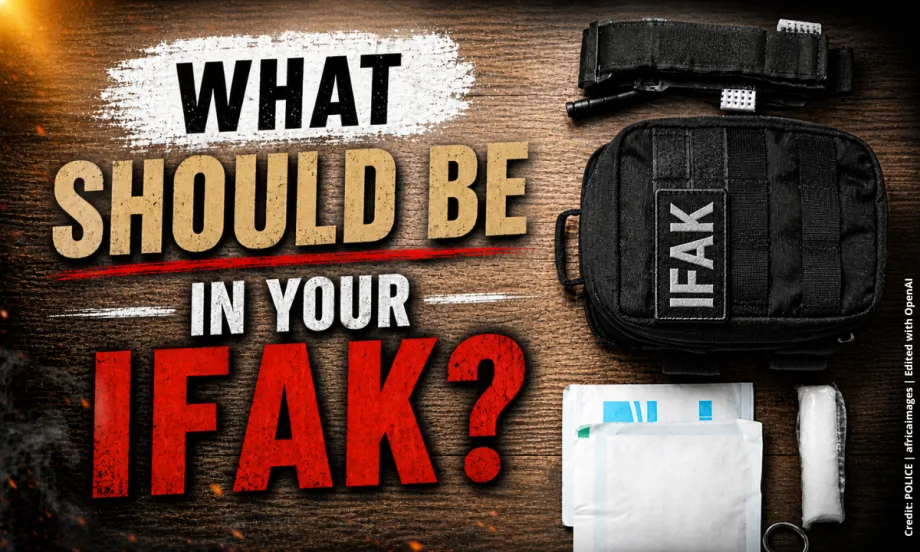
An individual first aid kit (IFAK) should contain all the items an officer needs to deal with medical situations, particularly stopping bleeding.
*Summarized by AI
When immediate lifesaving aid is needed, it is important for every officer to have an individual first aid kit (IFAK) and be trained in proper and expedient use of every item contained within.
Whether that means treating oneself, another injured or wounded officer, or potentially a member of the public, the officer’s IFAK must be readily accessible. In a life-or-death situation, in particular when faced with the need to immediately stop blood loss, seconds can matter.
So, what should an officer’s IFAK contain?
For the answer, let's consult an expert, Sydney Vail, M.D., a veteran trauma surgeon, former SWAT surgeon, and a lieutenant colonel in the U.S. Army Reserve serving with the 628th Forward Resuscitative Surgical Detachment. He is also the former director and a deploying member of the SWAT Tactical Medicine Program for the Arizona Department of Public Safety State SWAT Team.
He stressed the importance of an officer knowing how to use whatever is in his or her IFAK, having trained with the various components, and having those components approved by a medical authority within the department.
“It's important to know what you carry and how to use it,” Vail said.
When it comes to tourniquets, one is not enough, according to Vail. He suggested always having two.
“I'm always a big fan of ‘one is none, two is one,’,” he explained. “That's a military thing, but people have more than one limb, and what happens, God forbid, if a second officer gets injured, or a civilian?”
He recommends carrying two tourniquets, combat gauze, QuikClot, and whatever else helps stop bleeding.
“Yes, gauze, tissues, newspaper, can help stop bleeding with good pressure, but you want to take advantage of all the technology we have to get the best chance of stopping bleeding, so QuikClot Combat Gauze is probably the way to go, or a similar product,” Vail added.
Besides that, the veteran surgeon suggests not forgetting the little things, like Band-Aids, moleskins, and other simple first-aid supplies.
“People are going to get little things that happen, and you want to cover up a wound as quickly as you can, so covering up with band aids or a simple dressing, but don't get fancy,” he explained.
Although some would consider a chest seal as part of an IFAK, Vail does not think it is needed.
“People will tell you chest seals for penetrating chest injuries. Don't bother, you don't need it,” he said, with the caveat of how that is with the assumption you are in a populated area with access to healthcare. In an extremely remote area, he noted, that would be a different story.
Does an IFAK have to be in a kit or a pouch?
No, said Vail, but it must be on your person.
Vail suggested that your IFAK be centrally located, and not on one hip or the other like a service weapon and other duty gear.
“You want everything central, on your vest, behind your vest, on your belt, somewhere where left hand or right hand can get to it, because if one of the hands isn't working, how do you get it?” Vail said. “I'm a big fan of center, or at least to where a left hand can come across to the right side and grab versus on a right hip. If you want to put it in the small of your back, on your belt, that's fine, but somewhere where both hands can get to it.”
While access is crucial, another key consideration is training.
“Don't just put it there and forget it,” Vail emphasized. “Every time you go to the range, every time you're on training, practice with your medical gear, just like you're training with OC or a weapon or any other piece of equipment you have. Your IFAK medical gear should be practiced with.”
While Vail has suggested how you should stage your IFAK, ultimately, that should not be your decision alone. He recommended that departments standardize IFAKs, whether that be the contents or the location, but particularly the location.
Everyone should have the same setup in the same location.
Imagine you are down, and another officer rushes to provide aid. Standardized placement means the assisting officer can quickly access your IFAK without losing precious seconds looking for where you carry it.
“It should be the same or similar setups for everybody and, yes, the IFAK kit should be marked itself,” Vail said. “What I see on patrol officers is typically a tourniquet is out and obvious, but if you are containing it in a kit, whether it has a little cross on it, or it says IFAK kit, or some other designation, it should show that is where your equipment is.”
He also pointed out that there could be a scenario in which a wounded or injured officer might be assisted by a civilian who would need to quickly locate the IFAK.
The veteran trauma surgeon said your tourniquet should not only be quickly accessible, but also already unwrapped and ready for use.
“Take it out of the wrapper, use it at least once. Get used to your tourniquet, as different tourniquets are used by different agencies. But don't continuously train with it. It can weaken,” Vail recommended.
But be sure your kit has a solid tourniquet, not what he terms a cheaper “knock-off” sold online.
Officers should regularly train with training tourniquets. As far as obtaining training tourniquets, Vail said that if a tourniquet is used, it can be washed off and rotated in as a training tourniquet. He said that if you ask your local hospital, they usually take the tourniquets off, wash them, and have some available for training purposes.
“That's what we do at our facility,” Vail said. “We hand them right back out for training. Plus, when I go to train our teams, I also have ton, well, a few dozen training tourniquets to use, but they are designated training tourniquets.”
But those training tourniquets should match the style of the ones you're using on duty, so there’s no question of how they function when the time comes to deploy them in a true medical emergency.
Earlier, Vail noted that an officer should carry two tourniquets. But some departments only issue one. In that situation, the officer should purchase a second tourniquet that matches the department-issued one.
“Tourniquets are not that expensive. Your life is worth a lot of money. It is worth the $30 or $35 to go buy another tourniquet that is similar to the one that's issued to you,” he said.
Some departments, however, issue two tourniquets. Vail said sometimes they will tell an officer to carry one on-body and have the second one in the patrol car. But the veteran trauma surgeon is a believer in having both on your person.
“What's wrong with putting two on you, and then when you're done your shift, put the one back in the car for the next guy,” he suggested.
You have to stop the bleed, on you or a fellow officer. It is time to react. What do you do?
“Make the decision. Do it. If you think it, do it. If you're wrong, when we get to you or EMS gets to you, we do what's called tourniquet conversion, meaning we have controlled the situation,” Vail said. “We then establish a logical reason to keep it or remove it, because sometimes it was put on and you didn't need it, because in the heat of the moment, you saw blood, you saw an injury, you put on a tourniquet thinking you're going to bleed more or bleed out.”
EMS will determine if the tourniquet is necessary, if it needs to remain on until the hospital, or if it needs to be loosened and removed.
Training with a tourniquet is more than just training to apply the tourniquet. Vail stresses officers, during training, should apply a tourniquet and complete whatever drill is being run. That teaches invaluable lessons, and Vail used to take this approach with his SWAT team while training.
“If you don't train with a tourniquet on your limb, you will never know what it's like to stay in a fight with a tourniquet,” Vail explained.
“What we used to do with my old SWAT team in Arizona is we would go to the range, and we would actually apply a tourniquet, cut off the circulation, and see how long that limb would last in terms of functionality,” he explained.
According to Vail, this shows officers:
“Some guys last many minutes until the arm just literally does give out because of lack of blood flow,” Vail said. “But it's good to know what you have in terms of your reserve, putting on a tourniquet on an arm or a leg, and then staying in the fight.”
Loading data...

Within your agency, are officers using e-learning platforms as a means to complete mandatory training and engaging in nothing more than ‘click through’ or ‘mindless clicking’ to get to the end of the training modules?
Investigations
For years, law enforcement has worked to dispel the myth that someone must be missing for 24 or 48 hours before a report can be taken, but another problem gets far less attention. A missing-person report is not an investigation.
Vehicle Ops
Pickup trucks are not new to patrol duties, but with the debut of the 2027 Ram 2500 Emergency Response Vehicle, they are getting larger and heavier. POLICE reached out to the Michigan State Police Precision Driving Unit to learn more about pickup truck handling, vehicle dynamics, and what officers need to know.

Patrol
Tennessee’s new deadly force law is more limited than many may realize. Effective July 1, 2026, the law applies to a person who is not engaged in conduct that would constitute a felony or a Class A misdemeanor and who is in a place where the person lawfully resides. But it could have far-reaching influence.

Patrol
Time-sensitive injuries like penetrating trauma mean a wounded officer needs to reach a trauma center as soon as possible, and in some cases, that means transporting by police vehicle rather than waiting for EMS. What are the factors to consider in making that transport decision?
Patrol
What should every officer include in an IFAK? Sydney Vail, M.D., a veteran trauma surgeon and former SWAT surgeon, explains which components are needed and which are not, and stresses training.
Procedures & Policies
Detective David Lee Stephens wants the public and every law enforcement agency to know there is no truth nor logic to the widely held belief that one must wait 24 or 48 hours to report a missing person.