
July 2, 2026
Pickups on Patrol: Understanding the Vehicle Dynamics
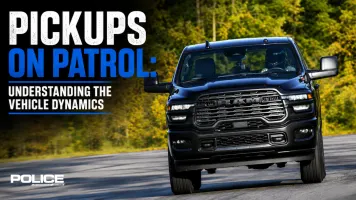
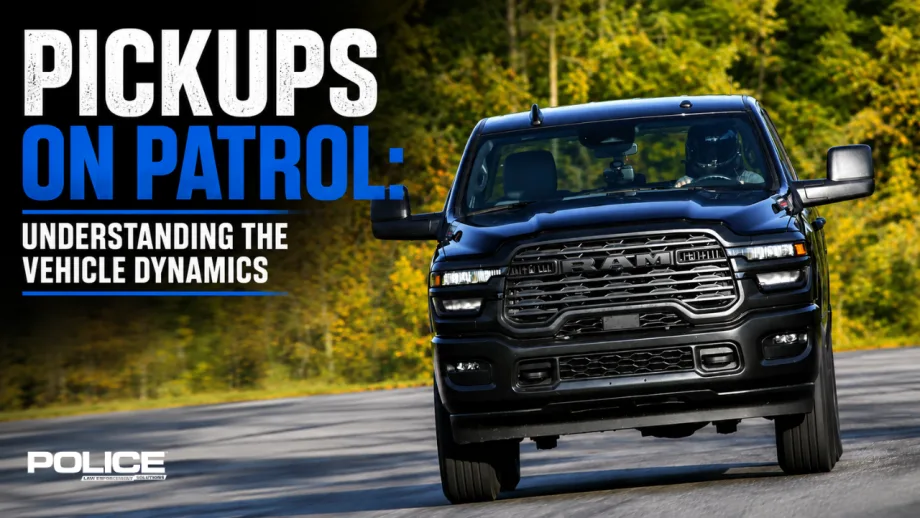
Pickup trucks are not new to patrol duties, but with the debut of the 2027 Ram 2500 Emergency Response Vehicle, they are getting larger and heavier. POLICE reached out to the Michigan State Police Precision Driving Unit to learn more about pickup truck handling, vehicle dynamics, and what officers need to know.
What do officers need to know about pickup truck handling compared to a sedan or SUV patrol vehicle?
Credit:
Michigan State Police | POLICE | Edited with OpenAI
10 min to read
- Pickup trucks are increasingly utilized for patrol duties, with the new 2027 Ram 2500 Emergency Response Vehicle marking a trend of larger and heavier models.
- The Michigan State Police Precision Driving Unit was consulted to provide insights into handling and vehicle dynamics of these patrol pickups.
- Understanding vehicle dynamics is crucial for officers who need to navigate the larger, heavier patrol trucks effectively.
*Summarized by AI
The days of the Chevrolet Caprice and Ford Crown Victoria patrol cars are long gone. At some point, they gave way to newer sedan models, SUVs, and even pickup trucks. While most law enforcement pickup trucks to date have been half-ton trucks, Ram has launched the 2027 Ram 2500 Emergency Response Vehicle. So, what do officers need to know about pickup truck dynamics and handling as increasingly more are on patrol?
Even with Ram’s new three-quarter-ton truck soon to hit the road, for years half-ton trucks like the Ford F-150 Police Responder and the Chevrolet Silverado 1500 PPV have already been pressed into service.
Sure, pickup trucks have a higher center of gravity and less weight in the rear than patrol cars and SUVs, but the dynamics at play are still the same. Whether a rookie cop or a veteran state trooper, every officer needs to be prepared to use whatever vehicle platform the department chooses.
The Michigan State Police Precision Driving Unit tests and evaluates patrol vehicles each year, so POLICE reached out to one of its driving instructors for insights into pickup truck handling characteristics and the factors at play.
When MSP trains drivers, they prepare them for any vehicle platform.
“Fortunately, at our training academy, we have the luxury of being able to train in the Ford Explorer Utility, the Dodge Durangos, the Chevy Tahoes, and we also have some Dodge Chargers still floating around because we realize that when we're training recruits and they go out in the field, they may not be in the Ford Explorer that we do all of our evaluations on,” explained Sgt. Ryan Davis, of the Michigan State Police Precision Driving Unit.
Davis has been with MSP for 10 years, including the past four years as a supervisor at the Precision Driving Unit, plus he has about five years of experience as a driving instructor.
“We pay special attention to allowing these recruits to drive each platform, because each platform handles differently, brakes differently, accelerates differently, corners differently,” he added. “They all have to have a feeling for each one of those vehicles.”
However, much of what the recruits learn by driving the different vehicles can translate over to pickups as well.
Patrol Pickup Dynamics & Handling
“So, the biggest thing that comes to mind is the high center of gravity. You're going to have more body roll, and you're not going to have the weight in the back of the vehicles, compared to a Tahoe, which is going to have seats and a roof to add more weight,” Davis pointed out about pickups. “So obviously you are changing the dynamics of the vehicle, especially when it comes to braking and turning.”
Davis also said that in a pickup, you have to be more conscious not to stab the brakes. If you do, all the weight shifts to the front, and you won't have much weight on the rear.
“You have to watch out for that, the vehicle coming around on you just because you don't have the weight back there. So, as a driver, you need to be able to recognize that and adjust to it,” he added.
How big of a difference is that in the real world when you get behind the wheel on patrol?
While there are significant differences in vehicle dynamics when you hit the road in a pickup, technology is mitigating some of that.
“Fortunately, the modern electronics in the vehicles, the stability control and traction control, make up for a lot of the errors, but the faster you go, obviously, the harder it is to recover from a lost control situation,” Davis said.
“You really need to understand that body weight is going to all roll to the front or all roll to whatever side you're turning, which then is unhooking the rear, and then you're going to have a loss of control situation, because the rear end is going to come around on you,” explained Davis.
“Good moderate braking, not braking while you're turning, those are the pinnacles of what we teach here. We never turn and brake at the same time,” he stressed.
Familiarization with the body roll, cornering, and braking adjustments of a pickup comes from everyday driving, not just when responding to an emergency.
“You have to make your adjustments just driving it every day. Then, especially when you start emergency driving, you really have to be aware that it's not going to be the same as a Durango or Utility, or even a Charger,” Davis suggested.
How are those dynamics magnified if you have reduced-traction environments?
“The vehicle dynamics are the same, no matter what, but you get those heavy snow situations, or a lot of water on the roadway, it doesn't matter what car you're going to be in, you're still going to change your driving,” Davis replied.
“But I think you're going to have to be more sensitive to it in the high center of gravity pickup trucks, and that's where the threshold braking, not braking and turning, light steering inputs are really going to come into play,” he added.
Is it different in a pickup when it comes to navigating urban areas, traffic, etc?
Davis provided data on the Ram 2500, the Ford F-150, and the Silverado PPV, which are probably the most common pickups you'll see in police fleets. All were tested in the MSP Police Vehicle Evaluation Model Year 2025.
The Ram 2500 weighs 6,680 pounds, compared to the F-150 and the Silverado, which are just over 5,000 pounds.
“So, obviously, the more weight you're going to have, the more distance it's going to take to stop,” he noted.
But beyond the stopping distance, there are other factors in play.
You're not going to have the maneuverability that you would in a smaller vehicle, compared to a Durango, a Charger, or a Utility. So, the more weight, the more body roll, the longer the vehicle, the heavier the vehicle. Obviously you're going to change your driving,” Davis said.
If you had a chief or fleet manager who was transitioning an agency from a car or SUV over to a pickup, and they said, "Hey, I'm about to move my people from cars over to pickup trucks," what would you tell them?
“First thing I would tell him is they're not the same,” Davis answered. “You're going to have to change your driving; its maneuverability is going to be a little more difficult compared to a smaller vehicle, a lighter vehicle, especially in a city, an urban setting.”
Davis pointed out the turning radius of a pickup and how it will be different. You're not going to be able to maneuver around the vehicles, around traffic, around corners, as you would in a smaller vehicle, because obviously the turning radius is going to be a little more.
“You're really going to have to pay special attention to getting that vehicle around obstacles,” he suggested. “There's going to be a difference just because of the weight, the size, the turning radius.”
What about acceleration? Can you have challenges and lose traction with less weight on the rear vehicle?
“I'm going to say yes, because you don't have the weight back there. But again, the stability control, the traction control, has come light years since when they first started. Once those tires start sensing that you're having a loss of friction on the drive axle, your stability control is taking over.”
Davis said it will obviously affect your response times somewhat as well.
“The harder you try to drive a vehicle, and the less that it wants to have friction, it's actually going to slow you down more than you think, which, for safety reasons, is a good thing,” he added.
What are the differences in rollover risk?
“Obviously, with a higher center-of-gravity vehicle, you're going to have more body roll. It could increase the risk of rollovers. Fortunately for us, for our testing, for our training, we have not experienced that yet. You have heard some rumors of some cars rolling over, the high center of gravity vehicles, but if you're doing what you're taught, understanding the vehicle dynamics, you shouldn't have any issues.”
Again, he pointed to stability control, now standard on vehicles, and to the impact of technology on safety.
“It is amazing when you're going around a corner traveling at a high rate of speed, like in a vehicle testing situation, and you can feel the brakes engaging on the left rear wheel, the right rear wheel, because the vehicle thinks that the car's getting ready to lose control, and it straightens that car out,” Davis said. “It’s amazing what the traction control, stability control, can do to a vehicle.”
“It doesn't matter if it's a high center of gravity three-quarter-ton Ram compared to a Dodge Charger, most of the time it will straighten you up and get you back to being in control of your vehicle.”
Pushing Hard in Testing, but Not on Duty
The Precision Driving Unit troopers are well-prepared and trained to push vehicles hard during testing, including patrol pickups. Also, the testing is done on a closed track.
“When we're vehicle testing, we want to get that real-world data; we want to see what that vehicle can do and can withstand. So, we are driving them as hard as the drivers can drive them,” Davis said.
While the specialized testing may allow a driver to push to 100% of his ability, or even higher, that is not how to approach real-world driving or while responding to a call.
“When we teach at the academy to our recruits, we have the term driving at 80% of their ability, and when we say 80% of your ability, that's leaving a 20% ability cushion,” Davis emphasized. “We never teach our troopers or recruits to drive it 100% of their ability, because we just like to have that little cushion for error.”
Four-Wheel Drive, Two-Wheel Drive, or All-Wheel Drive
As agencies adopt pickup trucks, do you think they are going for two-wheel drive, four-wheel drive, or all-wheel drive?
“Well, I can't speak for the whole U.S., but in the northern states, they're all going to be four- wheel drive, just because of the amounts of snow that we get,” the MSP trooper said.
He recalled how when he first started, he patrolled in a two-wheel-drive Tahoe. Even without four-wheel drive, he somehow never got stuck, yet still sees the advantages of four-wheel-drive vehicles. If a trooper or officer is stuck in snow up north, or even on a muddy road down south, there is no ability to respond to a call.
In testing, the Precision Driving Unit has tested all-wheel drive compared to rear-wheel drive. All the trucks the unit has tested have been four-wheel drive.
Payload Considerations for Patrol Pickups
How can pickup trucks offer payload advantages to law enforcement?
Davis pointed out that in certain roles, like commercial vehicle enforcement, officers need to carry extra gear, such as truck scales. That weight adds up in whatever vehicle they drive.
He said that motor carrier compliance officers with the Michigan State Police have expressed interest in pickup trucks because of their need for payload capacity.
Among patrol pickups, the new three-quarter-ton 2027 Ram 2500 Emergency Response Vehicle offers the most payload, 3,320 pounds, compared to the half-ton Chevrolet and Ford pickups, which offer about 1,850.
“So, there's a significant payload difference between three-quarter-ton and half-ton, and I could see there being a market for the three-quarter-ton, just because of the amount of equipment that you can put in the back of one of those safely,” Davis explained.
LE Adoption of Patrol Pickups
What do you see as far as agencies adopting pickup trucks?
“There are a lot of agencies that are going to trucks, and I don't know if it's because of its cost savings as compared to a Tahoe, or they can maybe get more bang for the buck with a truck, but I'm starting to see them quite often,” answered Davis.
He said troopers in Michigan’s Upper Peninsula, where multiple feet of snow accumulation is common, are interested in four-wheel-drive pickup trucks only for those special cases.
“I really see the pickup trucks becoming more popular as the horsepower increases, the stability control increases, and if they keep the price point down, I think it's attractive to fleet managers to purchase them for their departments,” Davis said.
Loading data...