Why Tennessee’s New Deadly Force Law Matters Beyond Tennessee


 MENU
 SEARCH
What cops need to know about alpha-gal, the tick-borne allergy that can turn an ordinary exposure into a problem weeks or months later.
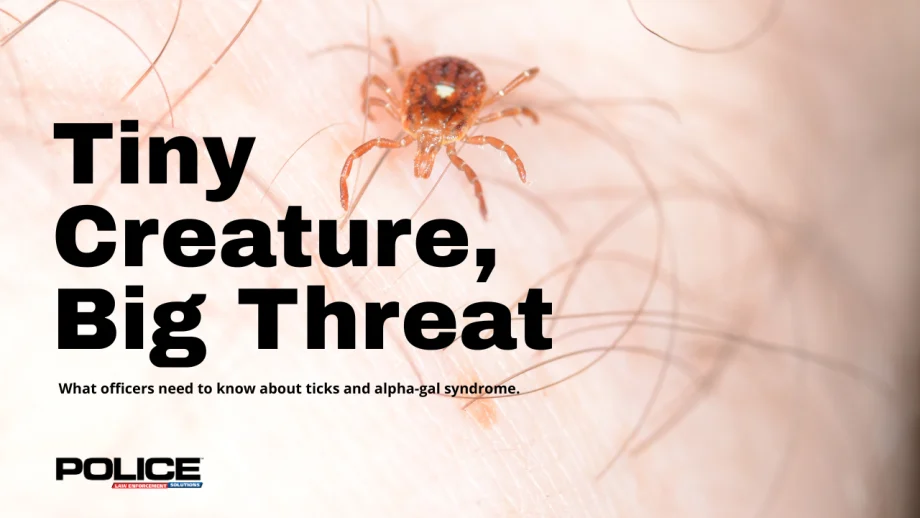
How many cops are getting bitten by ticks at work, pulling them off and never giving the bite another thought?
POLICE |Edited with OpenAI
*Summarized by AI
I was less than a mile into the woods when my body started quitting on me.
I was on a search in June, moving through terrain that was nothing unusual for rural law enforcement. I have spent plenty of my career in places where cell service disappears, radio traffic gets spotty, and the easiest way from Point A to Point B is usually straight through something covered in briars.
Then I started collapsing.
I could make it ten or 20 feet before my muscles seemed to run out of power. I would stop, recover enough to stand, move a little farther, and go down again.
No cell service.
No radio contact.
It took me more than five hours to get out of an area less than a mile from where I started.
I cannot tell you that alpha-gal syndrome caused what happened that day. I do not have the medical evidence to make that claim.
What I can tell you is that several weeks earlier, I was bitten by a tick while working.
Months later, after recurrent nausea, gastrointestinal problems, and other unexplained health issues, testing pointed me toward something I had barely heard of before.
Alpha-gal syndrome.
The more I learned about it, the more one question kept bothering me: How many cops are getting bitten by ticks at work, pulling them off and never giving the bite another thought?
alpha-gal syndrome, or AGS, is an allergy associated in the United States most commonly with bites from the Lone Star tick.
Alpha-Gal is short for galactose-alpha-1,3-galactose, a sugar molecule found in most mammals. After certain tick bites, a person's immune system can become sensitized to it. Later, exposure to products containing alpha-gal can trigger an allergic reaction.
In plain English, a tick bite can leave you reacting to foods you have eaten your entire life.
Beef and pork are obvious examples, but the list does not necessarily end there. Lamb, venison, and other mammalian meats can be involved. Some people also react to dairy products, gelatin, or other mammalian-derived ingredients. Certain medications and medical products can become part of the equation as well.
Already, that makes AGS unusual.
Then comes the part that makes it particularly difficult to recognize.
The reaction may wait.
Most of us think of food allergies as immediate. Eat something. Reaction starts. Cause and effect stand side by side.
Alpha-Gal often does not work that way.
According to the CDC, reactions frequently begin two to six hours after exposure.
You eat a hamburger at lunch and become sick late that afternoon.
You eat pork for dinner and wake up during the night with severe abdominal pain.
You finish a shift, grab something to eat on the way home and feel terrible hours later.
By then, the meal may not even be on your suspect list.
The tick bite certainly may not be.
AGS can also hide behind symptoms that do not immediately scream "allergic reaction."
Symptoms may include nausea, vomiting, diarrhea, and severe abdominal pain. Others can experience hives, itching, swelling, or difficulty breathing. More serious reactions may include dizziness, faintness, a drop in blood pressure, and anaphylaxis.
And not every reaction necessarily looks the same.
That can make recognizing the pattern difficult for both the patient and the medical provider.
Someone may eat mammalian meat once without noticing an obvious reaction and experience symptoms another time. Physical activity and exercise have also been described as possible cofactors that may influence reactions in some people.
For law enforcement, that deserves attention.
Our version of physical activity is not always a treadmill.
It may be climbing a wooded ridge during a missing-person search, running behind a K-9, dragging equipment across a firing range, holding a perimeter in summer heat, or fighting with somebody on the side of a highway.
A delayed medical problem is bad enough.
A delayed medical problem that develops while you are alone, miles into the woods or outside reliable communications, is something else entirely.
That is no longer only a health issue.
It is an officer-safety issue.
There is another important distinction.
A positive blood test for alpha-gal antibodies does not, by itself, prove that someone has clinical alpha-gal syndrome.
Diagnosis involves more than one number on a laboratory report. Medical providers consider symptoms, exposure history, the timing of reactions, and testing together.
Cops should understand that concept better than most.
One piece of evidence rarely proves the entire case.
Context matters.
CDC researchers identified more than 110,000 suspected cases of AGS between 2010 and 2022 and have estimated that as many as 450,000 Americans may have been affected.
More recent CDC research also showed high levels of alpha-gal sensitization in several states where rural officers spend a lot of time outdoors, including Tennessee, Kentucky, Arkansas, Missouri and Virginia.
A 2026 CDC study using blood-donor samples estimated alpha-gal antibody seroprevalence in Tennessee at 21.5% among the adult population represented in the study.
That does not mean one in five Tennesseans has alpha-gal syndrome.
People can have detectable antibodies without developing clinical AGS.
But the number should still make officers in this part of the country pay attention.
Tick exposure and alpha-gal sensitization are not some bizarre medical footnote happening somewhere else.
They are here.
When somebody says "outdoor worker," most people picture farmers, loggers, landscapers or park employees.
Law enforcement belongs on that list.
We search woods for missing people.
We track suspects through fields.
K-9 teams work vegetation constantly.
Crash investigators stand along brush-covered roadsides.
Crime-scene personnel recover evidence outdoors.
SWAT officers establish perimeter positions in vegetation.
Detectives search abandoned properties and rural crime scenes.
Firearms instructors spend hours on outdoor ranges.
Deputies in rural jurisdictions may walk through tick habitat during an ordinary shift and never think of themselves as having an occupational exposure.
Ticks do not care what patch is on your shoulder.
NIOSH identifies outdoor workers as being at increased risk for tick exposure in wooded and brushy areas, tall grass and leaf litter. Its guidance also treats tick bites occurring while working as reportable work-related injuries.
That caught my attention.
Because when I found the tick that had bitten me during firearms training, filing anything about it was the last thing on my mind.
It was a tick.
Pull it off.
Kill it.
Keep working.
I suspect many cops would do the same thing.
I look at that differently now.
Police officers are professional documenters.
We photograph scratches on cars.
We document bruises.
We measure tire marks.
We photograph a cigarette butt lying beside a road because we understand something that seems meaningless at 10 o'clock in the morning may become extremely important by 10 o'clock that night.
We should apply the same mentality to an occupational tick bite.
That does not mean every tick causes alpha-gal syndrome.
It does not mean every bite causes disease.
And it certainly does not mean officers need to panic every time they find one crawling up a pant leg.
It means preserve the information.
Photograph the tick if you can.
Photograph the bite.
Record the date.
Record where you were working and what you were doing.
If the area becomes unusually painful, swollen or leaves a persistent mark, document that too.
Follow your agency's occupational-injury procedure.
Then, if unexplained symptoms begin weeks or months later, you have something more useful to give a medical provider than:
"I think I got bitten by a tick sometime last summer."
Dates matter.
Locations matter.
Exposure history matters.
We already know that.
We just normally apply it to everybody else's evidence.
The goal is not for cops to start diagnosing themselves.
The goal is recognition.
If an officer begins experiencing unexplained gastrointestinal problems, hives, swelling, dizziness or breathing difficulty, it may be worth asking whether there is a pattern associated with mammalian foods.
Do symptoms tend to appear several hours after eating beef, pork, venison, dairy or another mammalian product?
Was there a previous tick bite?
Does the officer spend significant time working in woods, fields or brush?
Those are details worth giving a medical provider.
Severe symptoms - particularly difficulty breathing, significant swelling, fainting or signs of anaphylaxis - are emergencies.
Knowing about alpha-gal does not replace medical evaluation.
It simply puts one more possibility on the board.
Sometimes that is how an investigation finally starts moving in the right direction.
Law enforcement spends an incredible amount of time preparing officers for threats.
Firearms.
Bloodborne pathogens.
Heat.
Dehydration.
We train because recognizing a threat before it hurts us gives us an advantage.
Tick exposure deserves a place somewhere in that conversation too, particularly for officers whose workplace regularly includes woods, fields, and roadside brush.
I cannot prove alpha-gal caused what happened to me that day. But after evaluating the other possibilities, my doctor could not identify another medical explanation and concluded that alpha-gal was the most plausible cause.
But I know what I would do differently with the tick bite that came before it.
I would photograph it.
I would document it.
I would record where and when it happened.
I would treat it like evidence whose importance had not yet been determined.
Because after more than two decades in law enforcement, I have learned that danger does not always announce itself.
Sometimes there is no gun.
No flashing lights.
No radio traffic warning you that something bad is coming.
Sometimes the threat is crawling through the grass.
And sometimes it is small enough to fit under your fingernail.
Loading data...

Patrol
What cops need to know about alpha-gal, the tick-borne allergy that can turn an ordinary exposure into a problem weeks or months later.
Investigations
The federal government is building a nationwide framework for autism-related missing-person alerts. For law enforcement, the bigger opportunity may be what happens before the public ever sees one.

Technology
Police officers face a wide range of working conditions that can damage or even destroy a regular consumer laptop. Learn what qualifies a computer as rugged or fully rugged and why those devices are vital for law enforcement.

Within your agency, are officers using e-learning platforms as a means to complete mandatory training and engaging in nothing more than ‘click through’ or ‘mindless clicking’ to get to the end of the training modules?
Investigations
For years, law enforcement has worked to dispel the myth that someone must be missing for 24 or 48 hours before a report can be taken, but another problem gets far less attention. A missing-person report is not an investigation.

Vehicle Ops
Pickup trucks are not new to patrol duties, but with the debut of the 2027 Ram 2500 Emergency Response Vehicle, they are getting larger and heavier. POLICE reached out to the Michigan State Police Precision Driving Unit to learn more about pickup truck handling, vehicle dynamics, and what officers need to know.

Patrol
Tennessee’s new deadly force law is more limited than many may realize. Effective July 1, 2026, the law applies to a person who is not engaged in conduct that would constitute a felony or a Class A misdemeanor and who is in a place where the person lawfully resides. But it could have far-reaching influence.

Patrol
Time-sensitive injuries like penetrating trauma mean a wounded officer needs to reach a trauma center as soon as possible, and in some cases, that means transporting by police vehicle rather than waiting for EMS. What are the factors to consider in making that transport decision?

Patrol
What should every officer include in an IFAK? Sydney Vail, M.D., a veteran trauma surgeon and former SWAT surgeon, explains which components are needed and which are not, and stresses training.
Procedures & Policies
Detective David Lee Stephens wants the public and every law enforcement agency to know there is no truth nor logic to the widely held belief that one must wait 24 or 48 hours to report a missing person.