



SWAT Sends in the Drones
Unmanned aerial systems are becoming valuable tools for locating suspects inside buildings.

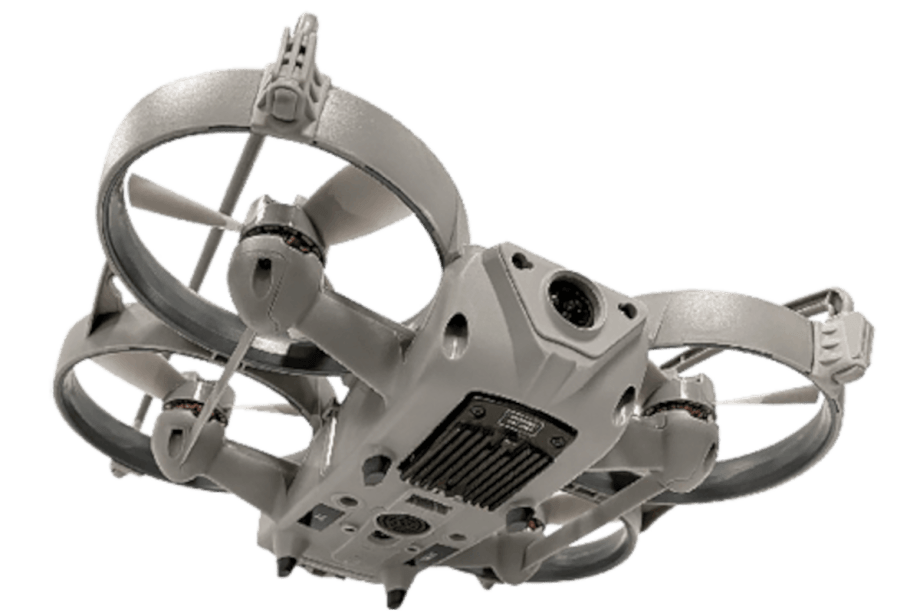
The Sky-Hero Loki Mk2 is a drone that was purpose built for building searches. It features rugged construction and shielded rotors so it can be bounced off walls.
Air Support has often been essential for the effective execution of tactical police operations. From the earliest days of SWAT, helicopters on scene were common for monitoring anybody coming and going from the targeted building. Then in recent years teams have been able to carry their own air support with them in the form of small unmanned aerial systems (UAS), commonly called “drones.” Now the drones available to tactical law enforcement units are becoming even more useful during barricades, hostage rescues, and standoffs, as these birds can go into a structure and find the bad guys.
Locating Suspects
Gaining useful intelligence from inside a building has always been one of the greatest challenges facing SWAT. Until recently, there were only two ways to do it: make entry or send in the robot. Officers breaching into the building is risky for everyone involved. So sending in a robot when possible has become the preferred way to handle such situations. They can find the suspect, deliver communications devices for negotiators, locate hazards, and even allow officers to speak to the suspect.
But not every tactical team can afford a robot. And even if they have one, tactical robots have some limitations. They move fairly slowly within a building. You can’t just go charging in full speed with the robot because it will bump into things, and it may need to climb stairs. Obstacles on the floor can impede the robot’s progress and sometimes cause it to get stuck. Robots also have a ground level view that may miss important details of what is going on inside the structure such as suspects hiding behind furniture or under beds. These and other reasons are why some tactical teams are now sending drones inside buildings.
In June, the Madison, WI, SWAT team sent a drone inside a movie theater to find auto theft suspects. The five juvenile grand theft auto suspects bought tickets to the movie and hid themselves behind the screen. Police evacuated the theater, then used the drone to locate the teens. They were taken into custody without further incident.
Purpose Built
The Madison incident is an example of how useful drones can be in locating suspects hidden in a large building. In such situations with clear flying paths and plenty of room to maneuver, just about any small drone can do the job.
But most buildings do not offer the perfect indoor flying conditions of a movie theater. Which is why a number of companies are now building small drones specifically designed for tactical operations inside of buildings.
Aardvark Tactical—The Sky-Hero Loki Mk2 from Aardvark Tactical was built specifically for building searches. Its rotors are fully shielded, and it’s also ruggedly constructed so you can crash it without worry.
“You can bounce it off walls and ceilings; fly it into attics, crawl spaces, under duct work, you can even fly it under furniture,” Aardvark Tactical CEO Jon Becker says about the Loki Mk2. “Indoor tactical flight is a full-contact sport and often bouncing Loki off of the walls and floors is required to reach the objective.”
The Loki Mk2 features a forward-facing .0008 lux day and night camera with a 150-degree wide angle field of view. For low-light performance, it has front and bottom selectable and dimmable infrared LED. The LEDs allow operators to gain intelligence in total darkness, and it lights up rooms for operators wearing night-vision goggles. “Loki has ‘happy dog’ mode,” Becker explains. “You can fly it into a room, turn it over, and switch on its IR lights for use with night vision.”
Loki can be launched by hand or take off from the ground. It has a flight time of 16 minutes, but can be landed for use as a surveillance system for up to six hours.
Brinc Drones—Back in 2017 when a gunman shot up the Route 91 Harvest concert in Las Vegas and killed 60 people, a local teenager realized that Las Vegas Metro SWAT needed better tools to locate active shooters in the casino towers. Blake Resnick, 17, cold-called the SWAT team and told them he could build them a drone that would do the job. The amazing thing is that Vegas SWAT listened to the young man.
Today the drone that Resnick built for Vegas SWAT has evolved into the Lemur S and Resnick is the CEO of Brinc Drones.
The Brinc Lemur S is designed to not just fly inside of structures, it can even breach them. A spinning carbon tungsten glass breaker on the front of the drone can smash through tempered glass, residential glass, and even automotive glass. Of course all that falling glass is likely to bring the drone crashing down, but it’s built for that with rotor guards and rugged construction. Brinc says the Lemur S can survive a 40-foot crash. It can also relaunch, even if it crashes on its back. The Lemur S features “turtle mode,” which will flip the upside down aircraft and get it back on the job.
Features of the Lemur S include high-resolution video camera, infrared and eye-visible lighting, local video storage, and more. Perhaps its most important feature is the one that makes the Lemur S a de-escalation tool. It’s a flying cellphone that can be flown to the suspect. All officers have to do is dial a phone number and they can speak to subjects within range of the aircraft’s built-in speakers. The subjects can talk back through the drone’s built-in microphone.
Flying time for the Lemur S is 31 minutes. It can land and provide surveillance for up to 10 hours.
Automated Flight
Many drones can fly a set course without pilot intervention. They can also avoid obstacles. But advances in artificial intelligence mean that drones will one day be able to enter a building and create their own flight plan.
Skydio is working on that technology today. The company’s drones use six 4K cameras to build a 3D map of their environment, deep learning algorithms to understand the imagery, and AI to assist the pilot in navigation. An important tactical feature of this system is that it can track objects and keep them in camera view.
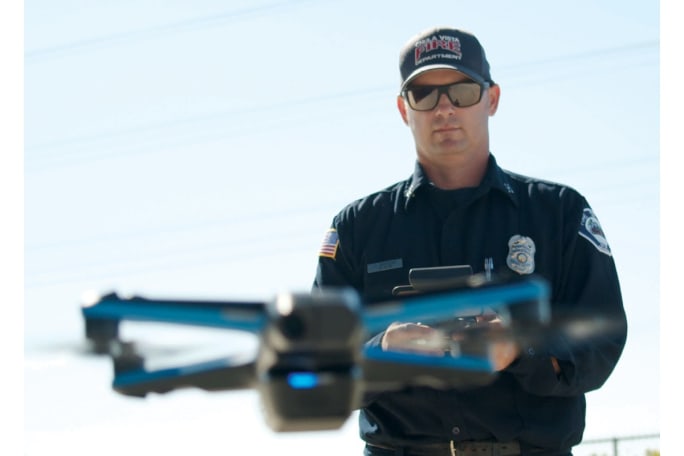
Skydio’s 2+ for Enterprise uses six 4K cameras and artificial intelligence technology to avoid obstacles.
The Skydio 2+ for Enterprise is the company’s workhorse for the public safety profession. Skydio’s enterprise model can be flown indoors and out. It uses its six cameras and nine deep networks to avoid objects all around the aircraft, so it’s well-suited to building entry.
For imaging, the Skydio 2+ carries a Sony IMX577 1/2.3-inch CMOS sensor and Qualcomm’s RedDragon QCS605. The combination delivers 4K60 HDR video and 12 megapixel still photos. Last year Skydio announced that its video and images are now integrated with Axon Evidence. Users of the Axon Evidence platform can automatically download images and video from their Skydio drones to the Axon software using WiFi.
Because the Skydio 2+ uses deep learning and artificial intelligence while in flight, it carries a powerful onboard processor, an nvidia tegra x2. Skydio says this is the most advanced computer system available on a public safety drone.
More Technology

A police agency's guide to data-driven fleet management
Costs are rising and the public expects more transparency into how their tax dollars are spent. This e-book shows how police agencies can use fleet data to take control of fleet expenses while improving officer safety and demonstrating fiscal responsibility to the communities they serve.
Read More →
AI and analytics for law enforcement: Turning data into insights
Law enforcement agencies are managing more video, sensor data and digital evidence than ever before. Discover how AI and analytics can help turn that data into actionable insights that strengthen situational awareness, accelerate investigations and support more informed decisions.
Read More →
Vasco Electronics Adds Automatic Language Detection to Vasco Translator Q1
Vasco Electronics’ software update introduces hands-free language switching and expanded offline translation across 45 language pairs, empowering law enforcement, healthcare, and front-office enterprise teams
Read More →
North Miami Police Department Deploys Mark43
The North Miami Police Department has deployed Mark43 as part of its Five-Year Strategic Plan that represents its collective vision and goals for a more proactive police department, anchored by a core commitment to leveraging modern technology to enhance efficiency and public safety.
Read More →
Cellebrite Genesis for Enterprise Now Generally Available
Made available to the public sector in June, Cellebrite Genesis is serving a growing mix of national, regional, and local agencies worldwide, including some of the largest regional and metropolitan police departments. It is now available for enterprise organizations.
Read More →
2026 Vision FirstNet Users Summit to Host Emerging Leaders Training on Grassroots Advocacy for Public Safety
“Emerging Leaders Training: Understanding the Importance of Grassroots Advocacy for Public Safety," a session during the 2026 Vision FirstNet Users Summit, will offer a roadmap for unified advocacy at the federal level.
Read More →
Motorola Solutions Completes Acquisition of D-Fend Solutions
Motorola Solutions has acquired D-Fend Solutions, an industry leader in counter-drone technology. This deal provides public safety and enterprise customers with access to advanced counter-unmanned aerial systems.
Read More →
ZeroEyes, Advantech & Camden Police Partner to Bring AI Gun Detection Technology to Delaware School District
ZeroEyes has partnered with Advantech and the Camden Police Department to deploy ZeroEyes’ AI gun detection and intelligent situational awareness platform at Delaware’s Caesar Rodney School District (CRSD).
Read More →
Leonardo U.S. Cyber & Security Solutions Introduces SignalTrace, the Next Evolution in Electronic Signature Detection Technology
SignalTrace reflects years of product refinement and a clearer expression of the technology’s purpose of recognizing and correlating electronic signatures in publicly broadcast wireless signals to reveal patterns, relationships, and trends that might otherwise go undetected.
Read More →
Pimloc Launches Secure File Sharing to Streamline Release of Redacted Video
Pimloc’s Secure File Sharing lets organizations deliver redacted video, audio, and documents through expiring, passcode-protected links, accelerating delivery while reducing security, compliance, and chain-of-custody risks.
Read More →