



My Technology Can…Record Why an Officer Used Deadly Force
The Viridian Fact Duty gun camera fits on the accessory rail and activates automatically when the weapon is drawn.

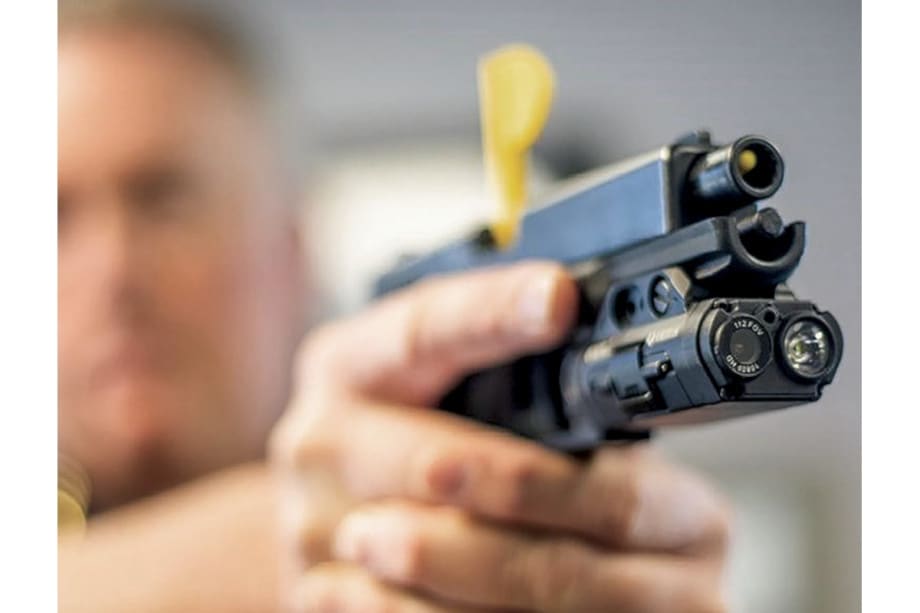
Viridian Fact Duty+ weapon-mounted camera fitted on duty weapon. The camera has a 112-degree field of view and captures 1920 x 1080 HD video at 30 frames per second. There is an integrated microphone for recording HD audio. (Photo: Viridian Weapon Technologies)
The ultimate in transparency is now expected from all American law enforcement agencies. This expectation is never more critical than when officers are involved in shootings. Over the last decade, community response to these incidents have sparked mass demonstrations and riots. Sometimes the community rises up because video evidence of the incident is inconclusive.
The Problem
In many use-of-force incidents, the video evidence available after the event is not captured, or is not as clear or insightful as desired. Body-worn cameras, in-vehicle cameras, and other evidence-gathering devices do not always provide conclusive evidence. Body cameras were not designed specifically to capture officer-involved shootings. Which is why a solution was necessary that shows what the officers saw when they decided to use deadly force.
The Solution
Viridian created a solution to capture critical evidence with the Fact Duty gun camera. The Fact Duty attaches to the weapon accessory rail and automatically activates when the weapon is drawn. It provides an unobstructed view of critical use-of-force events from the end of the firearm, addressing limitations officers can face with body cameras, which can be blocked when officers seek cover or even when they present their weapons during a shooting.
In 2022, Viridian has introduced the Fact Duty+, which features advanced technology and performance with new capabilities centered around ease of use for the officer and improved implementation and management by agencies.
The most important new features of the Fact Duty+ are the Dattery and Dattery Dock, a new data storage system that detaches from the firearm’s recording device for immediate charging and secure data transfer to multiple third-party data management platforms. The Fact Duty+ was created for larger departments and incorporates years of feedback and use-case information from officers and law enforcement leaders across the country.
The Fact Duty+ features Viridian’s patented Instant-On technology, which automatically activates when the firearm is removed from the holster. The camera itself captures 1920 x 1080 HD video, has a 112-degree field of view, and records at 30 frames per second. There is an integrated microphone for HD audio and it fits securely to all duty weapon rail systems. The Fact Duty+ is available in Taclight and Laser + Taclight versions. Both models offer a 500-lumen tactical light and the laser option comes with Viridian’s patented green laser technology, which has a range of 100 yards in daylight and two miles in the dark.
The Dattery Dock is password protected for evidence integrity and is set for automatic download when mated with a standalone charger. It features 32GB of data storage built right into the removable, rechargeable battery. This allows the Fact Duty to remain connected to the firearm while the removable Dattery simultaneously downloads recorded gun camera data and recharges.
Case Study
The idea for Viridian’s gun cameras was born in August 2014 when Ferguson, MO, Officer Darren Wilson was involved in a shooting that killed Michael Brown. From that incident and the ensuing riots and protests, it became obvious to Viridian that cameras were needed on officers’ guns and that automatic activation was necessary to ensure the evidence is captured.
Viridian had already been manufacturing cutting-edge accessories for firearms for a decade. The idea to use our technology to attach a camera to a firearm was a natural outgrowth from our product line of laser sights and weapon lights.
The first Viridian gun cameras were put into the hands of officers in 2017. These devices equipped officers with the ability to have unfettered views and clear evidence from most use-of-force events involving their duty guns. These first trials quickly led to several deployments in Arizona, Minnesota, Texas, and several other states.
In 2020, Viridian’s Fact Duty gun camera captured its first video of an officer-involved shooting. That video provided the key evidence to convict a suspect in the shooting of a Vernon, TX, officer.
The video from the Fact Duty Weapon-Mounted Camera (WMC) showed the defendant pointing a sawed-off shotgun at Vernon Police Corporal T.J. Session during an exchange of gunfire in which both Session and the defendant were shot and wounded.
The WMC evidence helped eliminate any reasonable doubt on the defendant’s actions as the jury took less than 30 minutes to arrive at the guilty verdict. The defense claimed self-defense in the case based on allegations of the officer using unlawful force in the situation. I attended the trial as Viridian’s general counsel and saw that the evidence provided by the WMC refuted that defense. The defendant was convicted of aggravated assault with a deadly weapon on a public official—a level one felony in Texas—and sentenced to 40 years in prison. “It (the video) was really an absolutely critical piece of evidence in this case,” says Wilbarger County District Attorney Staley Heatly, who prosecuted the case.
“The WMC provided essential footage of this particular incident,” I said at the time. “This case would have been much more difficult to prosecute without the WMC footage.”
What I also realized at the time was that when police departments and legal officials from around the country learned of the result, they would see the necessity of the WMC as a supplement or alternative to body cameras as a mandatory evidentiary tool to provide the critical evidence of a subject’s actions at the time a police officer is forced to make the split-second decision to pull the trigger.
Viridian subjectively researched publicly available body camera footage for the years 2016 and 2017 obtained by officers of incidents in which their firearms were drawn. The objective was to determine what aspect of the footage was most crucial from legal and community relations perspectives, the situation leading to drawing the weapon or the reason the weapon was fired. Viridian then compared the footage to what a Fact Duty Weapon-Mounted Camera would have captured had it been deployed by an agency in these situations.
This study showed a Fact Duty gun camera would have reasonably captured essential evidence in officer-involved shootings 86% of the time. Furthermore, a body camera only captured difference-making evidence 37% of the time and on 11% of instances, didn’t capture anything at all. Our research shows that gun cameras can benefit agencies even if they already use body cameras.
Adding Gun Cameras
More and more police agencies are discovering a need for gun cameras. They are also discovering that gun camera program are easy to implement. Gun cameras do not require extra training, nor do they alter the use of police firearms. Gun camera programs also cost significantly less than body camera programs and body camera evidence storage.
To get your department on the list to receive the Fact Duty+ in the very near future, contact sales@ViridianWeaponTech.com.
Matt Plowman is general counsel for Viridian Weapon Technologies.
More Technology

A police agency's guide to data-driven fleet management
Costs are rising and the public expects more transparency into how their tax dollars are spent. This e-book shows how police agencies can use fleet data to take control of fleet expenses while improving officer safety and demonstrating fiscal responsibility to the communities they serve.
Read More →
AI and analytics for law enforcement: Turning data into insights
Law enforcement agencies are managing more video, sensor data and digital evidence than ever before. Discover how AI and analytics can help turn that data into actionable insights that strengthen situational awareness, accelerate investigations and support more informed decisions.
Read More →
Vasco Electronics Adds Automatic Language Detection to Vasco Translator Q1
Vasco Electronics’ software update introduces hands-free language switching and expanded offline translation across 45 language pairs, empowering law enforcement, healthcare, and front-office enterprise teams
Read More →

North Miami Police Department Deploys Mark43
The North Miami Police Department has deployed Mark43 as part of its Five-Year Strategic Plan that represents its collective vision and goals for a more proactive police department, anchored by a core commitment to leveraging modern technology to enhance efficiency and public safety.
Read More →
Cellebrite Genesis for Enterprise Now Generally Available
Made available to the public sector in June, Cellebrite Genesis is serving a growing mix of national, regional, and local agencies worldwide, including some of the largest regional and metropolitan police departments. It is now available for enterprise organizations.
Read More →
2026 Vision FirstNet Users Summit to Host Emerging Leaders Training on Grassroots Advocacy for Public Safety
“Emerging Leaders Training: Understanding the Importance of Grassroots Advocacy for Public Safety," a session during the 2026 Vision FirstNet Users Summit, will offer a roadmap for unified advocacy at the federal level.
Read More →
Motorola Solutions Completes Acquisition of D-Fend Solutions
Motorola Solutions has acquired D-Fend Solutions, an industry leader in counter-drone technology. This deal provides public safety and enterprise customers with access to advanced counter-unmanned aerial systems.
Read More →
ZeroEyes, Advantech & Camden Police Partner to Bring AI Gun Detection Technology to Delaware School District
ZeroEyes has partnered with Advantech and the Camden Police Department to deploy ZeroEyes’ AI gun detection and intelligent situational awareness platform at Delaware’s Caesar Rodney School District (CRSD).
Read More →
Leonardo U.S. Cyber & Security Solutions Introduces SignalTrace, the Next Evolution in Electronic Signature Detection Technology
SignalTrace reflects years of product refinement and a clearer expression of the technology’s purpose of recognizing and correlating electronic signatures in publicly broadcast wireless signals to reveal patterns, relationships, and trends that might otherwise go undetected.
Read More →
Pimloc Launches Secure File Sharing to Streamline Release of Redacted Video
Pimloc’s Secure File Sharing lets organizations deliver redacted video, audio, and documents through expiring, passcode-protected links, accelerating delivery while reducing security, compliance, and chain-of-custody risks.
Read More →