



Axon Launches First Advanced AI-Powered Redaction Tool
Axon has announced the launch of Redaction Assistant, the first advanced artificial intelligence (AI) powered tool to be offered to law enforcement agencies and prosecutors through the Axon network. Redaction Assistant is a productivity tool built to increase efficiency for agencies who currently spend up to eight hours manually redacting each hour of body camera video footage.

Axon (www.axon.com) has announced the launch of Redaction Assistant, the first advanced artificial intelligence (AI) powered tool to be offered to law enforcement agencies and prosecutors through the Axon network. Redaction Assistant is a productivity tool built to increase efficiency for agencies who currently spend up to eight hours manually redacting each hour of body camera video footage. Redaction Assistant is available now to agencies in the United States, UK and Canada as a software add-on and is included automatically for U.S. agencies on Axon's Officer Safety Plan (OSP) 7+.
“I'm excited to see our first advanced AI-powered product come to life," says Moji Solgi, Axon VP of AI and machine learning. "We've put a huge focus on developing a technology that will both increase efficiency for our public safety customers and at the same time increase transparency for the public.”
Redaction Assistant is now included in Axon's Redaction Studio, which debuted in 2017. It is Axon's first advanced redaction product to be powered by AI. Currently, when redacting video footage, users are manually drawing boxes around objects frame-by-frame. With Redaction Assistant, the AI detects a license plate, face or screen and automatically draws a box around it so the user can then confirm whether it is an object that needs to be redacted. The workflow is streamlined so the video is redacted and ready to share with the public much more quickly.
The face detection tool detects that there is a human face in the frame and redacts it—it does not identify the individual to whom the face belongs, neither does it recognize their race, age, or gender, Axon says. The technology is similar to what is found in almost all cellphone cameras where objects of interest, such as faces, are detected to improve the lighting conditions of the captured image.
The City of Kent Law Department is one of several agencies that began partnering with Axon in the first quarter of 2019 to trial Redaction Assistant. In the first three weeks of using Redaction Assistant, the department found that their video redaction workload decreased by 81%.
“I no longer believe I need an additional attorney to help with the workload increase as I can hire and train a support staff person to handle the majority of work associated with the footage,” says
Tami A. Perdue, chief prosecutor for the City of Kent. “This tool has completely changed my staffing recommendations, and consequently, will save our city a significant amount of money. I am very impressed with the product."
The Axon AI team engaged with the AI & Policing Technology Ethics Board on Redaction Assistant and will continue to collaborate with them on future development of AI technologies. The mission of this independent board is to provide expert guidance to Axon on the development of its AI products and services, paying particular attention to its impact on communities.
More Technology
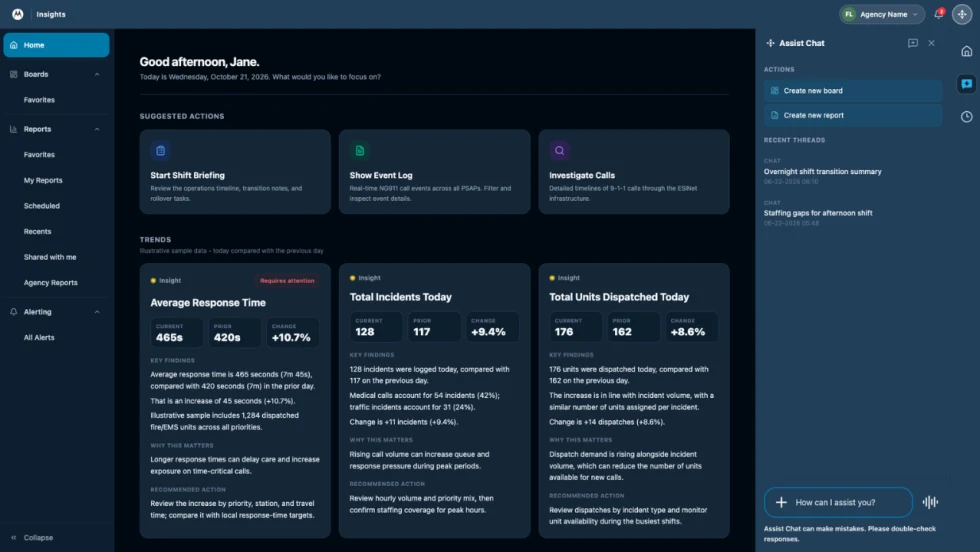
How Motorola Solutions’ New “Insights” Platform Helps Public Safety Agencies Identify Trends to Improve Their Operations
Motorola Solutions has introduced Insights, which leverages Assist, its mission-critical artificial intelligence (AI), to address these challenges and shape what’s next for public safety analytics and reporting technology.
Read More →
What Qualifies a Laptop as Rugged or Fully Rugged?
Police officers face a wide range of working conditions that can damage or even destroy a regular consumer laptop. Learn what qualifies a computer as rugged or fully rugged and why those devices are vital for law enforcement.
Read More →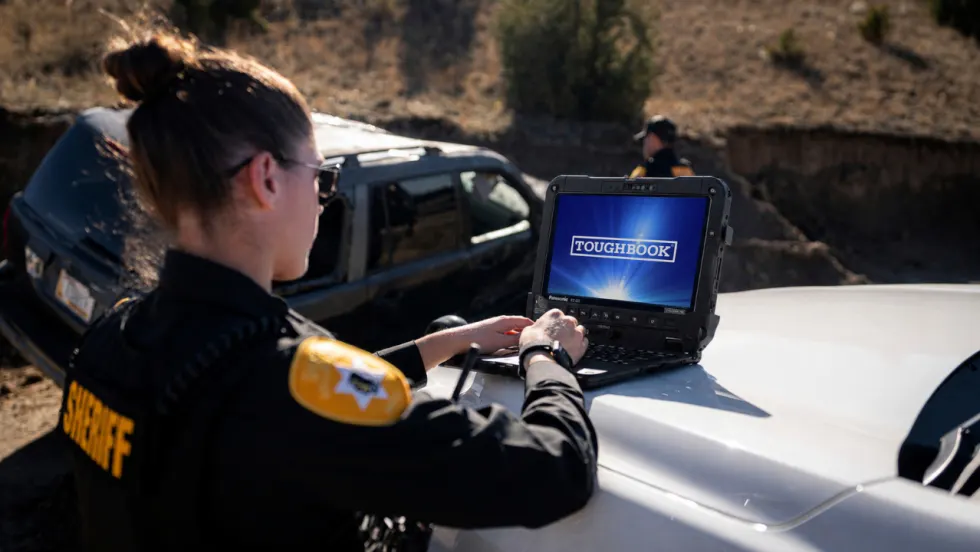
Panasonic Connect Launches the Toughbook 34 and Toughbook G3, Fully Rugged 2-in-1 Mobile Computers
Panasonic Connect has launched the Toughbook 34 and Toughbook G3 to facilitate in-vehicle dispatch, records management, and mobile command operations from any location.
Read More →

A police agency's guide to data-driven fleet management
Costs are rising and the public expects more transparency into how their tax dollars are spent. This e-book shows how police agencies can use fleet data to take control of fleet expenses while improving officer safety and demonstrating fiscal responsibility to the communities they serve.
Read More →
AI and analytics for law enforcement: Turning data into insights
Law enforcement agencies are managing more video, sensor data and digital evidence than ever before. Discover how AI and analytics can help turn that data into actionable insights that strengthen situational awareness, accelerate investigations and support more informed decisions.
Read More →
Vasco Electronics Adds Automatic Language Detection to Vasco Translator Q1
Vasco Electronics’ software update introduces hands-free language switching and expanded offline translation across 45 language pairs, empowering law enforcement, healthcare, and front-office enterprise teams
Read More →
North Miami Police Department Deploys Mark43
The North Miami Police Department has deployed Mark43 as part of its Five-Year Strategic Plan that represents its collective vision and goals for a more proactive police department, anchored by a core commitment to leveraging modern technology to enhance efficiency and public safety.
Read More →
Cellebrite Genesis for Enterprise Now Generally Available
Made available to the public sector in June, Cellebrite Genesis is serving a growing mix of national, regional, and local agencies worldwide, including some of the largest regional and metropolitan police departments. It is now available for enterprise organizations.
Read More →
2026 Vision FirstNet Users Summit to Host Emerging Leaders Training on Grassroots Advocacy for Public Safety
“Emerging Leaders Training: Understanding the Importance of Grassroots Advocacy for Public Safety," a session during the 2026 Vision FirstNet Users Summit, will offer a roadmap for unified advocacy at the federal level.
Read More →
Motorola Solutions Completes Acquisition of D-Fend Solutions
Motorola Solutions has acquired D-Fend Solutions, an industry leader in counter-drone technology. This deal provides public safety and enterprise customers with access to advanced counter-unmanned aerial systems.
Read More →