



Motorola Solutions Launches Remote Mic with Two-Way Radio, Body Camera and AI Capabilities
As a converged and wireless device, SVX effectively halves the number of devices and reduces maintenance, while everyday shifts are covered with the swappable battery. Critically, the convergence of radio, video and AI serves as a force multiplier.
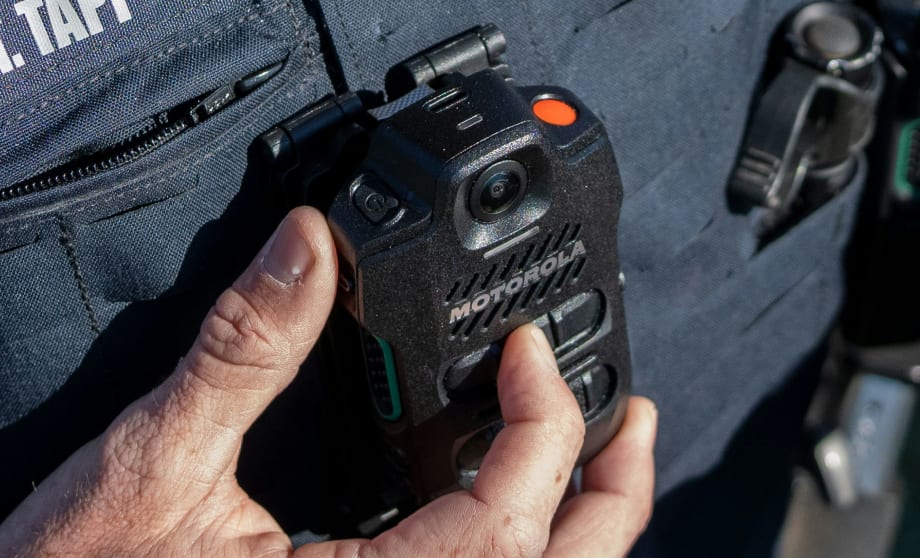
SVX is a remote mic that converges secure voice, video and AI, designed for Motorola Solutions' flagship radio, APX NEXT.
Motorola Solutions
Motorola Solutions has launched SVX, a remote mic that converges secure voice, video and AI, designed for the company’s flagship radio, APX NEXT. Another Motorola product Assist has also launched. It is designed to advance the company’s strategy to put the power of AI into the hands of every first responder in the U.S.
Converging a body camera with first responders’ most trusted lifeline—their radio—replaces the need for multiple devices. And Assist introduces a new category of human-AI collaboration for public safety, providing contextual and actionable information that’s personalized for the time, person and place where decisions need to be made.
As a converged and wireless device, SVX effectively halves the number of devices and reduces maintenance, while everyday shifts are covered with the swappable battery. Critically, the convergence of radio, video and AI serves as a force multiplier, capturing and synthesizing a greater diversity of data throughout an incident for more accurate police reporting and verified evidence.
“An officer’s uniform is their emblem. Their emblem of service, of protection, of courage and sometimes of sacrifice, in the pursuit of making our communities safer,” said Mahesh Saptharishi, executive vice president and chief technology officer of Motorola Solutions. “We’ve designed SVX and Assist to combine secure voice, video and AI with exceptional quality and capability for the people in uniform who protect us all.”
SVX brings Motorola Solutions’ mission-critical communications security and audio clarity now to both voice and video. Integrated with the APX NEXT radio, it features the company’s latest generation of ambient noise reduction, allowing officers to communicate with clarity or ask Assist for support despite background noise. At the same time, SVX’s high-definition video retains all ambient sound to protect the objective integrity of everything an officer sees and hears through the camera. Capturing dual streams through both radio and video communications, which Assist can unify in evidence, means SVX is capturing greater context and clarity for a more comprehensive timeline of events.
“Try using your everyday smartphone AI assistant with police sirens blaring; your message won’t be understood,” said Saptharishi. “Police officers need to confidently communicate wherever they are, and the quality of audio directly affects the usability of radio and video evidence.”
The power of Assist’s AI redefines SVX from being hardware to actively supporting an officer in real time. For example, Assist enables SVX to query a license plate or driver’s license and automatically search for associated records or warnings. Assist can detect keywords in radio traffic, such as “shots fired,” alerting nearby officers and command center staff while making it possible to see and hear what’s going on through SVX to support a response. Assist can turn SVX into a live language translator between an officer and a community member. Assist can also guide officers with steps to follow per agency policies, such as administering a life-saving EpiPen, which streamlines incident management and follows protocols.
“In this line of work, the worst feeling is knowing a key piece of information that would’ve changed your approach didn’t make it to you, that it was buried somewhere,” said Saptharishi. “When AI can make information proactively available, instead of something that needs to be found, we can automate tasks and augment human attention. In public safety, precious time can be the consequential difference.”
The company says its research shows that patrol officers spend between 40% to 60% of their time when writing reports entering basic data about people, vehicles and property. Motorola Solutions is targeting this time-consuming work, accelerating more factually-grounded police reports and evidence, while preserving officers’ time holistically, from 911 call to case closure.
The convergence of radio, video and AI means Assist can go far beyond documenting an officer’s individual perspective by collating the diversity of data from every stage of the incident, including radio conversations, officer’s location, 911 call information, dispatch records, other body or street camera footage, community inputs and more. Assist’s access to more sources means more cross-referencing and verification for higher levels of accuracy, reliability and trustworthy insights.
“An officer is trained to notice things in the field, so it's critical their reports reflect their perception of the incident, in their voice,” said Saptharishi. “Assist can support and verify their perspective, including identifying discrepancies. For example, Assist may flag that ‘the car is black (per video footage), not blue,’ a finding that must be confirmed by a human. This is about augmenting human memory versus replacing it.”
“We call this ‘good friction,’” said Saptharishi. “We’re designing to augment people, but it's incredibly important to make sure there is no blind trust and overreliance on AI. This is critical in the face of courtroom scrutiny and upholding justice.”
Motorola Solution says the development of SVX and Assist highlights its vision for AI, to simplify tasks through automation and proactively provide information with context for the person and the role they’re performing at a specific point in time. The company adds it will continue to develop and announce new applications for Assist across its safety and security technologies, marked by the Assist emblem to transparently denote when information is surfaced by Assist so that humans can evaluate and verify it.
More Technology
A police agency's guide to data-driven fleet management
Costs are rising and the public expects more transparency into how their tax dollars are spent. This e-book shows how police agencies can use fleet data to take control of fleet expenses while improving officer safety and demonstrating fiscal responsibility to the communities they serve.
Read More →
AI and analytics for law enforcement: Turning data into insights
Law enforcement agencies are managing more video, sensor data and digital evidence than ever before. Discover how AI and analytics can help turn that data into actionable insights that strengthen situational awareness, accelerate investigations and support more informed decisions.
Read More →
Vasco Electronics Adds Automatic Language Detection to Vasco Translator Q1
Vasco Electronics’ software update introduces hands-free language switching and expanded offline translation across 45 language pairs, empowering law enforcement, healthcare, and front-office enterprise teams
Read More →

North Miami Police Department Deploys Mark43
The North Miami Police Department has deployed Mark43 as part of its Five-Year Strategic Plan that represents its collective vision and goals for a more proactive police department, anchored by a core commitment to leveraging modern technology to enhance efficiency and public safety.
Read More →
Cellebrite Genesis for Enterprise Now Generally Available
Made available to the public sector in June, Cellebrite Genesis is serving a growing mix of national, regional, and local agencies worldwide, including some of the largest regional and metropolitan police departments. It is now available for enterprise organizations.
Read More →
2026 Vision FirstNet Users Summit to Host Emerging Leaders Training on Grassroots Advocacy for Public Safety
“Emerging Leaders Training: Understanding the Importance of Grassroots Advocacy for Public Safety," a session during the 2026 Vision FirstNet Users Summit, will offer a roadmap for unified advocacy at the federal level.
Read More →
Motorola Solutions Completes Acquisition of D-Fend Solutions
Motorola Solutions has acquired D-Fend Solutions, an industry leader in counter-drone technology. This deal provides public safety and enterprise customers with access to advanced counter-unmanned aerial systems.
Read More →
ZeroEyes, Advantech & Camden Police Partner to Bring AI Gun Detection Technology to Delaware School District
ZeroEyes has partnered with Advantech and the Camden Police Department to deploy ZeroEyes’ AI gun detection and intelligent situational awareness platform at Delaware’s Caesar Rodney School District (CRSD).
Read More →
Leonardo U.S. Cyber & Security Solutions Introduces SignalTrace, the Next Evolution in Electronic Signature Detection Technology
SignalTrace reflects years of product refinement and a clearer expression of the technology’s purpose of recognizing and correlating electronic signatures in publicly broadcast wireless signals to reveal patterns, relationships, and trends that might otherwise go undetected.
Read More →
Pimloc Launches Secure File Sharing to Streamline Release of Redacted Video
Pimloc’s Secure File Sharing lets organizations deliver redacted video, audio, and documents through expiring, passcode-protected links, accelerating delivery while reducing security, compliance, and chain-of-custody risks.
Read More →