



The Next Stage of Patrol Computers
Your next mobile in-car laptop will probably connect to the Internet using built-in wireless connectivity like the latest smartphones and tablets. Your agency may even choose to equip your car with a tablet instead of a laptop.

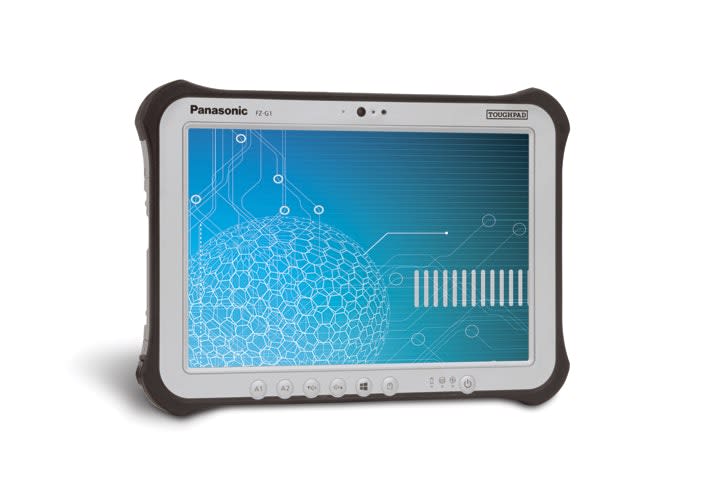
Panasonic's Toughpad FZ-G1 is a fully rugged, 10-inch tablet that runs Windows 7 or Windows 8. Photo courtesy of Panasonic.
Today's patrol officer starts his or her shift by logging into a laptop that's been specially constructed to survive the rigors of law enforcement, that same officer carries a smartphone that boasts more power than the desktop computers of a decade ago, and if that officer works for a particularly well-heeled or technologically forward agency, there may even be a tablet computer in his or her cruiser.
The rapid penetration of mobile computers into everyday law enforcement operations during the last decade has coincided with advancements in wireless technology. Not long ago, equipping patrol cars with mobile computers required modems in the trunk. Now agencies are using air cards to connect to mobile broadband. And your next mobile in-car laptop will probably connect to the Internet using built-in wireless connectivity like the latest smartphones and tablets. Your agency may even choose to equip your car with a tablet instead of a laptop. Some are already experimenting with this configuration.
Mobile computing technology is evolving rapidly, so rapidly that it can be hard to put a finger on the trends that you will see in the next five years. But by talking to the experts and checking out the equipment at trade shows, we can get a pretty good idea of what's coming in law enforcement mobile computing.
Goodbye to Simple Passwords
Few predictions can be assigned 100% probability. But more security in law enforcement computing is a lead pipe cinch.
The Criminal Justice Information Services (CJIS) Division of the FBI is requiring that agencies using NCIC and IAFIS data on their computers tighten access security by requiring advanced authentication. Hint: It can't be (Your Dog's Name)1234 or your (Agency Name)badge number. The password as you know it is becoming obsolete.
CJIS compliance will require every computer that's used in the field by patrol officers to have a combination of agency approved password and user name authentication and an advanced security system. Advanced security systems come in seven flavors, but they basically break down into three options: hardware, software, and biometric.
If your agency chooses hardware authentication, that means you will need a physical object to unlock your computer. Most likely you will be carrying a smart card in your wallet that will grant you access to your computer by its proximity or a hardware token that you will have to insert into the computer's USB port to gain access.
The most common software authentication system is essentially a random password generator. Once you gain access to the system through another means, the software creates a one-time password that you have to plug in to gain further access. These tools are often called software "tokens."
Biometric is by far the most common advanced authentication system on today's mobile computing systems. That's because it seems to be the easiest. You put a thumb on the scanner and you get access for the trouble of giving the machine your print. But agencies are discovering that these systems require a lot of support on the back end to make sure that the machine recognizes the authorized users. Also scanners can misread because of skin oil and perspiration. So biometrics may soon fall out of favor and be replaced by a hardware or software option.
Regardless of which way your agency chooses to go with its CJIS compliance, it will change the way you do business.
Will Prices Come Down?
When you consider the price of the average Windows laptop in the consumer market, it would seem likely that ruggedized law enforcement computers would also drop in price. But don't hold your breath.
There are two essential reasons why law enforcement laptops don't follow the same trends as standard Windows laptops. One, ruggedized computer manufacturers pretty much follow Apple's strategy on pricing and not HP's. In other words, they give you faster processors and more memory and more features but hold the line on pricing. Two, when you buy a ruggedized laptop that meets Mil-Spec, you are buying a computer in armor, and the armor is a substantial part of the cost.
"Our products are value products," says Sean Hall, Panasonic's national sales manager. "You pay a bit more to purchase, but you are going to save more when you use it. You can buy a cheaper product, but then you have to operate it in the field. We have a less than 2% failure average on our devices. And that saves you money in the long run because every failure incident costs an agency $300 to $800."
Here Come the Tablets
While very few agencies have taken the leap and replaced their rugged laptops with car-mounted tablets, it's likely that more will very soon. The versatility of tablet computers is hard to deny, but some agencies may find this transition more difficult than imagined.
How tablets will comply with CJIS authentication is certainly going to be a complication. It's likely that these systems will use some form of software token to generate random passwords. The reason for this is simple, many tablets do not have USB ports that could be used with hardware tokens.
Also some officers may resist the transition from laptops to tablets because they believe the tablet screens are too small to be an effective alternative. This is largely an optical illusion, since the usable display real estate of a full-size tablet is not significantly less than that of a small laptop.
Perhaps the greatest difficulty that agencies making the switch from laptops to tablets will face is deciding what tablet will serve their needs. Tablets generally operate on one of three operating systems: Apple's iOS, Google's Android, and Microsoft's Windows. For anything more than a complementary tool to an in-car computer, Apple and Android are not really a viable choice. Most critical law enforcement software solutions like computer-aided dispatch run only on Windows. Most patrol tablets used to replace laptops are probably going to be Windows models. And for the near future they are going to be Windows 7 because most law enforcement software companies have not embraced Win 8.
Several manufacturers of rugged law enforcement computers offer Mil-Spec tablets that run Windows 7. But another question that agencies will face when choosing mission critical tablets is whether to pay the cost for ruggedization when consumer tablets are much cheaper and can be encased in impact-resistant and water-resistant cases for nominal cost. But before an agency loads up on consumer tablets, there are major issues that need to be considered. For example, consumer tablets are not built for mission critical police work.
Tablets are solid state so they are not as prone to the vibration damage that most consumer laptops would face rolling around in a patrol car. But they do have at least two distinct vulnerabilities: the displays are easily damaged and they are not shielded against heat and humidity. The screen issue can be addressed by a commercially available protective case, but such cases do not offer heat and humidity protection. Another issue with consumer tablets is that they are not easily read in sunlight and some can't be read at all by someone wearing polarized sunglasses. They also don't work very well with gloves.
Still, despite all of the questions about tablets that must be answered, it's pretty certain that the laptop's role in public safety will begin to decline as much as the laptop has in the consumer market. Powerful, durable, and versatile tablets will be in your patrol cars in the near future.
For More Information:
Dell
Getac
Panasonic
More Technology

A police agency's guide to data-driven fleet management
Costs are rising and the public expects more transparency into how their tax dollars are spent. This e-book shows how police agencies can use fleet data to take control of fleet expenses while improving officer safety and demonstrating fiscal responsibility to the communities they serve.
Read More →
AI and analytics for law enforcement: Turning data into insights
Law enforcement agencies are managing more video, sensor data and digital evidence than ever before. Discover how AI and analytics can help turn that data into actionable insights that strengthen situational awareness, accelerate investigations and support more informed decisions.
Read More →
Vasco Electronics Adds Automatic Language Detection to Vasco Translator Q1
Vasco Electronics’ software update introduces hands-free language switching and expanded offline translation across 45 language pairs, empowering law enforcement, healthcare, and front-office enterprise teams
Read More →
North Miami Police Department Deploys Mark43
The North Miami Police Department has deployed Mark43 as part of its Five-Year Strategic Plan that represents its collective vision and goals for a more proactive police department, anchored by a core commitment to leveraging modern technology to enhance efficiency and public safety.
Read More →
Cellebrite Genesis for Enterprise Now Generally Available
Made available to the public sector in June, Cellebrite Genesis is serving a growing mix of national, regional, and local agencies worldwide, including some of the largest regional and metropolitan police departments. It is now available for enterprise organizations.
Read More →
2026 Vision FirstNet Users Summit to Host Emerging Leaders Training on Grassroots Advocacy for Public Safety
“Emerging Leaders Training: Understanding the Importance of Grassroots Advocacy for Public Safety," a session during the 2026 Vision FirstNet Users Summit, will offer a roadmap for unified advocacy at the federal level.
Read More →
Motorola Solutions Completes Acquisition of D-Fend Solutions
Motorola Solutions has acquired D-Fend Solutions, an industry leader in counter-drone technology. This deal provides public safety and enterprise customers with access to advanced counter-unmanned aerial systems.
Read More →
ZeroEyes, Advantech & Camden Police Partner to Bring AI Gun Detection Technology to Delaware School District
ZeroEyes has partnered with Advantech and the Camden Police Department to deploy ZeroEyes’ AI gun detection and intelligent situational awareness platform at Delaware’s Caesar Rodney School District (CRSD).
Read More →
Leonardo U.S. Cyber & Security Solutions Introduces SignalTrace, the Next Evolution in Electronic Signature Detection Technology
SignalTrace reflects years of product refinement and a clearer expression of the technology’s purpose of recognizing and correlating electronic signatures in publicly broadcast wireless signals to reveal patterns, relationships, and trends that might otherwise go undetected.
Read More →
Pimloc Launches Secure File Sharing to Streamline Release of Redacted Video
Pimloc’s Secure File Sharing lets organizations deliver redacted video, audio, and documents through expiring, passcode-protected links, accelerating delivery while reducing security, compliance, and chain-of-custody risks.
Read More →