



IQ Biometrix FACES 4.0
If you are looking for the best software for creating composite pictures of suspects, check out IQ Biometrix's FACES 4.0.

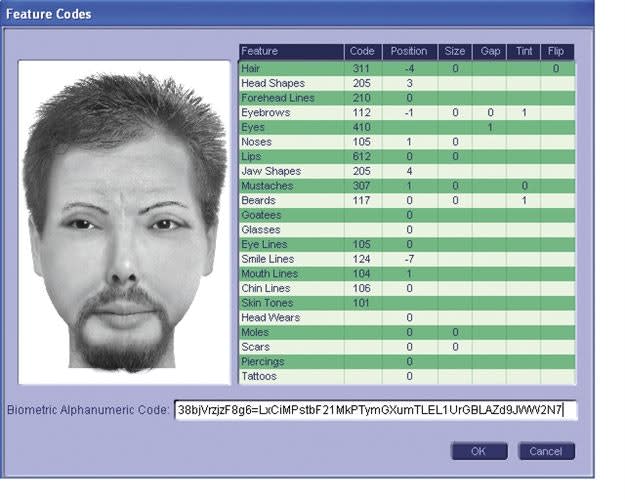
If you are looking for the best software for creating composite pictures of suspects, check out IQ Biometrix's FACES 4.0.
This state-of-the-art software combines myriad facial characteristics to create what some would call photo-quality composites. Additionally, FACES continues to revolutionize the way law enforcement agencies create composite pictures of suspects now and how we'll integrate them against our captured photographic databases into the future.
FACES, developed in 1998, is used by law enforcement agencies all over the world. It's also the compositing software of choice for Fox Television Network's "America Most Wanted," where composites created by FACES software are used on a regular basis and have led to the capture of suspects.
IQ Biometrix's latest version of FACES, version 4.0, expands the facial feature database, allows easier integration with law enforcement database applications, and adds numerous enhancements, including:
More than 4,400 expanded facial features
Three-tone hair color
Side-to-side hair flip
Scars, moles, piercing, and tattoos and markings
Improved age progression
Detachable hats and headwear
Full Windows XP compatibility
Ability to export composites as JPEG files
Integration with TRAK alert system
Slide show capability
Improved zooming and positioning tools
And while IQ Biometrix's coders have been busy improving the company's software, they have also taken great care to maintain its user interface, which is so intuitive that any police officer can create high-quality digital composites with just a little training. Artistic skills are not necessary for successful compositing with FACES. The software's point-and-click user interface lets the operator select from basic facial components and then adjust them as victims and witnesses report them.
FACES also gives you very precise control of the image that you are creating. The software's zoom tool allows you to refine facial features in fine detail and a positioning grid lets you adjust height and width of individual facial features, including lines and shadows for aging effects. FACES 4.0 also lets you adjust the tone or intensity of hair, mustaches, and beards.
With more than 4,400 facial features, including a new scars, marks, piercings, earrings, and tattoos capability, FACES can reproduce almost any facial characteristic that is described to you by a victim or witness. It also lets you fine-tune the suspect's image to capture nuances that are critical to a successful manhunt. For example, when the victim mentions the suspect's five o'clock shadow you can alter it from five that afternoon to a few day's growth with just a left click or two and back again if necessary.
FACES 4.0 can create composites that are so photographically lifelike that the software now includes a tool to make the composites look more like line art and a "Not a Real Photograph" disclaimer to avoid confusion. That's not arrogance on the part of IQ Biometrix; it's a necessary feature. This software is that good.
Most facial compositing software is designed for use in the police station by investigators or police artists. But FACES 4.0 has features that will make it very useful for first responders.
FACES not only lets first responders create lifelike composites, when used in combination with new wireless-capable notebook computers, it can lead to quicker apprehensions. Saved files are relatively small, making it easy for you to send and receive images via wireless Internet connection, a Wi-Fi hotspot, or your department's own backbone. The files I created for this article consumed only 13KB of space on my hard drive.
The secret to FACES 4.0's minimal file sizes is a special biometric alphanumeric code (BAC) for every composite created. Typically less than 1KB in size, the BAC is ideal for wireless transmission and when the file is reentered into a receiving PC's copy of FACES the BAC ensures that the identical composite face is automatically recreated.
I know what some of you veterans are thinking. After all, I'm a skeptical experienced cop, too. You're thinking, "We don't need this new stuff. We get along just fine without it."
But before you blow me off and close your minds to new ideas, think back to your days in the field. (For some of you, like me, it may not be that easy.) How many times did you hear a radio description of a suspect on the air and you wanted more? The description was just too vague to help you identify the bad guy. How many times did you wonder what exactly did that radio description really mean when the dispatcher said "short hair and beard?"
With software like FACES 4.0, in just a few short minutes, a preliminary digital composite can be created and sent via e-mail right to the PC in the car. And, if revisions are made, updates are immediately available to all of the users. That's when a picture will truly be worth a thousand words in the arrest narrative.
With the advancement of computerized computer-aided dispatch (CAD) systems, I believe that every patrol car equipped with a PC should have FACES composite imaging software as part of our crime fighting tools. And this is only the beginning. Integrating FACES into our mugshot systems might help us match composites to real booking photos, and using it to create composites from grainy surveillance videos might just help us solve that cold homicide case.
Unlike some software companies that make composite programs, IQ Biometrix has kept the cost of FACES reasonable while constantly improving the product. Furthermore, the folks at IQ Biometrix don't want annual subscription fees as some of their competitors are requiring and its software runs on Windows 98 PC or better with 64MB of RAM and 1.2GB of hard drive space or any Mac computer using system 8.6 with CarbonLib 1.3.1 or better.
FACES 4.0 is available in English, Spanish, and French. It comes with a 40-page user's guide, plus more than 150 pages of thumbnail images that demonstrate facial features in the FACES database. In addition to showing you what the software can do, these thumbnails can be an invaluable tool in witness interviews.
A demo version of FACES may be downloaded at the IQ Biometrix Website at www.iqbiometrix.com. Law Enforcement agencies can also request FACES 4.0 to test on a trial basis.
A 25-year police veteran and a member of the San Diego Police Department, Bob Davis has extensive experience managing technology for major events. He currently runs the SDPD computer lab.
More Technology

A police agency's guide to data-driven fleet management
Costs are rising and the public expects more transparency into how their tax dollars are spent. This e-book shows how police agencies can use fleet data to take control of fleet expenses while improving officer safety and demonstrating fiscal responsibility to the communities they serve.
Read More →
AI and analytics for law enforcement: Turning data into insights
Law enforcement agencies are managing more video, sensor data and digital evidence than ever before. Discover how AI and analytics can help turn that data into actionable insights that strengthen situational awareness, accelerate investigations and support more informed decisions.
Read More →
Vasco Electronics Adds Automatic Language Detection to Vasco Translator Q1
Vasco Electronics’ software update introduces hands-free language switching and expanded offline translation across 45 language pairs, empowering law enforcement, healthcare, and front-office enterprise teams
Read More →

North Miami Police Department Deploys Mark43
The North Miami Police Department has deployed Mark43 as part of its Five-Year Strategic Plan that represents its collective vision and goals for a more proactive police department, anchored by a core commitment to leveraging modern technology to enhance efficiency and public safety.
Read More →
Cellebrite Genesis for Enterprise Now Generally Available
Made available to the public sector in June, Cellebrite Genesis is serving a growing mix of national, regional, and local agencies worldwide, including some of the largest regional and metropolitan police departments. It is now available for enterprise organizations.
Read More →
2026 Vision FirstNet Users Summit to Host Emerging Leaders Training on Grassroots Advocacy for Public Safety
“Emerging Leaders Training: Understanding the Importance of Grassroots Advocacy for Public Safety," a session during the 2026 Vision FirstNet Users Summit, will offer a roadmap for unified advocacy at the federal level.
Read More →
Motorola Solutions Completes Acquisition of D-Fend Solutions
Motorola Solutions has acquired D-Fend Solutions, an industry leader in counter-drone technology. This deal provides public safety and enterprise customers with access to advanced counter-unmanned aerial systems.
Read More →
ZeroEyes, Advantech & Camden Police Partner to Bring AI Gun Detection Technology to Delaware School District
ZeroEyes has partnered with Advantech and the Camden Police Department to deploy ZeroEyes’ AI gun detection and intelligent situational awareness platform at Delaware’s Caesar Rodney School District (CRSD).
Read More →
Leonardo U.S. Cyber & Security Solutions Introduces SignalTrace, the Next Evolution in Electronic Signature Detection Technology
SignalTrace reflects years of product refinement and a clearer expression of the technology’s purpose of recognizing and correlating electronic signatures in publicly broadcast wireless signals to reveal patterns, relationships, and trends that might otherwise go undetected.
Read More →
Pimloc Launches Secure File Sharing to Streamline Release of Redacted Video
Pimloc’s Secure File Sharing lets organizations deliver redacted video, audio, and documents through expiring, passcode-protected links, accelerating delivery while reducing security, compliance, and chain-of-custody risks.
Read More →