



Guardians in the Sky
Now that the FAA has relaxed its regulations for commercial drone operation by public safety agencies, more and more police departments want to add this tool to their capabilities.

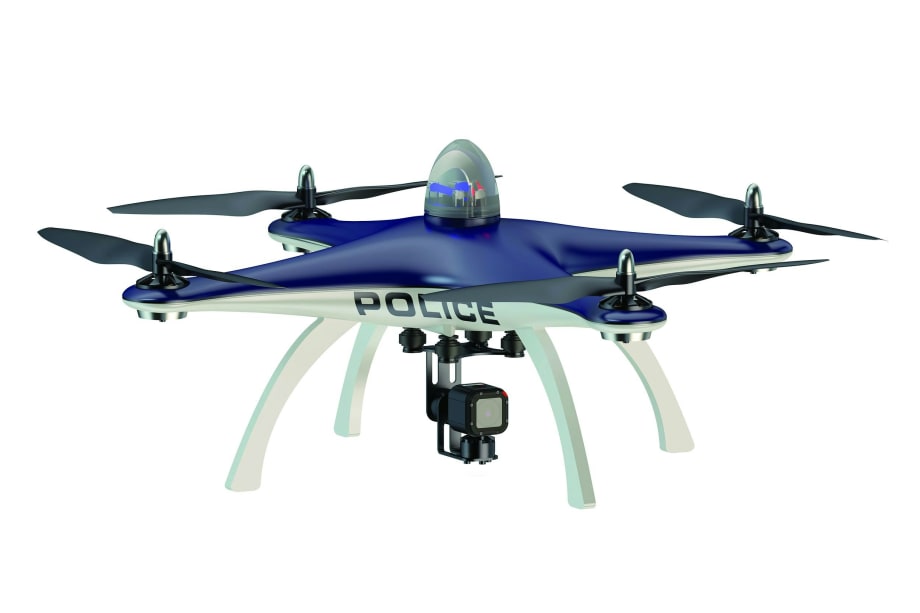
A law enforcement UAS, or drone. Photo: Getty Images
Few law enforcement technologies have grown faster than unmanned aerial systems (UAS), what most people call drones.
In 2014, POLICE ran an article ("Drones Grounded Until Further Notice," October 2014) about how law enforcement use of drones was stymied by a combination of FAA regulations and civil liberty concerns. Now, four years later it's estimated that a thousand or more agencies are operating drones.
This massive growth in law enforcement use of drones can be traced to the FAA relaxing its requirement for agencies operating drones. You still have to jump through some hoops to start a UAS program, but the hoops are not nearly as narrow or as many as they were in 2014.
POLICE contributor and certified air traffic controller Michael Hamann explained these regulations in detail in a January 2018 article titled "How to Implement and Justify a Drone Program."
Essentially there are two processes through which public safety agencies can gain licensing from the FAA that allows them to fly drones commercially: certificate of authorization (COA) or Part 107 regulations. An agency must choose which process it wishes to follow, and it can't do both.
The COA requires the applying agency to thoroughly document and self-certify their drones, pilots, and intended locations of operation. The Part 107 exemption requires less work than the COA process but it has more restrictions. Hamann wrote: "Drones operated under Part 107 must weigh less than 55 pounds and be registered as aircraft. Operators of the drone must be certified as remote pilot operators with a small UAS rating. Once this process is complete, the agency is permitted to operate its drone in accordance with the provisions of Part 107, including obtaining instant airspace waivers through the future Low Altitude Authorization and Notification Capability (LAANC) program."
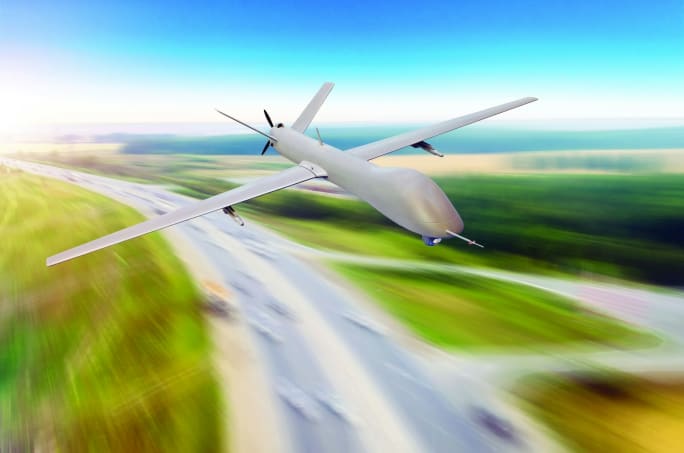
Police drones are different from a military drone (pictured). Military drones can fire weapons and loiter for hours. Police drones can fly an hour at best and are unarmed. Photo: Getty Images
What relaxed regulations under Part 107 have meant for law enforcement is that numerous agencies are now capable of using small drones in their operations. Even the smallest hobby drones can have application in police work. And the price of more sophisticated drones, the type that have infrared imaging and other powerful tools on board, has dropped substantially.
The list of applications for drones in law enforcement operations is growing. But they are proving to be most valuable for the following missions:
Search and Rescue—Earlier this year, the Moore County (NC) Sheriff's Office was able to rescue an 11-year-old girl who wandered away into the woods. Lt. Tim Davis brought one of the agency's drones to the scene and flew it over the wooded area and 15 minutes later was able to detect the girl using the drone's thermal imaging system. She was found safe and asleep under thick brush in an area that had already been searched by teams on the ground. Moore County Sheriff Neil Godfrey told local media that it would have taken 45 minutes or more to bring a helicopter on scene. The drone gave the Moore County SO an air asset that it could deploy quickly and prevent a possible tragedy.
Crime Scene and Accident Scene Imaging—In the past, crime scene investigators and accident investigators had to call in a helicopter in order to get a bird's-eye view of the area. That was an expensive call and one that many agencies were reluctant to make because of budget constraints. Drones are so much cheaper to operate that aerial imaging of accident scenes and outdoor crimes scenes is becoming standard practice at some agencies. Drones can be equipped with 3D imaging systems and can capture the entire scene in a similar fashion to a ground-based 3D scanning system. The data can then be measured, animated, and combined with ground-based 3D scans to create an entire picture of the scene for evidence and courtroom presentations.
Intelligence Gathering at Critical Incidents—Drones can be used to scout a location before a tactical operation such as a high-risk warrant service, to inspect disaster damage, to provide surveillance during an active shooter attack to help locate the shooter, and a host of other eye-in-the-sky missions.
Enhancing Security at Big Events—After the horrific active shooter incident at the Route 91 country music concert in Las Vegas in October 2017, agencies in jurisdictions that host such events have been finding ways to use drones for crowd and area overwatch. In April the Indio (CA) Police Department hired a commercial drone company to help it bolster ground security at the Coachella Valley Music and Arts Festival, which draws as many as 125,000 people per day. Sgt. Dan Marshall of the Indio PD told the Los Angeles Times that the drones were being used to monitor the perimeters. "It takes us a few minutes to get an officer to a perimeter breach, but a drone takes 45 seconds," he said.
Now that the FAA has relaxed its regulations for commercial drone operation by public safety agencies, more and more police departments want to add this tool to their capabilities. But many face one more major hurdle, public perception. Whenever a big city police department asks a city council for a drone program, the privacy activists and the ACLU fight it tooth and nail.
There is this misguided belief that law enforcement drones have the capabilities of extremely sophisticated military unmanned aerial vehicles (UAV). The differences are clear to anyone who compares the two different types of aircraft. Military UAVs are usually capable of delivering missiles on target. Law enforcement drones are not armed. Military UAVs can loiter hours and hours over a target; the Grumman Global Hawk can stay in the air more than a day. In contrast, police drones usually have a flight time of 30 minutes to an hour. The only law enforcement agencies using the types of drones that can loiter over an area a long time are federal agencies like the Border Patrol, which need to watch over vast areas of territory. Despite the fears of privacy activists who believe law enforcement drones could watch them all day long and through the windows of their homes, the truth is that law enforcement drones are not designed for that kind of surveillance, agencies don't have the officers necessary to do it, and it would be illegal to do so without a warrant.
The best argument an agency can present to the local bureaucracy for why a drone program should be implemented is that the aerial imaging provided by drones can save lives. And in many instances, drones can provide law enforcement with that imaging capability much more cheaply than helicopters or fixed-wing aircraft. Helicopters cost millions of dollars to purchase and then you have to hire or train pilots. In contrast, law enforcement-quality drones cost anywhere from a few thousand dollars to $25,000 and pilots can be trained in-house for a few thousand dollars more. One agency estimated its drone operation costs at $25. In contrast just the fuel costs for one hour of helicopter operation is around $600.
Does that mean drones can do everything helicopters and their flight crews do for pennies on the dollar? No. Drones are not suited to patrol, or pursuit, or any other mission that requires a human pilot and human observer. They are not a replacement for manned aircraft, at least not yet. But what they can do is give you the ability to gather aerial imaging quickly and efficiently for missions like searches and overwatch of events or law enforcement operations.
More Technology

A police agency's guide to data-driven fleet management
Costs are rising and the public expects more transparency into how their tax dollars are spent. This e-book shows how police agencies can use fleet data to take control of fleet expenses while improving officer safety and demonstrating fiscal responsibility to the communities they serve.
Read More →
AI and analytics for law enforcement: Turning data into insights
Law enforcement agencies are managing more video, sensor data and digital evidence than ever before. Discover how AI and analytics can help turn that data into actionable insights that strengthen situational awareness, accelerate investigations and support more informed decisions.
Read More →
Vasco Electronics Adds Automatic Language Detection to Vasco Translator Q1
Vasco Electronics’ software update introduces hands-free language switching and expanded offline translation across 45 language pairs, empowering law enforcement, healthcare, and front-office enterprise teams
Read More →

North Miami Police Department Deploys Mark43
The North Miami Police Department has deployed Mark43 as part of its Five-Year Strategic Plan that represents its collective vision and goals for a more proactive police department, anchored by a core commitment to leveraging modern technology to enhance efficiency and public safety.
Read More →
Cellebrite Genesis for Enterprise Now Generally Available
Made available to the public sector in June, Cellebrite Genesis is serving a growing mix of national, regional, and local agencies worldwide, including some of the largest regional and metropolitan police departments. It is now available for enterprise organizations.
Read More →
2026 Vision FirstNet Users Summit to Host Emerging Leaders Training on Grassroots Advocacy for Public Safety
“Emerging Leaders Training: Understanding the Importance of Grassroots Advocacy for Public Safety," a session during the 2026 Vision FirstNet Users Summit, will offer a roadmap for unified advocacy at the federal level.
Read More →
Motorola Solutions Completes Acquisition of D-Fend Solutions
Motorola Solutions has acquired D-Fend Solutions, an industry leader in counter-drone technology. This deal provides public safety and enterprise customers with access to advanced counter-unmanned aerial systems.
Read More →
ZeroEyes, Advantech & Camden Police Partner to Bring AI Gun Detection Technology to Delaware School District
ZeroEyes has partnered with Advantech and the Camden Police Department to deploy ZeroEyes’ AI gun detection and intelligent situational awareness platform at Delaware’s Caesar Rodney School District (CRSD).
Read More →
Leonardo U.S. Cyber & Security Solutions Introduces SignalTrace, the Next Evolution in Electronic Signature Detection Technology
SignalTrace reflects years of product refinement and a clearer expression of the technology’s purpose of recognizing and correlating electronic signatures in publicly broadcast wireless signals to reveal patterns, relationships, and trends that might otherwise go undetected.
Read More →
Pimloc Launches Secure File Sharing to Streamline Release of Redacted Video
Pimloc’s Secure File Sharing lets organizations deliver redacted video, audio, and documents through expiring, passcode-protected links, accelerating delivery while reducing security, compliance, and chain-of-custody risks.
Read More →