



Dotworkz Systems' IP Video Surveillance
Minutes after the recent Underground bombings in London, British police and Scotland Yard investigators were working tirelessly, viewing and analyzing digital surveillance imagery from the numerous cameras active throughout London. Within hours, they released images of the suspected bombers to media outlets around the world. Information came pouring in from the public and arrests quickly followed.

Minutes after the recent Underground bombings in London, British police and Scotland Yard investigators were working tirelessly, viewing and analyzing digital surveillance imagery from the numerous cameras active throughout London. Within hours, they released images of the suspected bombers to media outlets around the world. Information came pouring in from the public and arrests quickly followed.
The arrests of suspects in the London bombings were both a tribute to the dedication of British police and a triumph of surveillance technology. So for this month’s column, I thought it would be interesting to take a look at wireless video surveillance systems.
In the recent past, installing surveillance systems required a considerable amount of planning and a hoard of cash. It also had to be connected with miles of cabling, raceways, and conduits. All of this cable led from the cameras in the field to 10, 20, 30 or more monitors sometimes viewed by a single employee who was hopelessly overwhelmed.
Today’s systems are much more sophisticated. They exploit wireless mesh network technology, digitized recording systems, computerized analysis, and most importantly Internet Protocol (IP).
IP cameras are cameras with computer networking built in. They have their own IP address; so they can capture and transmit their video over any IP-enabled network anywhere in the world. When you combine these cameras with the newest compression algorithms, you see live, higher-quality images at faster and faster frame rates over the Internet. True, IP video is not 30 frames per second “broadcast quality” video, not yet, but it will be soon.
William Ferris, president of Dotworkz Systems, a leading wireless video surveillance system provider and systems integrator, says that one of his major concerns about law enforcement use of wireless video surveillance is the level of commitment to the technology. It’s not something you can turn on today and just forget about. Someone has to actively operate it, Ferris explains. You can’t expect employees who have used the system infrequently to remember what to do if something goes wrong.
Dotworkz recently installed a state-of-the-art five camera pilot system in Pittsburgh, Calif., just north of Oakland, using wireless mesh networking technology. When deciding where to place the cameras in the limited pilot program, several factors were considered, including extent of criminal activity and, however odd it may sound, ease of installation in the context of connectivity of the network.
It’s the mesh networking, which allows cameras to link with each other via line-of-sight or by exploiting the digital signal’s ability to bounce off reflective surfaces, that makes state-of-the-art wireless surveillance systems so much more powerful than even last year’s models. With antennas pointed in the right directions, you can “bend” signals around corners and, under the proper circumstances, you can place cameras a mile or more apart, all without the expensive cabling and trenching typically associated with earlier public surveillance systems.
Although getting the video is important, it’s only half the equation. Once you have the video, you’ll need to store it and analyze it. It’s important to find video servers that are optimized for this purpose. Don’t think you can just order one from Dell. Sure they have great servers, but they’re really not designed to handle this type of intensive work. Dotworkz has designed and engineered its own servers to perform with optimum efficiency for surveillance work, capturing one of the industry’s highest wireless frame rates of 17 to 19 frames a second at 640x480 resolution, which is twice the industry standard.
For software, Dotworkz uses On-Net Surveillance’s NetCentral video management system for camera management as well as content analysis. Other vendors such as CVideo can provide other proprietary solutions for backend video management and storage.
Wireless IP cameras do have limits. You must give serious consideration to which “band” of the radio frequency spectrum gives you the best bang for your buck. Whether you have an older 900MHz system or the widely popular, no license necessary, 2.4GHz spectrum can make a difference on how your system works. There’s also the “newer” 5.8GHz band and the latest spectrum reserved specifically by the FCC for public safety, 4.9GHz. However, before you allow a vendor to sell you equipment using 4.9GHz frequencies, do your homework. Currently, the FCC is strictly limiting licenses to experimental use while a needs assessment and terrestrial inference issues are worked out.
Other limitations are operational issues. More specifically, pan-tilt-zoom (PTZ) vs. fixed field or focal length cameras. Both types have advantages and disadvantages that you’ll need to thoroughly evaluate.
The best advice I can give is, consider how your system will be monitored. If you’re passively managing surveillance points, then fixed cameras make sense. However, if you’re actively working an area, then PTZ cameras offer much more flexibility. The other dilemma to worry about is where the camera should be “homed” or if it should instead be programmed to continuously pan.
While doing my research, I found a couple of Websites that offer extensive information about IP camera technology: one is www.ipcamerasreports.com; the other is www.ipcamerademos.com. Both sites supply extensive information, reviews, and camera specifications, so you can really educate yourself before contacting a vendor.
And yeah, these things are expensive. But surveillance systems can easily fall under one or more categories of homeland security grants. Finally, while systems integrators like Dotworkz cannot write your grant for you, they can assist you in preparing some necessary documents.
Bob Davis supervises the San Diego Police Department’s computer lab. He has 26 years of experience on the force.
More Technology

How Motorola Solutions’ New “Insights” Platform Helps Public Safety Agencies Identify Trends to Improve Their Operations
Motorola Solutions has introduced Insights, which leverages Assist, its mission-critical artificial intelligence (AI), to address these challenges and shape what’s next for public safety analytics and reporting technology.
Read More →
What Qualifies a Laptop as Rugged or Fully Rugged?
Police officers face a wide range of working conditions that can damage or even destroy a regular consumer laptop. Learn what qualifies a computer as rugged or fully rugged and why those devices are vital for law enforcement.
Read More →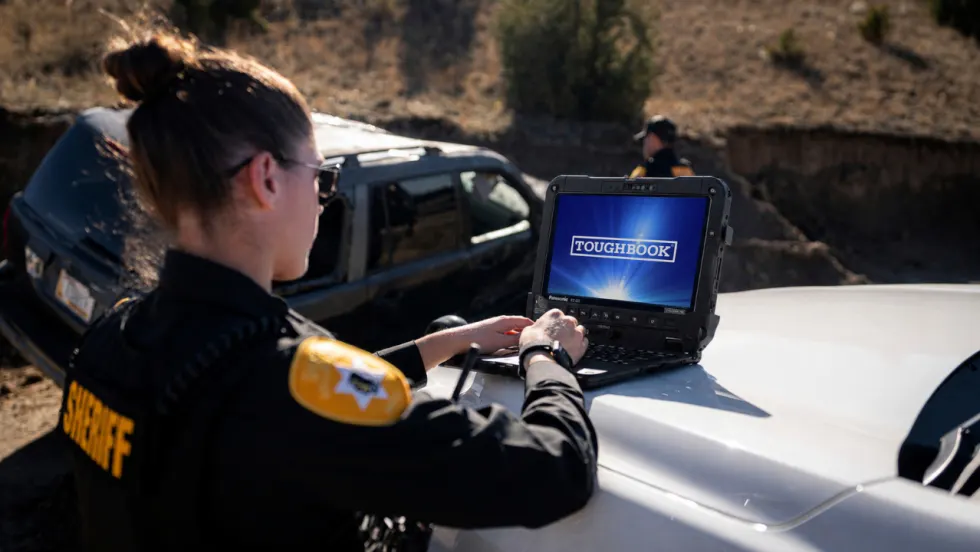
Panasonic Connect Launches the Toughbook 34 and Toughbook G3, Fully Rugged 2-in-1 Mobile Computers
Panasonic Connect has launched the Toughbook 34 and Toughbook G3 to facilitate in-vehicle dispatch, records management, and mobile command operations from any location.
Read More →

A police agency's guide to data-driven fleet management
Costs are rising and the public expects more transparency into how their tax dollars are spent. This e-book shows how police agencies can use fleet data to take control of fleet expenses while improving officer safety and demonstrating fiscal responsibility to the communities they serve.
Read More →
AI and analytics for law enforcement: Turning data into insights
Law enforcement agencies are managing more video, sensor data and digital evidence than ever before. Discover how AI and analytics can help turn that data into actionable insights that strengthen situational awareness, accelerate investigations and support more informed decisions.
Read More →
Vasco Electronics Adds Automatic Language Detection to Vasco Translator Q1
Vasco Electronics’ software update introduces hands-free language switching and expanded offline translation across 45 language pairs, empowering law enforcement, healthcare, and front-office enterprise teams
Read More →
North Miami Police Department Deploys Mark43
The North Miami Police Department has deployed Mark43 as part of its Five-Year Strategic Plan that represents its collective vision and goals for a more proactive police department, anchored by a core commitment to leveraging modern technology to enhance efficiency and public safety.
Read More →
Cellebrite Genesis for Enterprise Now Generally Available
Made available to the public sector in June, Cellebrite Genesis is serving a growing mix of national, regional, and local agencies worldwide, including some of the largest regional and metropolitan police departments. It is now available for enterprise organizations.
Read More →
2026 Vision FirstNet Users Summit to Host Emerging Leaders Training on Grassroots Advocacy for Public Safety
“Emerging Leaders Training: Understanding the Importance of Grassroots Advocacy for Public Safety," a session during the 2026 Vision FirstNet Users Summit, will offer a roadmap for unified advocacy at the federal level.
Read More →
Motorola Solutions Completes Acquisition of D-Fend Solutions
Motorola Solutions has acquired D-Fend Solutions, an industry leader in counter-drone technology. This deal provides public safety and enterprise customers with access to advanced counter-unmanned aerial systems.
Read More →