



Why Take Public Safety Data into the Cloud?
Cloud technology is a force to be reckoned with in the field of public safety and can provide secure, cost-effective solutions to meet the technological needs of law enforcement.

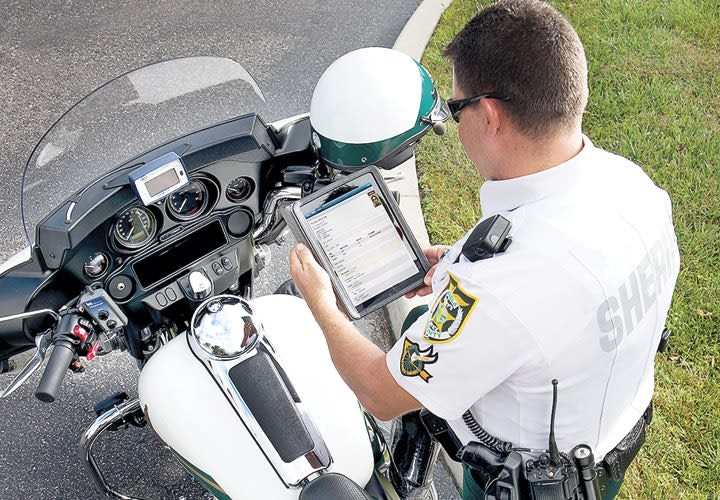
Using cloud storage, agencies of all sizes can give their officers the ability to view records and save accurate data in the field on a variety of mobile devices. (Photo: Spillman Technologies)
Technological advances in recent decades have provided law enforcement professionals with the tools needed to increase efficiency and more effectively serve the public. Agencies are now equipped to manage dispatch, records, corrections, and other key public safety functions with innovative equipment and software, storing vast amounts of crucial data either in their own facilities using on-premises software packages and servers or in the cloud.
On-premises servers are used by many law enforcement agencies nationwide. But this system is not necessarily a viable or economical option for every agency. Fortunately, an alternative has emerged for agencies that don't want to use on-premises servers, cloud technology.
What is the Cloud?
The cloud is a Web-based network of servers used to store and access data and software through the Internet.
Web-based data storage is a major component in cloud technology, as most if not all, Web-based software solutions utilize the cloud to store and access data. Some vendors utilize the cloud exclusively for this purpose and provide the participating agencies with access to a database through a desktop application. In these cases, the desktop client on each individual computer pulls data from and pushes data to the database as the user performs various tasks. This method functions similarly to programs such as iTunes and Skype. The software itself is located on the individual desktop or laptop, but remains in constant communication with data in the cloud.
An alternative option involves hosting an interface, with the data within the cloud, and then accessing both using a standard Internet browser such as Google Chrome or Mozilla Firefox. This browser-based solution operates similarly to online banking platforms or social media websites. The user simply logs in on the vendor's website to access agency data. All tasks are then performed within the browser window. Spillman Technologies' Web-based solution, Spillman Nova, falls into this category.
Benefits of the Cloud
One of the benefits of utilizing either type of Web-based solution to meet public safety needs is they are often more cost effective for agencies that might not be able to accommodate an on-premises software system. Cloud-based products often fall under a subscription-based Software-as-a-Service (SaaS) pricing structure, which allows solutions to be tailored to fit the size of the agency, eliminating unnecessary spending. Law enforcement agencies can benefit from utilizing modern technology without spending a vast portion of their budgets to purchase and maintain large physical databases on their premises.
Both desktop- and browser-based methods of cloud computing provide agencies with the benefit of consistent access to the most current public safety tools. Frequent software updates can be distributed instantly through the cloud with no hardware installation required.
For agencies using desktop-based platforms, the process of updating can be as simple as checking for and downloading updates or even configuring software settings to automatically install updates as soon as they are released by the vendor.
The process of updating browser-based software is essentially effortless for agency users because no updates are required on the user's end. The vendor simply updates the application within the cloud and every participating agency gains immediate access to the new technology, with no waiting lists and no disruptions in service.
Both methods can prove beneficial to law enforcement agencies because the SaaS format generally includes access to all software updates in the cost of the subscription. Agencies are able to remain constantly abreast of the latest technological developments, regardless of location, size, hardware, and the date the software was originally implemented.
The cloud-based solution model also allows law enforcement personnel to utilize cutting-edge technology and data wherever and whenever needed. Any device with an Internet connection can provide users with access to mission-essential information and tools while serving out in the community. Field officers can use Web-enabled laptops in their patrol vehicles to access name and vehicle records during a routine traffic stop, check on past events associated with an address before ever approaching the door, or easily type and submit reports after finishing with a call, capturing and saving accurate data while the details of the incident are fresh.
Mobile browser-based interfaces and downloadable apps make it possible to also maximize agency efficiency and data accuracy using tablets and smartphones. Thorough integration with the hardware and software built into these devices allows users to take advantage of the tools they are already carrying around in their pockets such as the camera, microphone, GPS, text-to-speech capability, and near-field communication (NFC) capability. For example, an officer could use the camera built into a smartphone to capture several images of damaged or vandalized property and then upload those images directly to the agency's database in the cloud, giving all other agency personnel instant access to the scenes in front of them. The officer could then verbally dictate a statement using the built-in microphone and text-to-speech software before uploading the completed report into the cloud.
All of these capabilities can be utilized to benefit agencies and communities, but one of the greatest benefits of cloud-based public safety technology is that it enables law enforcement agencies to take their data beyond the fields of capture and storage alone. By placing data in the ever-growing and evolving environment of the cloud, users are able to search and organize the information quickly, easily, and in innumerable configurations, maximizing the value of data they work so hard to collect.
Is It Secure?
Much of the conversation surrounding cloud computing in public safety operations has often been dominated by one question: Is data stored in the cloud secure? Law enforcement agencies have expressed concern that because cloud databases are stored and accessed through the Internet it may be difficult to maintain the level of security required by the FBI's Criminal Justice Information System (CJIS).
In 2012, the FBI stated that cloud-based technology can be utilized effectively within the sphere of public safety, as long as the software vendors maintain standards of CJIS compliancy. Those requirements initially posed challenges for vendors, but process improvements and fine-tuning in the years since have allowed law enforcement agencies to successfully adopt secure, cloud-based solutions.
Cloud technology is clearly a force to be reckoned with in the field of public safety. As software vendors provide secure, cost-effective solutions to meet the technological needs of law enforcement, agencies are constantly finding new ways to make the most of their data. While on-premises solutions meet the needs for many law enforcement agencies, the development of public safety technology within the cloud provides another viable option. It falls to each individual agency to decide what kind of solution best fits the needs of its personnel and community.
Morgan Hardy is a marketing writer for Spillman Technologies.
More Technology

A police agency's guide to data-driven fleet management
Costs are rising and the public expects more transparency into how their tax dollars are spent. This e-book shows how police agencies can use fleet data to take control of fleet expenses while improving officer safety and demonstrating fiscal responsibility to the communities they serve.
Read More →
AI and analytics for law enforcement: Turning data into insights
Law enforcement agencies are managing more video, sensor data and digital evidence than ever before. Discover how AI and analytics can help turn that data into actionable insights that strengthen situational awareness, accelerate investigations and support more informed decisions.
Read More →
Vasco Electronics Adds Automatic Language Detection to Vasco Translator Q1
Vasco Electronics’ software update introduces hands-free language switching and expanded offline translation across 45 language pairs, empowering law enforcement, healthcare, and front-office enterprise teams
Read More →

North Miami Police Department Deploys Mark43
The North Miami Police Department has deployed Mark43 as part of its Five-Year Strategic Plan that represents its collective vision and goals for a more proactive police department, anchored by a core commitment to leveraging modern technology to enhance efficiency and public safety.
Read More →
Cellebrite Genesis for Enterprise Now Generally Available
Made available to the public sector in June, Cellebrite Genesis is serving a growing mix of national, regional, and local agencies worldwide, including some of the largest regional and metropolitan police departments. It is now available for enterprise organizations.
Read More →
2026 Vision FirstNet Users Summit to Host Emerging Leaders Training on Grassroots Advocacy for Public Safety
“Emerging Leaders Training: Understanding the Importance of Grassroots Advocacy for Public Safety," a session during the 2026 Vision FirstNet Users Summit, will offer a roadmap for unified advocacy at the federal level.
Read More →
Motorola Solutions Completes Acquisition of D-Fend Solutions
Motorola Solutions has acquired D-Fend Solutions, an industry leader in counter-drone technology. This deal provides public safety and enterprise customers with access to advanced counter-unmanned aerial systems.
Read More →
ZeroEyes, Advantech & Camden Police Partner to Bring AI Gun Detection Technology to Delaware School District
ZeroEyes has partnered with Advantech and the Camden Police Department to deploy ZeroEyes’ AI gun detection and intelligent situational awareness platform at Delaware’s Caesar Rodney School District (CRSD).
Read More →
Leonardo U.S. Cyber & Security Solutions Introduces SignalTrace, the Next Evolution in Electronic Signature Detection Technology
SignalTrace reflects years of product refinement and a clearer expression of the technology’s purpose of recognizing and correlating electronic signatures in publicly broadcast wireless signals to reveal patterns, relationships, and trends that might otherwise go undetected.
Read More →
Pimloc Launches Secure File Sharing to Streamline Release of Redacted Video
Pimloc’s Secure File Sharing lets organizations deliver redacted video, audio, and documents through expiring, passcode-protected links, accelerating delivery while reducing security, compliance, and chain-of-custody risks.
Read More →