



The All Seeing Eye
You are always on video. The only question that you have to ask yourself is whose video it will be?

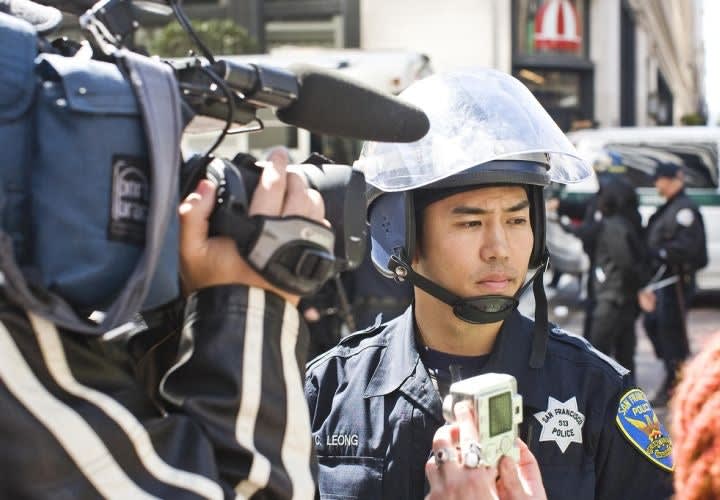
Photo courtesy of Thomas Hawk (Flickr.com).
There's a fundamental dictum in American law enforcement. It goes something like this: Regardless of whether the subjects an officer contacts are armed, the very presence of the officer brings a deadly weapon to the scene in the form of the officer's duty gun. Therefore, one of the officer's most important tasks is to safeguard his or her sidearm.
That dictum is drilled into you throughout your careers. You hear it in the academy and during in-service defensive tactics classes. There is at least one gun at every incident, it's yours, and you have to protect it.
Today there's another dictum that academy instructors and all other American law enforcement officers would also do well to remember. It goes something like this: There is always a camera watching you, and it would be better if you had one, too.
Consider the case recently in the news involving an officer from the El Monte (Calif.) Police Department. At the end of a dangerous high-speed pursuit, this officer was captured on tape delivering a kick to the head of a proned-out suspect. That video was taken from a news helicopter hovering overhead. And it quite clearly shows an officer kicking an apparently surrendering suspect in the forehead. Other aspects of this video are not so clear.
Since it was taken from a helicopter overhead, the video doesn't capture anything said by any of the participants.
Could anything said by the suspect justify a boot to the brain box?
Well, if all he said was something obscene about the officer's mother, then no. The officer might want to kick the guy quiet, but legally he wouldn't have the grounds to do so. In such a case, audio from the incident might actually be used to hang the officer.
But let's say the suspect said something like, "I've got a gun." Could that be grounds for a boot to the head? Maybe.
Let's postulate that the officer in question can articulate that he had good reason to believe the suspect's words were true, that perhaps he saw a glint of metal, or even a glint of deadly intent in the suspect's eye and the twitch of a hand. Given that totality of circumstances, would he have grounds to kick a surrendering suspect? Maybe. His administrators and possibly a jury would have to make that decision.
One problem that this officer and his attorneys face in this scenario is that the only visual evidence in the case may be the helicopter-shot footage of the officer kicking the suspect. There were—as far as we know—no other cameras on the scene.
But this incident happened away from in-car video cameras. Think how beneficial it could have been to that officer if he himself knew that he had a camera on his body and it was running at the time. It might carry the one angle of the incident that shows he had grounds to kick the suspect.
If such an incident happens a few years from now, the officer involved will likely be equipped with a body-worn video system that captures everything he sees. You can read all about these systems on page 38.
While researching our body-worn video article, we spoke to a variety of agencies that have fitted their officers with some of these systems. Not one of them reported any resistance from their officers. Their officers wanted to wear the cameras.
And with good reason. The International Association of Chiefs of Police reports that "93 percent of officers charged with misconduct are exonerated when video evidence is available." To that I'd like to add, only if the video evidence isn't shot by an amateur videographer (Rodney King), on a passenger's cell phone (Oakland BART), or by a hovering news copter (El Monte).
You are always on video. The only question that you have to ask yourself is whose video it will be? Believe me, you will be better off if the images are captured by your own body-worn or in-car video system than by another interested party. And even if another person videos you performing your duties, your official video will likely provide a better angle and a more comprehensive record of what really happened.
More Technology

A police agency's guide to data-driven fleet management
Costs are rising and the public expects more transparency into how their tax dollars are spent. This e-book shows how police agencies can use fleet data to take control of fleet expenses while improving officer safety and demonstrating fiscal responsibility to the communities they serve.
Read More →
AI and analytics for law enforcement: Turning data into insights
Law enforcement agencies are managing more video, sensor data and digital evidence than ever before. Discover how AI and analytics can help turn that data into actionable insights that strengthen situational awareness, accelerate investigations and support more informed decisions.
Read More →
Vasco Electronics Adds Automatic Language Detection to Vasco Translator Q1
Vasco Electronics’ software update introduces hands-free language switching and expanded offline translation across 45 language pairs, empowering law enforcement, healthcare, and front-office enterprise teams
Read More →

North Miami Police Department Deploys Mark43
The North Miami Police Department has deployed Mark43 as part of its Five-Year Strategic Plan that represents its collective vision and goals for a more proactive police department, anchored by a core commitment to leveraging modern technology to enhance efficiency and public safety.
Read More →
Cellebrite Genesis for Enterprise Now Generally Available
Made available to the public sector in June, Cellebrite Genesis is serving a growing mix of national, regional, and local agencies worldwide, including some of the largest regional and metropolitan police departments. It is now available for enterprise organizations.
Read More →
2026 Vision FirstNet Users Summit to Host Emerging Leaders Training on Grassroots Advocacy for Public Safety
“Emerging Leaders Training: Understanding the Importance of Grassroots Advocacy for Public Safety," a session during the 2026 Vision FirstNet Users Summit, will offer a roadmap for unified advocacy at the federal level.
Read More →
Motorola Solutions Completes Acquisition of D-Fend Solutions
Motorola Solutions has acquired D-Fend Solutions, an industry leader in counter-drone technology. This deal provides public safety and enterprise customers with access to advanced counter-unmanned aerial systems.
Read More →
ZeroEyes, Advantech & Camden Police Partner to Bring AI Gun Detection Technology to Delaware School District
ZeroEyes has partnered with Advantech and the Camden Police Department to deploy ZeroEyes’ AI gun detection and intelligent situational awareness platform at Delaware’s Caesar Rodney School District (CRSD).
Read More →
Leonardo U.S. Cyber & Security Solutions Introduces SignalTrace, the Next Evolution in Electronic Signature Detection Technology
SignalTrace reflects years of product refinement and a clearer expression of the technology’s purpose of recognizing and correlating electronic signatures in publicly broadcast wireless signals to reveal patterns, relationships, and trends that might otherwise go undetected.
Read More →
Pimloc Launches Secure File Sharing to Streamline Release of Redacted Video
Pimloc’s Secure File Sharing lets organizations deliver redacted video, audio, and documents through expiring, passcode-protected links, accelerating delivery while reducing security, compliance, and chain-of-custody risks.
Read More →