



Technology Preview: Detecting Weapons with Radio Waves
First Responder Technologies is working on a system that uses WiFi to improve the security of public buildings.

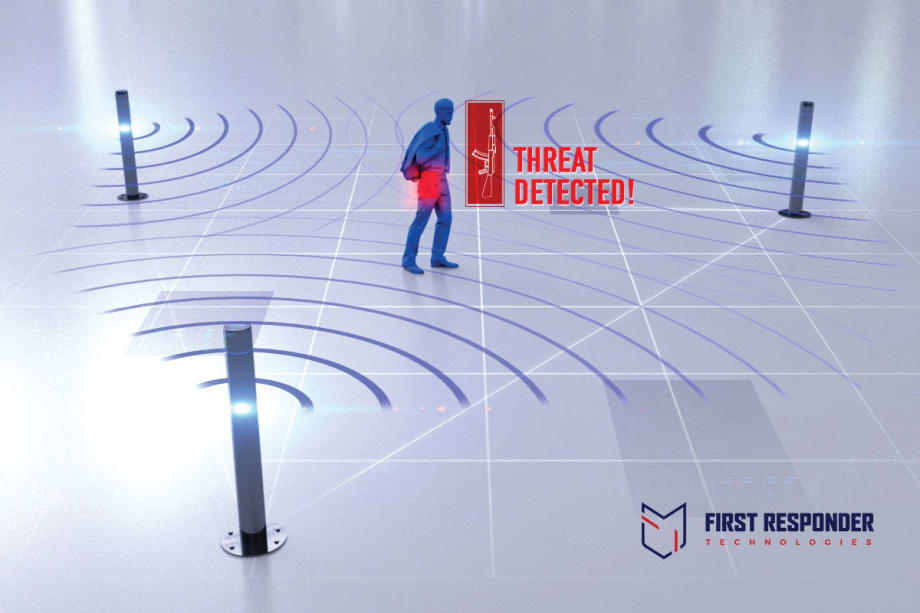
Artist rendering of how the WiFi technology licensed by First Responder Technologies can detect concealed weapons. The company hopes to have a beta product by next summer.
Image: First Responder Technologies
In the wake of the El Paso and Dayton mass shootings, many American law enforcement officers and private security professionals are asking how these attacks can be prevented or at least mitigated. Canada's First Responder Technologies believes it may have the answer, a new way of detecting concealed firearms.
The new Concealed Weapon Detection Device being developed by First Responder uses WiFi signals to detect hidden threats. The technology was developed by researchers at Rutgers University in the School of Engineering's Wireless Information Network Laboratory. First Responder recently secured exclusive rights to commercialize the concept.
Robert Delamar, CEO of First Responder Technologies, says the Rutgers research is a "very impressive feat of engineering." He likens the technology to radar. The WiFi signal is transmitted around the area being protected and when it is reflected off of a suspicious object it can alert security personnel.
First Responder says there are advantages to using WiFi instead of millimeter wave technology currently in use at many of the nation's airports. The WiFi system uses a lower frequency for better penetration of clothes, cases, and packs; there is no need for an FCC operating license to use it; and there are no known health risks, the company says on its website.
The inventor of the WiFi weapon detection technology, Yingying (Jennifer) Chen, a professor at Rutgers, believes it's a "game changer" for the security profession. "The cost will be much lower than X-ray-based systems," she says on a First Responder Technologies' video. Because of the lower cost, Chen says more facilities will have better security. "Public safety could be significantly improved," she says.
The WiFi signals can be used to detect cans, laptops, batteries inside bombs, and liquids as well as guns. But Delamar says his company's primary focus at the moment is developing a practical tool for detecting guns in areas where they should not be, especially long guns.
He envisions the system augmenting other security measures at schools and other public buildings. The First Responder system would not require additional security personnel and it would not inconvenience the public. "It will produce a detection field that people can walk through," according to Delamar. "It could look like fence posts around the building, so it's relatively inconspicuous," he explains.
Delamar says the system uses WiFi points like the ones used for internet connectivity and three access points are sufficient for covering 20 meters (66 feet) of space.
First Responder is currently working with Rutgers and the Canadian engineering firm Misty West to develop a prototype, and Delamar says he believes the company will be able to demonstrate it soon. The next step after that is a beta product, which he believes will be available for testing in summer 2020.
"This is all about finding a way to create a better perimeter detection system," Delamar says. And he realizes the urgency for such a new security concept and what it could mean for law enforcement and the American public.
How Technology Mitigates Threats at Large-Scale Events
Learn more about how technology is evolving to make large-scale events safer.

"A mass shooter is intent on killing as many people as quickly as possible," he says. "If this technology can give law enforcement and security a 10-, 15-, or 30-second heads up, that can save a lot of lives."
In addition to developing the WiFi weapons detection technology for facility security, First Responder is working on a wearable WiFi weapon detection system for law enforcement. And the company is even working on a short lifespan pepper spray. As Delamar is quick to point out, the "technologies" is in the company's name for a reason. "It's plural because we are actually developing several technologies for first responders," he says.
More Technology

A police agency's guide to data-driven fleet management
Costs are rising and the public expects more transparency into how their tax dollars are spent. This e-book shows how police agencies can use fleet data to take control of fleet expenses while improving officer safety and demonstrating fiscal responsibility to the communities they serve.
Read More →
AI and analytics for law enforcement: Turning data into insights
Law enforcement agencies are managing more video, sensor data and digital evidence than ever before. Discover how AI and analytics can help turn that data into actionable insights that strengthen situational awareness, accelerate investigations and support more informed decisions.
Read More →
Vasco Electronics Adds Automatic Language Detection to Vasco Translator Q1
Vasco Electronics’ software update introduces hands-free language switching and expanded offline translation across 45 language pairs, empowering law enforcement, healthcare, and front-office enterprise teams
Read More →

North Miami Police Department Deploys Mark43
The North Miami Police Department has deployed Mark43 as part of its Five-Year Strategic Plan that represents its collective vision and goals for a more proactive police department, anchored by a core commitment to leveraging modern technology to enhance efficiency and public safety.
Read More →
Cellebrite Genesis for Enterprise Now Generally Available
Made available to the public sector in June, Cellebrite Genesis is serving a growing mix of national, regional, and local agencies worldwide, including some of the largest regional and metropolitan police departments. It is now available for enterprise organizations.
Read More →
2026 Vision FirstNet Users Summit to Host Emerging Leaders Training on Grassroots Advocacy for Public Safety
“Emerging Leaders Training: Understanding the Importance of Grassroots Advocacy for Public Safety," a session during the 2026 Vision FirstNet Users Summit, will offer a roadmap for unified advocacy at the federal level.
Read More →
Motorola Solutions Completes Acquisition of D-Fend Solutions
Motorola Solutions has acquired D-Fend Solutions, an industry leader in counter-drone technology. This deal provides public safety and enterprise customers with access to advanced counter-unmanned aerial systems.
Read More →
ZeroEyes, Advantech & Camden Police Partner to Bring AI Gun Detection Technology to Delaware School District
ZeroEyes has partnered with Advantech and the Camden Police Department to deploy ZeroEyes’ AI gun detection and intelligent situational awareness platform at Delaware’s Caesar Rodney School District (CRSD).
Read More →
Leonardo U.S. Cyber & Security Solutions Introduces SignalTrace, the Next Evolution in Electronic Signature Detection Technology
SignalTrace reflects years of product refinement and a clearer expression of the technology’s purpose of recognizing and correlating electronic signatures in publicly broadcast wireless signals to reveal patterns, relationships, and trends that might otherwise go undetected.
Read More →
Pimloc Launches Secure File Sharing to Streamline Release of Redacted Video
Pimloc’s Secure File Sharing lets organizations deliver redacted video, audio, and documents through expiring, passcode-protected links, accelerating delivery while reducing security, compliance, and chain-of-custody risks.
Read More →