



Police Robots on Land and Sea
Some of the top police and sheriff's departments in this country have fielded robots for a variety of tasks since the 1990s. But we are now seeing a broad expansion of the types of robot tools available to law enforcement and a reimagining of what they can do.

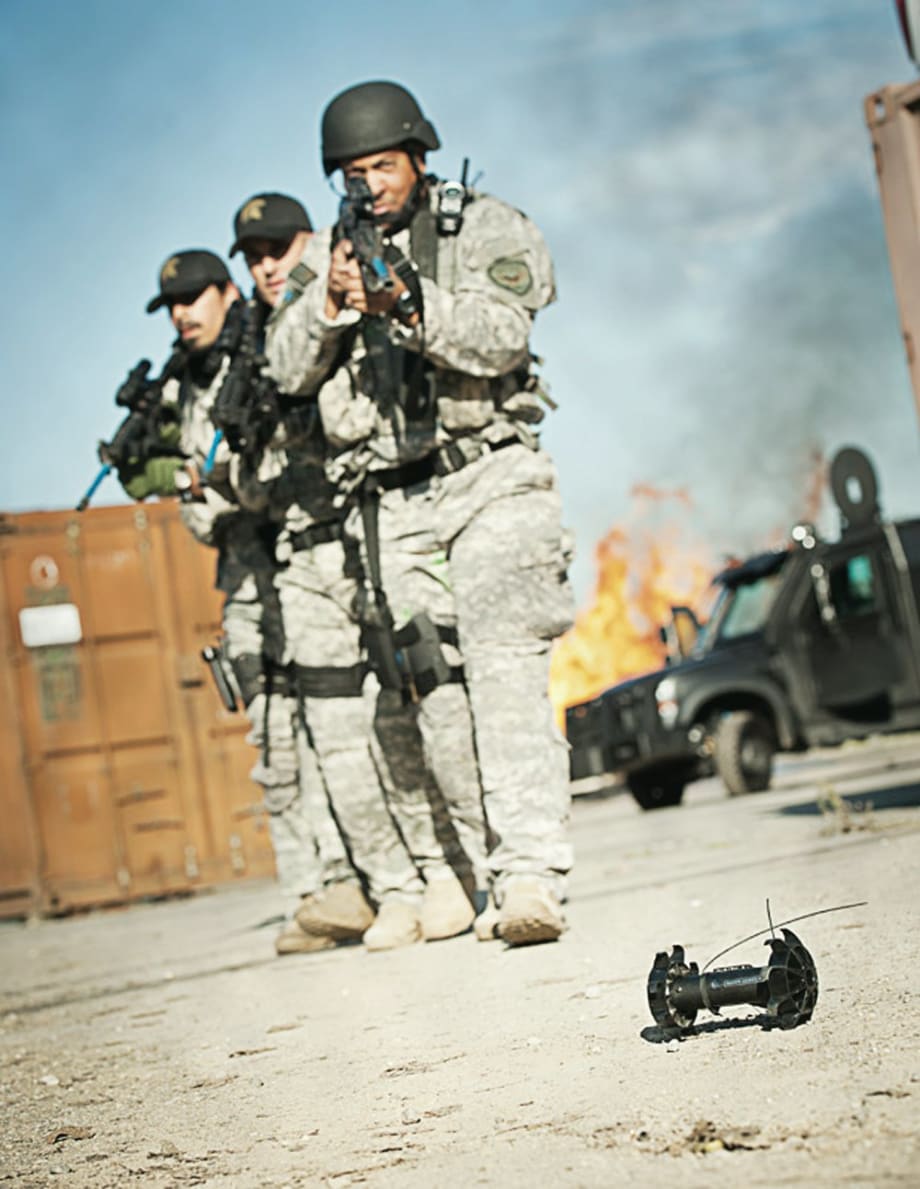
The ReconRobotics Throwbot can run ahead of a team to provide valuable intel. Photo via Recon Robotics
In the popular culture of the 20th century, the robots of the 21st century were supposed to be our maids, our soldiers, and our law enforcement officers. They were pretty much going to be bi-pedal, autonomous machines that could operate on their own with very little human oversight.
That vision hasn't come true of course. Which when you think about it is probably for the best. But robots are playing an increasingly important role in our lives. Your patrol car was at least partially built by assembly robots, some people have robot vacuum cleaners in their homes, the New Horizons probe that NASA sent all the way to Pluto was an interplanetary robot, the drones we now send to kill our enemies and harass our next door neighbors are aerial robots. And robots are now a critical tool in many law enforcement operations.
Some of the top police and sheriff's departments in this country have fielded robots for a variety of tasks since the 1990s. But we are now seeing a broad expansion of the types of robot tools available to law enforcement and a reimagining of what they can do.
Going Big
By far the largest law enforcement robot in operation today is the LAPD's BatCat, which sounds like something that Bruce Wayne should keep in his cave, but is actually a 39,000-pound remote-controlled vehicle that can be used to lift cars and tear into buildings. Built on a Caterpillar Telehandler, the BatCat (Bomb Assault Tactical Control Assessment Tool) features a hydraulic arm that can extend as much as 50 feet. The arm can be equipped with a claw, a forklift, or a bucket, depending on the mission. LAPD uses its $1 million BatCat in both barricade and bomb incidents. One of its purposes is to reduce the need for SWAT to make a dynamic entry to end barricade incidents. Another is to respond to vehicle borne IED situations.
Another unusual and very large robot is the Robotic Ballistic Shield (SWAT Bot) from Howe & Howe Technologies, makers of the military's Ripsaw unmanned tank. Howe & Howe's law enforcement vehicle is a tracked platform with a 25-horsepower engine that carries a shield capable of protecting 12 officers and can be used for breaching. The company says the SWAT Bot was developed with input from the Massachusetts State Police and the Southern Maine Regional Response Team.
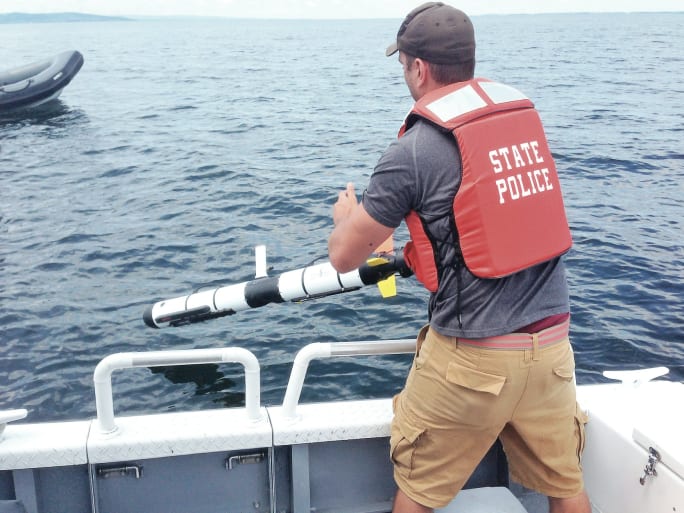
A state police officer launches the Ocean Server Technology Iver3-580 submersible robot. The Iver features side scan sonar and can operate at depths of up to 200 meters. Photo via Ocean Server
Going Small
There are a number of small, lightweight robots in use by law enforcement. These little devices are great for helping officers gain a view of what is going on in a building during a barricade incident, a search, or some other high-risk operation. And by far the most popular "microbot" in law enforcement is ReconRobotics' Throwbot XT.
If you haven't seen a Throwbot, then it's kind of hard to describe. It's basically a set of wheels, an axle with a stabilizer bar, a camera, and some antennae. Truthfully, it looks kinda strange, like a cross between a toy and an insect.
One very satisfied user of the Throwbot XT says a pair of suspects was so weirded out by the self-propelled reconnaissance tool that they didn't want any part of it. "We had this male and female who were barricaded in a house. We were set up on them downstairs. So we got out the Throwbot and tossed it up to the second floor and started running it around. Then we saw the suspects looking at it and talking about it. They were really confused by it. Three minutes later they surrendered. I think it actually spooked them," says Sgt. Mike Jerde of the Hennepin County (MN) Sheriff's Office.
Jerde, who serves on the Hennepin County SO Emergency Services Unit, says his team never goes out without the Throwbot. One member of the team carries the 8-inch-long, 1.2-pound robot in a sling pack across his tactical vest. Jerde says the robot is sometimes tethered on a length of rappelling rope to aid in recovery, and it can be tossed into the unseen areas of a building to give the team information on the room layouts and positioning of a subject or subjects before sending in officers. The tether helps the team recover the little robot.
Procedures vary based on the operation. Jerde says the team sometimes makes entry, establishes a position, and then sends the robot out for intel. Other times it has sent the robot through a window before entering the home or building.
Jerde says the Throwbot is also an excellent tool for checking out attics and crawlspaces. "We use a Search Stick to put it up in attics to get a picture of what's up there before an officer pops his head up there. It's much better than using a mirror," Jerde says.
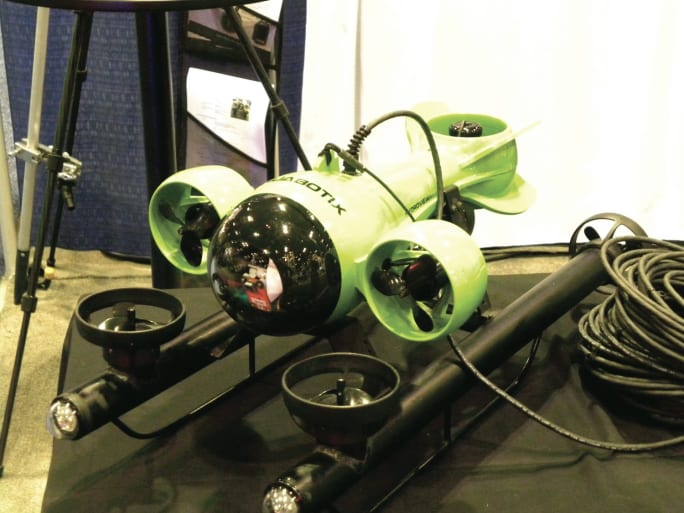
Aquabotix showed its HydroView at the 2014 IACP show. The HydroView records HD video at depths of up to 100 meters. Photo via David Griffith
Going In
In addition to its Throwbot, Hennepin County ESU also fields a tracked Icor robot that it sometimes uses on critical incident calls to breach doors and perform the kinds of tasks a little Throwbot can't do. For example, the Icor system can climb stairs on its own power, and its mechanical arms can be used to open doors and to lift and carry objects. "The Icor is a great tool that complements our Throwbot," says Jerde.
One of the most common uses for tracked robots in law enforcement is bomb response. The New Hampshire State Police Bomb Squad fields two iRobot Packbot 510s in its equipment inventory. "There's a lot of things now that we can do with that robot that we used to have to send a person downrange to do, right down to the actual disarm," says Sgt. Jeffrey Dade, commander of the NHSP bomb squad.
Dade says the NHSP bomb squad robots are also assets that are used in support of other public safety units across the state, including NHSP SWAT, local and regional SWAT, and hazmat teams. When the robots are requested by one of the other teams, the NHSP bomb techs deliver the machine and operate it at the incident scene. "The robots are not tremendously difficult to learn how to operate, but there is a learning curve," Dade says. "It just makes more sense to have a handful of dedicated operators who are very well trained and experienced run the robots. A less than experienced robot operator can take double the amount of time to complete the mission."
Most of the time the mission for the NHSP Packbots is SWAT support. Dade says the robots have helped a number of tactical teams across the state and have even helped at least one team disarm the suspects before making entry. "Being able to see into the building before making an entry, that's invaluable," Dade says. "In one barricade incident the robot revealed the suspects were passed out. So the operator just had the robot pick up the weapon and remove it from the room. Then the team went in."
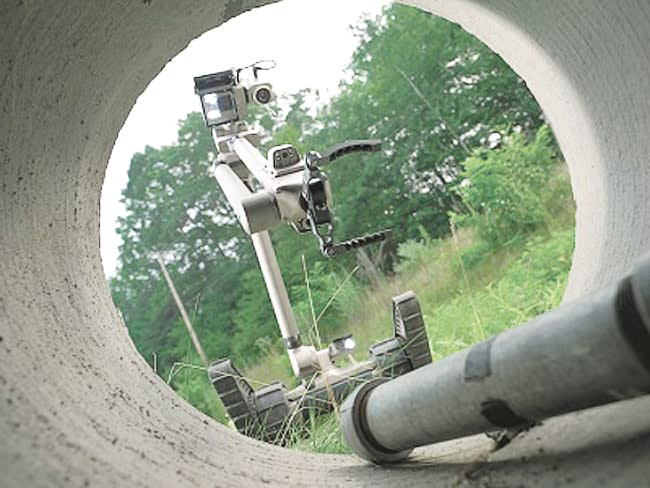
The iRobot Packbot-510 is a popular tool with bomb squads, as it can carry equipment and disrupt suspicious items. Photo via iRobot
Going Under
One of the standard reasons for using robots in any field is to send a machine where it is difficult, dangerous, or impossible to send a human. NASA shoots robots to the outer planets because it can't send humans. The nuclear power industry sends them into highly radiated areas where organic tissue would die. And bomb squads and SWAT teams send in the robots to reduce hazard to officers. The newest class of law enforcement robots also serves the purpose of helping officers go where it's difficult and sometimes dangerous to operate, under water.
Submersible drones known as remotely operated underwater vehicles (ROVs) and autonomous underwater vehicles (AUVs) are becoming important tools for some agencies. And two major manufacturers have already started marketing their submarine robots to law enforcement.
Aquabotix showed its HydroView Pro systems at the 2014 International Association of Chiefs of Police show. Powered by eight electric motors, the HydroView Pro ROV can operate at depths of up to 100 meters (330 feet) and at speeds of 3 knots. Features include a wide-angle 1080p HD camera with 32GB of memory, compact imaging/scanning sonar, and orientation, depth, and temperature sensors. The HydroView Pro can carry a two-pound payload and can be operated via a computer tablet or autonomously on auto pilot.
ReconRobotics
Ocean Server Technology's Iver3-580 is another underwater robot that is being used in law enforcement operations. The 85-pound Iver3-580 is about four feet long, looks like a tiny torpedo, and can operate at depths of up to more than 100 meters, depending on configuration. Because it can run for up to 18 hours at speeds of up to 2.5 knots, is truly autonomous, and can be set to make fixed lawn mower-style sweeps of wide areas, the Iver is an excellent tool for evidence recovery.
An Iver3-580 is currently on duty with the Michigan State Police Underwater Recovery Unit in the Great Lakes. Ocean Server Technology says the MSP's Iver3-580 features EdgeTech's 2205 sonar system, and it is rated for depths up to 200 meters.
MSP's Iver comes standard with Ocea Server's VectorMap mission planning and data presentation tool, which provides geo-registered data files that can be exported to other software analysis tools. The VectorMap program can input NOAA electronic navigational charts (ENCs) or any geo-referenced charts, maps, or photo images, allowing the operator to intuitively develop AUV missions using point-and-click navigation.
In addition to evidence recovery, the Iver is also being used by some agencies to search for bodies. In March the body of a missing San Diego State University student was recovered in La Mesa, CA's Lake Murray by San Diego County authorities using an Iver owned by Orca Maritime. The sonar capabilities of the Iver were invaluable in the search since the body was found in 60 feet of water with one foot of visibility.
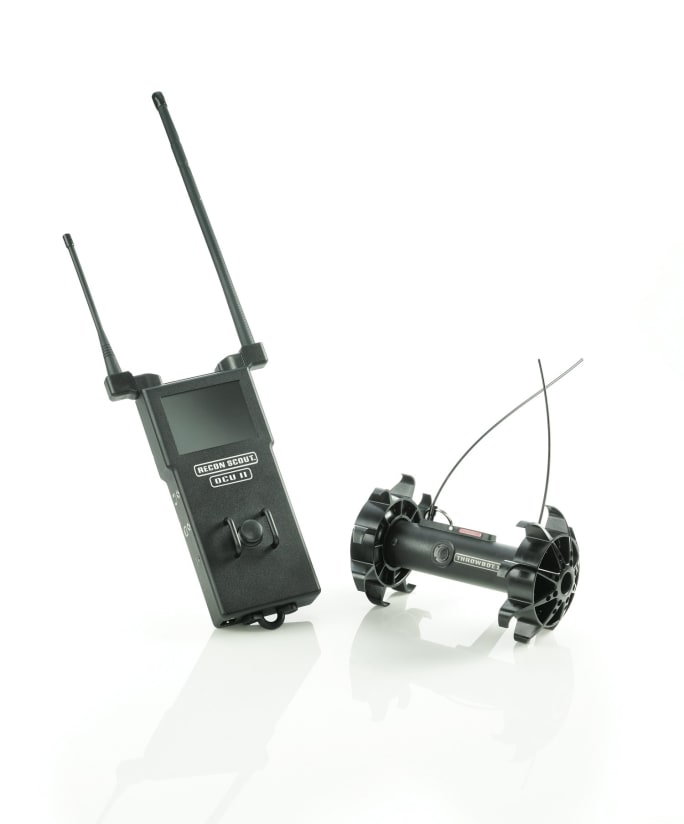
The ReconRobotics Throwbot XT is a surveillance robot. It can be thrown into a window or door or up or down stairs. Photo via ReconRobotics
More Technology
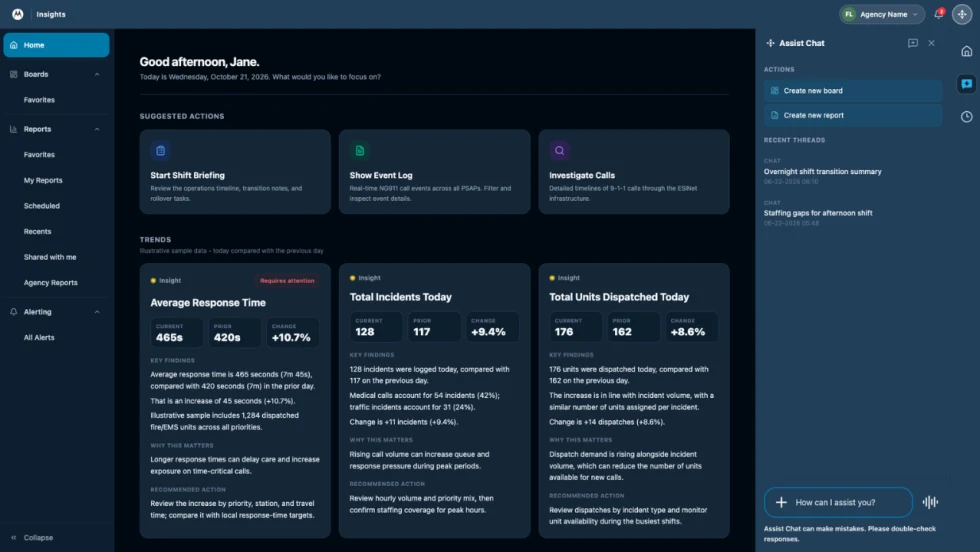
How Motorola Solutions’ New “Insights” Platform Helps Public Safety Agencies Identify Trends to Improve Their Operations
Motorola Solutions has introduced Insights, which leverages Assist, its mission-critical artificial intelligence (AI), to address these challenges and shape what’s next for public safety analytics and reporting technology.
Read More →
What Qualifies a Laptop as Rugged or Fully Rugged?
Police officers face a wide range of working conditions that can damage or even destroy a regular consumer laptop. Learn what qualifies a computer as rugged or fully rugged and why those devices are vital for law enforcement.
Read More →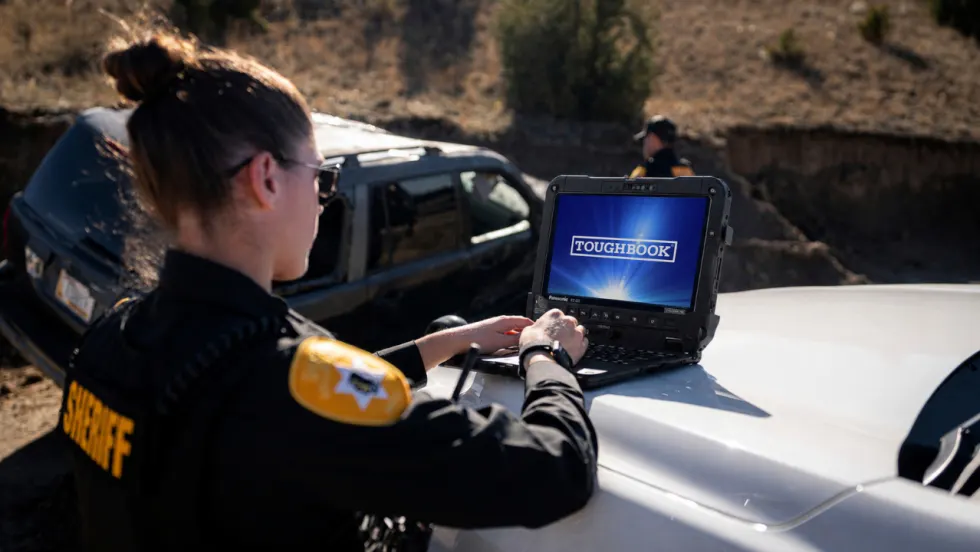
Panasonic Connect Launches the Toughbook 34 and Toughbook G3, Fully Rugged 2-in-1 Mobile Computers
Panasonic Connect has launched the Toughbook 34 and Toughbook G3 to facilitate in-vehicle dispatch, records management, and mobile command operations from any location.
Read More →
A police agency's guide to data-driven fleet management
Costs are rising and the public expects more transparency into how their tax dollars are spent. This e-book shows how police agencies can use fleet data to take control of fleet expenses while improving officer safety and demonstrating fiscal responsibility to the communities they serve.
Read More →
AI and analytics for law enforcement: Turning data into insights
Law enforcement agencies are managing more video, sensor data and digital evidence than ever before. Discover how AI and analytics can help turn that data into actionable insights that strengthen situational awareness, accelerate investigations and support more informed decisions.
Read More →
Vasco Electronics Adds Automatic Language Detection to Vasco Translator Q1
Vasco Electronics’ software update introduces hands-free language switching and expanded offline translation across 45 language pairs, empowering law enforcement, healthcare, and front-office enterprise teams
Read More →
North Miami Police Department Deploys Mark43
The North Miami Police Department has deployed Mark43 as part of its Five-Year Strategic Plan that represents its collective vision and goals for a more proactive police department, anchored by a core commitment to leveraging modern technology to enhance efficiency and public safety.
Read More →
Cellebrite Genesis for Enterprise Now Generally Available
Made available to the public sector in June, Cellebrite Genesis is serving a growing mix of national, regional, and local agencies worldwide, including some of the largest regional and metropolitan police departments. It is now available for enterprise organizations.
Read More →
2026 Vision FirstNet Users Summit to Host Emerging Leaders Training on Grassroots Advocacy for Public Safety
“Emerging Leaders Training: Understanding the Importance of Grassroots Advocacy for Public Safety," a session during the 2026 Vision FirstNet Users Summit, will offer a roadmap for unified advocacy at the federal level.
Read More →
Motorola Solutions Completes Acquisition of D-Fend Solutions
Motorola Solutions has acquired D-Fend Solutions, an industry leader in counter-drone technology. This deal provides public safety and enterprise customers with access to advanced counter-unmanned aerial systems.
Read More →