



LPR Under Fire
Many state legislators are listening to the ACLU and others who want to rein in LPR operations. New Hampshire already bans the use of the technology except at toll stations, and other states are considering legislation that to some degree would change the way agencies use LPR.

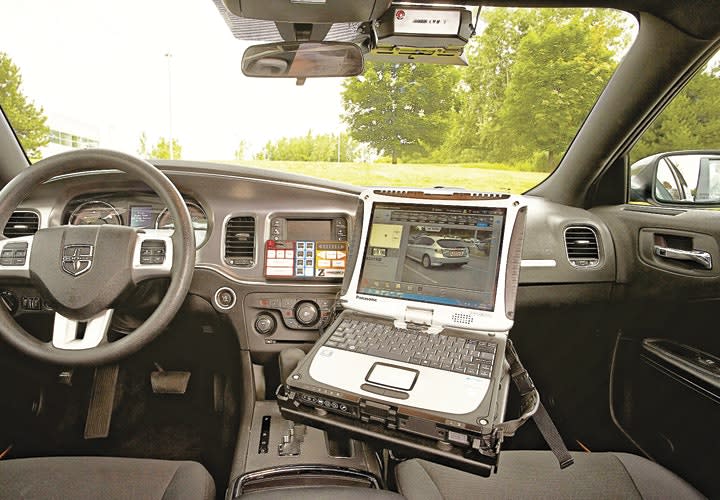
Photo: Genetec
Since its development in the United Kingdom in the 1970s, automatic license plate recognition—abbreviated both as ALPR and LPR—has been one of the greatest advances in crime-fighting technology since fingerprint analysis. But now law enforcement use of LPR systems and databases in the United States is raising concerns about privacy as more and more agencies acquire the systems.
The United States was actually late to the party when it comes to use of LPR. And the reason for that is easily understood when you compare the simple number plates on European vehicles with the more elaborate and often decorative license tags used in the States.
Adoption of LPR systems by local American law enforcement agencies began about 10 years ago and many agencies are still not fielding the systems because of legal restrictions, budget issues, or lack of perceived need.
Large agencies were among the first to equip their patrol vehicles with LPR systems, and their record of success has been remarkable. LPR has been instrumental in capturing murderers and terrorists as well as locating wandering Alzheimer's patients and missing children.
Earlier this year the Department of Homeland Security announced that it was going to build a nationwide LPR database. The timing for such an announcement could not have been worse. Privacy advocates were seething at the feds because of the NSA revelations of Edward Snowden, and the LPR database was characterized as a government invasion of privacy by the Electronic Frontier Foundation and the American Civil Liberties Union. The project was shelved.
Some law enforcement experts argue that was a mistake. They say the ability to track license plates was critical in the investigations of the attempted 2010 terror bombing of Times Square and last April's Boston Marathon bombing.
LPR industry leaders also argue that use of LPR as a law enforcement tool is not a violation of privacy or in any way an abridgement of anyone's Fourth Amendment rights. They say license plate numbers are publicly available information. And they stress that identifying someone by his or her license plate is a two-step process that requires both capture of the tag information and access to registration information, and access to the registration information is already restricted by the federal Driver's Privacy Protection Act.
Brian Shockley, vice president of Vigilant Solutions, told FoxNews.com that the privacy advocates and the public should be more concerned about invasions of privacy from social media than from LPR. "The data collected is completely anonymous and there is no identifiable information," he said. "Facebook and Twitter present a bigger privacy issue."
Unfortunately, law enforcement users and industry experts are not the loudest voices in this debate. Many state legislators are listening to the ACLU and others who want to rein in LPR operations. New Hampshire already bans the use of the technology except at toll stations, and other states are considering legislation that to some degree would change the way agencies use LPR.
One particularly sticky issue is how long agencies keep captured license plate data that is not being used in active investigations. Some retain this data for three years and some for 30 days. Retention policies can even differ wildly from agency to agency within the same state. Which is why even proponents of LPR as a crime-fighting tool say it would be a good idea for law enforcement agencies to come to a consensus on this issue.
Another major concern raised by privacy advocates is the sale of LPR data to private companies such as repossession agencies by LPR vendors. Industry leaders say this doesn't happen. They add that commercial LPR data is actually used by law enforcement, not the other way around.
Vigilant Solutions operates the National Vehicle Location Service (NVLS), which contains LPR data captured from both law enforcement and private sources. But the company states in no uncertain terms that use of NVLS data is restricted to law enforcement access only.
John Chigos, CEO of PlateSmart, advocates another solution. He believes LPR companies should get out of the database maintenance business entirely. "At PlateSmart we never touch the data," he says. "It flows directly from NCIC and state and local databases. We believe law enforcement should lock down its data and not allow it to be used for any other purposes."
So far there are no uniform policies regarding use of law enforcement LPR data and its retention, but the International Association of Chiefs of Police wants that to change. The IACP issued what it calls a "Technology Policy Framework" in January. This policy paper covers a variety of advanced law enforcement tools, including LPR, and it includes a nine-point statement of principles intended to help local agencies draft policy on such issues as privacy, transparency, data retention, and access to the data.
Experts say it would be a good idea for agencies that don't have such policies to get them in place quickly. Otherwise politicians may draft their policies for them.
Or the courts could do it. There have yet to be any significant court rulings specifically involving LPR. However, privacy advocates argue that the 2012 case of U.S. v. Jones that covers use of GPS tracking during investigations may apply, especially if law enforcement uses LPR to track a person's movements over an extended period of time.
Even if the use of LPR is regulated by policy, legislation, and the courts, it will likely remain a tool in the law enforcement kit. Privacy advocates like the ACLU admit that LPR used properly is a vital crime-fighting technology. And PlateSmart's Chigos says LPR is one of the best officer safety aids ever deployed by American law enforcement. "When making a stop (an officer with access to LPR data) knows if the vehicle is stolen or if it is the subject of a BOLO. That saves officer lives," he says.
More Technology

A police agency's guide to data-driven fleet management
Costs are rising and the public expects more transparency into how their tax dollars are spent. This e-book shows how police agencies can use fleet data to take control of fleet expenses while improving officer safety and demonstrating fiscal responsibility to the communities they serve.
Read More →
AI and analytics for law enforcement: Turning data into insights
Law enforcement agencies are managing more video, sensor data and digital evidence than ever before. Discover how AI and analytics can help turn that data into actionable insights that strengthen situational awareness, accelerate investigations and support more informed decisions.
Read More →
Vasco Electronics Adds Automatic Language Detection to Vasco Translator Q1
Vasco Electronics’ software update introduces hands-free language switching and expanded offline translation across 45 language pairs, empowering law enforcement, healthcare, and front-office enterprise teams
Read More →

North Miami Police Department Deploys Mark43
The North Miami Police Department has deployed Mark43 as part of its Five-Year Strategic Plan that represents its collective vision and goals for a more proactive police department, anchored by a core commitment to leveraging modern technology to enhance efficiency and public safety.
Read More →
Cellebrite Genesis for Enterprise Now Generally Available
Made available to the public sector in June, Cellebrite Genesis is serving a growing mix of national, regional, and local agencies worldwide, including some of the largest regional and metropolitan police departments. It is now available for enterprise organizations.
Read More →
2026 Vision FirstNet Users Summit to Host Emerging Leaders Training on Grassroots Advocacy for Public Safety
“Emerging Leaders Training: Understanding the Importance of Grassroots Advocacy for Public Safety," a session during the 2026 Vision FirstNet Users Summit, will offer a roadmap for unified advocacy at the federal level.
Read More →
Motorola Solutions Completes Acquisition of D-Fend Solutions
Motorola Solutions has acquired D-Fend Solutions, an industry leader in counter-drone technology. This deal provides public safety and enterprise customers with access to advanced counter-unmanned aerial systems.
Read More →
ZeroEyes, Advantech & Camden Police Partner to Bring AI Gun Detection Technology to Delaware School District
ZeroEyes has partnered with Advantech and the Camden Police Department to deploy ZeroEyes’ AI gun detection and intelligent situational awareness platform at Delaware’s Caesar Rodney School District (CRSD).
Read More →
Leonardo U.S. Cyber & Security Solutions Introduces SignalTrace, the Next Evolution in Electronic Signature Detection Technology
SignalTrace reflects years of product refinement and a clearer expression of the technology’s purpose of recognizing and correlating electronic signatures in publicly broadcast wireless signals to reveal patterns, relationships, and trends that might otherwise go undetected.
Read More →
Pimloc Launches Secure File Sharing to Streamline Release of Redacted Video
Pimloc’s Secure File Sharing lets organizations deliver redacted video, audio, and documents through expiring, passcode-protected links, accelerating delivery while reducing security, compliance, and chain-of-custody risks.
Read More →