



Lasers: In the Legal Crosshairs
The implication was clear: if laser would display target speeds for a stationary wall, what other errors were possible?

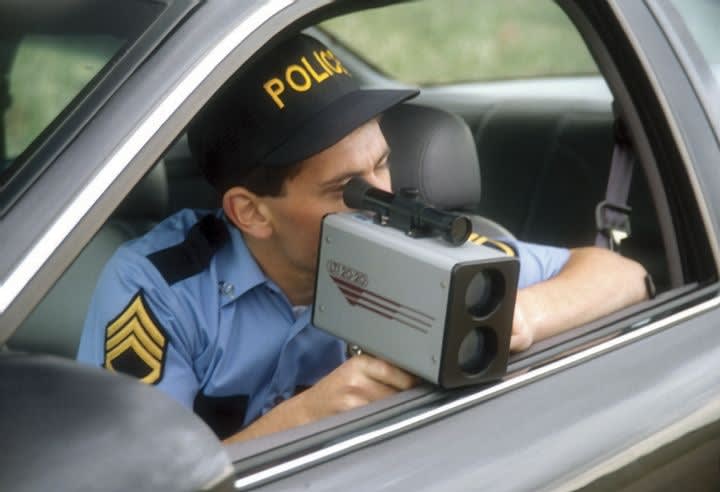
Students of history - including police and prosecutors - are well aware that when a new type of speed-measuring technology hits the street, court challenges to its accuracy won't be far behind. And until a case reaches a high-profile state superior court and is granted judicial notice, prosecutors are expected to produce expert witnesses at each trial to testify to the validity of its theory of operation.
At the time radar was introduced in the early 1950s, the Doppler Principle that formed the cornerstone of its operation had long been accepted by the scientific community. But it would still take a few years until judicial notice was finally taken in the case of New Jersey v. Dantonio. Another decade rolled by before tuning forks finally passed judicial muster in 1966. And the last precedent case of any real significance wasn't handed down until 1984, more than a quarter century after cops started using radar.
After its introduction in 1991, the speed laser appeared to be somehow exempt from the decades-long vetting process that greeted radar. By the spring of 1992, courts in six states had already granted judicial notice to speed laser. At that time, lasers were the darlings of the technological world. Lasers were commonplace in everything from precision munitions used in Operation Desert Storm, to CD players, to medical equipment. And with so much positive press coverage of laser technology, it seemed that court approval of lasers could only continue.
But the legal honeymoon was about to end.
Fittingly, the speed laser's big day in court occurred in the same state that was first to take judicial notice of radar: New Jersey. A defendant - popped with a laser by a state trooper - contested his speeding ticket. The laser in this instance, a Laser Technologies Inc. (LTI) 20-20 Marksman, had passed the required NHTSA tests and was on the CPL approved-product list, but Superior Court Judge Reginald Stanton wanted hard evidence proving the laser's reliability.
Arguments for reliability in that case took a major hit when, during a recess, one of the defense's expert witnesses hefted a Marksman and squeezed the trigger as he panned it across a back wall. A 4-mph target speed appeared. He repeated the feat twice more with the same results. The implication was clear: if laser would display target speeds for a stationary wall, what other errors were possible?
The prosecution's expert witnesses cried foul, knowing that the phenomenon, technically known as "sweep error," can be induced in any properly designed speed laser. All modern speed lasers determine target speeds by directing a burst of electromagnetic pulses at a target, and a portion of that burst is reflected back to the laser. With the round-trip elapsed time noted and the knowledge that the pulses travel at the speed of light (about 186,000 miles per second), range can be calculated.
When the target is in motion, the distance to the laser is changing. If a constant elapsed time between laser pulses is maintained, the laser can calculate speed by comparing the target's range from one pulse to the next. The entire process takes about one-third of a second.
But suppose the laser wobbles slightly during this calculation, shifting the point of aim from a vehicle's front bumper to the windshield header, a distance of perhaps four or five feet in a passenger car. The variation in distance will result in an incorrect target speed. Laser designers recognize this and use error-trapping algorithms to guard against the possibility. For example, the LTI laser's microcomputer does not display speeds and issues an error message when sweep error is detected. Other lasers collect a longer sampling before displaying a speed as a way to combat sweep error.
Trouble is, a laser in the hands of an expert, being panned very smoothly along a wall, may accept the relatively constant change in distance as legitimate and display a speed, as it did in the New Jersey case. Prosecution experts explained this phenomenon to the judge and described how error-trapping software prevents its occurrence in the real world.
Fine, said the judge, and he invited LTI to submit its error-trapping software for review. This posed a dilemma for LTI; the company was confident of the superiority of its software but also aware that by handing over proprietary data for public scrutiny, that data could be accessible to rival firms. LTI declined the offer.
Too bad, said the judge, who declared that the unit's software had not been scientifically proven to his satisfaction. "After considering all of the proofs and the analysis and the argument presented, I am satisfied that the general concept of using lasers to measure speed is widely accepted in the relevant scientific communities and is valid," he said. "I am, however, not satisfied that the laser speed-detector device is accurate and reliable enough to be used for law enforcement purposes."
Judge Stanton went on to note that he may have placed less weight on the software had there been more operational testing of the laser speed detector.
"Under actual highway conditions, we might be able to accept the detector as being reliable even though we did not have complete details about the way in which the error-trapping procedures are designed and programmed," he wrote.[PAGEBREAK]
But up to that time, no U.S. department had conducted extensive tests of any speed laser under real-world conditions. And Stanton was the first judge in the nation to request such data. Stanton declined to admit the results from several international tests, including that of the stringent German PTB.
Reluctantly, Stanton decided in favor of the defendant, but not before encouraging the prosecution to mount an effort to put together an operational field-testing program and return to court with the results.
Help wasn't hard to find. Both the New Jersey State Police and the New Jersey Department of Transportation quickly signed on to assist. It was decided to compare the laser to the standard issue State Police radar as well as to the DOT's weigh-in-motion (WIM) system used to weigh heavy trucks on the fly, itself calibrated using Doppler radar.
The goal was to answer two fundamental questions: Did the laser tend to produce the same average level of target speeds as the control methods, and on any individual measurement, how much variance was there between the laser and the others' target speeds?
To find out, the NJSP clocked a total of 1,908 targets using all three types of speed-measuring hardware. The conclusions that landed on Judge Stanton's desk included:
"...on the average, laser speed measurements tend to be lower than the control radar measurements by less than one-quarter mile per hour. Although this is statistically significant, a difference this small probably would not be regarded as practically significant from the standpoint of the intended use of this [laser] equipment."
And in comparison to the WIM: "... similar to the radar data, the difference [in target speeds] is relatively small (average of -0.418 mph, or less than one-half mile per hour) and in the favor of the motorist (negative average value, meaning the laser device tends to read lower than the WIM measurements based on Doppler radar). In this case, 14 out of the total 799 laser measurements exceeded the WIM measurements by more than 1.0 mph."
Armed with the report, the prosecution approached a receptive Judge Stanton. After reviewing it the judge issued his opinion. "I end up being impressed by the fact that when we combine the results for the comparisons with both the WIM system and radar, we have only 16 cases out of 1,908 in which the speed measurements produced by the laser speed detector exceeded the measure produced by the comparison device of more than one mile per hour. That amounts to 0.8 percent. I also note that the speed measurement produced by the laser speed detector never exceeded by more than one mile per hour the measurements produced by the track timer, the PEEK 241 or the fifth wheel.
"...I am satisfied from the totality of the evidence presented to me that the laser speed detector produces reasonably uniform and reasonably reliable measurements of the speed of motor vehicles under conditions likely to be present on New Jersey highways when the detector is used for law enforcement purposes," he concluded.
Case closed.
Or was it? Even if the judge was satisfied, to the state cops and DOT the issue of sweep error remained unresolved. They devised an exhaustive series of nine different tests and headed back out into the field.
And did they notice any sweep error? Nyet, nada, not even close. Satisfied, they folded their tents and went home, later issuing a report nearly twice as lengthy as their first effort.
The landmark New Jersey case was laser's first big win in court and the resulting field tests were the first public acknowledgement of the speed laser's accuracy. And despite the passage of five years and countless court cases, no similar tests have been requested by judges.
Craig Peterson has lent his expertise on vehicles to POLICE in the past and joins us again after a two-year absence from our pages.
More Technology

A police agency's guide to data-driven fleet management
Costs are rising and the public expects more transparency into how their tax dollars are spent. This e-book shows how police agencies can use fleet data to take control of fleet expenses while improving officer safety and demonstrating fiscal responsibility to the communities they serve.
Read More →
AI and analytics for law enforcement: Turning data into insights
Law enforcement agencies are managing more video, sensor data and digital evidence than ever before. Discover how AI and analytics can help turn that data into actionable insights that strengthen situational awareness, accelerate investigations and support more informed decisions.
Read More →
Vasco Electronics Adds Automatic Language Detection to Vasco Translator Q1
Vasco Electronics’ software update introduces hands-free language switching and expanded offline translation across 45 language pairs, empowering law enforcement, healthcare, and front-office enterprise teams
Read More →

North Miami Police Department Deploys Mark43
The North Miami Police Department has deployed Mark43 as part of its Five-Year Strategic Plan that represents its collective vision and goals for a more proactive police department, anchored by a core commitment to leveraging modern technology to enhance efficiency and public safety.
Read More →
Cellebrite Genesis for Enterprise Now Generally Available
Made available to the public sector in June, Cellebrite Genesis is serving a growing mix of national, regional, and local agencies worldwide, including some of the largest regional and metropolitan police departments. It is now available for enterprise organizations.
Read More →
2026 Vision FirstNet Users Summit to Host Emerging Leaders Training on Grassroots Advocacy for Public Safety
“Emerging Leaders Training: Understanding the Importance of Grassroots Advocacy for Public Safety," a session during the 2026 Vision FirstNet Users Summit, will offer a roadmap for unified advocacy at the federal level.
Read More →
Motorola Solutions Completes Acquisition of D-Fend Solutions
Motorola Solutions has acquired D-Fend Solutions, an industry leader in counter-drone technology. This deal provides public safety and enterprise customers with access to advanced counter-unmanned aerial systems.
Read More →
ZeroEyes, Advantech & Camden Police Partner to Bring AI Gun Detection Technology to Delaware School District
ZeroEyes has partnered with Advantech and the Camden Police Department to deploy ZeroEyes’ AI gun detection and intelligent situational awareness platform at Delaware’s Caesar Rodney School District (CRSD).
Read More →
Leonardo U.S. Cyber & Security Solutions Introduces SignalTrace, the Next Evolution in Electronic Signature Detection Technology
SignalTrace reflects years of product refinement and a clearer expression of the technology’s purpose of recognizing and correlating electronic signatures in publicly broadcast wireless signals to reveal patterns, relationships, and trends that might otherwise go undetected.
Read More →
Pimloc Launches Secure File Sharing to Streamline Release of Redacted Video
Pimloc’s Secure File Sharing lets organizations deliver redacted video, audio, and documents through expiring, passcode-protected links, accelerating delivery while reducing security, compliance, and chain-of-custody risks.
Read More →