



Image Security Guard
Lexar’s new LockTight security system helps preserve the chain of evidence for digital photography.

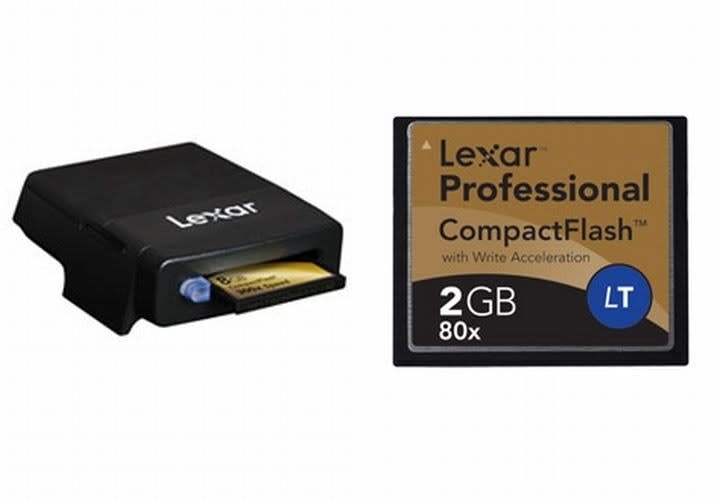
The LockTight media can only be read by the proprietary LockTight card reader. The reader intefaces with the PC via FireWire. Lexar LockTight CompactFlash cards are signified by the "Lt" logo. The cards are professional-quality digital media, so they're not cheap.
As a major crimes detective, forensic photographer, and crime scene investigator, I have often been asked to provide assistance to law enforcement agencies that were transitioning to digital imaging for evidence photography. One of the most common questions that I have heard in this capacity is as you might guess, “Are digital images accepted in court?”
The simple answer is, “Yes.” I am not aware of any court case where a judge has denied admission of digital photographs into evidence based solely on the technology used to capture the images. That said, it’s important that the law enforcement community establish standard operating procedures that preserve the chain of evidence and the integrity of the captured data so that digital images will continue to be accepted in court.
A critical concern in this area is image integrity. Anybody who has ever seen Adobe Photoshop knows that digital images can be manipulated very easily by anyone with a decent computer and a minimal investment in learning the program.
So if we are going to use digital images in court, we have to find a way to prevent any image manipulation, at least until the images are transferred to archival storage and working copies are made for enhancement purposes. And we also have to have a way to prove the integrity of the images in court.
The need for law enforcement to have a tool for securing forensic images and demonstrating their veracity in court is well know among digital photography companies. And a number of these companies have tried to address the issue. The latest technology in this category is the Lexar LockTight system.
LockTight is a unique solution that provides card-level access control to help guarantee image integrity. Simply put, the LockTight system makes certain that no unauthorized users can access images stored on a LockTight-enabled CompactFlash card. If you can’t access the images, you can’t alter them.
System Overview
The LockTight system consists of four components: a digital camera, a dedicated CompactFlash card, a special card reader, and the LockTight software package.
LockTight utilizes an authorization process based on the 160-bit HMAC encryption algorithm. Unless you work for the NSA or in digital file security, that probably doesn’t mean very much to you.
So, let’s simplify things a bit. The level of encryption afforded by the LockTight system is really secure, and that means that the data on a LockTight card is “locked” until the authorization process occurs between the LockTight card and either the camera or computer trying to access the card.
Let me explain that last sentence. The LockTight system isn’t an image-authentication process. Data on the card isn’t encrypted. Instead, LockTight controls access to the data stored on the card. Because the image data isn’t encrypted, it’s not changed or altered in any way.
The memory card is “unlocked” by entering an approved user name and password. This lets the user access the camera’s CompactFlash card in the LockTight reader. Once access is granted, the CompactFlash card shows up as a normal drive on the user’s computer desktop, allowing data to be transferred to archival storage per the agency’s standard operating procedures.
Currently, the Nikon D2X and D2Hs are the only digital cameras compatible with the LockTight system. (See “Cameras That Work With the LockTight System” in Sidebar below.) Lexar plans on adding additional new cameras in the future.
Lexar LockTight memory cards comprise the second component of the LockTight system. The LockTight memory cards are Type I CompactFlash cards available in sizes from 512MB to 4GB. This is high-quality digital media. The LockTight CompactFlash cards are based on Lexar’s professional 80X speed cards, which are highly regarded among professional photographers.
Unfortunately, professional quality media is not cheap. Expect to pay about twice as much for LockTight cards compared with standard CompactFlash cards.
Security is part of what you are paying for. The LockTight CompactFlash cards contain proprietary software and hardware that allow the cards to be accessed only by a LockTight-enabled card reader and LockTight software. Also, LockTight memory cards can only be used in cameras that have been “keyed” to the memory card. The data stored on the cards cannot be read by non-LockTight card readers.
Once the digital image data is stored on the memory card, the special LockTight card reader must be used to access the data. The LockTight card reader features a high-speed FireWire interface to speed image transfer to the computer, which makes a real difference when you’re transferring 4GB of image data off your card into a PC.
The “lock” part of the LockTight system is Lexar’s proprietary software. The software has two parts: LockTight Admin and LockTight Access. LockTight Admin allows the system administrator to manage the LockTight memory cards, cameras, and system users. LockTight Access grants approved personnel access to selected memory cards. LockTight Admin and LockTight Access are included with the LockTight hardware.
[PAGEBREAK]
Using the System
Over the four-month period I used the LockTight system I found it to be intuitively designed and easy to use. Let me walk you through the process.
First, set yourself up as the system administrator. This will allow you to add cards, cameras, and users. Once the software is installed on the host computer and the card reader is plugged in via a FireWire cable, insert a LockTight CompactFlash card in the reader and you will automatically be prompted to name the memory card. Now, connect a LockTight-compatible camera like the Nikon D2X to your computer via a USB cable.
The LockTight software will recognize that a compatible camera is connected and prompt you to name the camera. Now you can add system users, giving each user a unique password.
At this point cameras and users need to be associated with specific memory cards. Accomplishing this task is easy. It’s just a matter of dragging and dropping users and cameras to the selected memory cards. The system administrator controls which cards can be used with which cameras and users.
Once a LockTight memory card has been “keyed” to a specific camera, the camera will “see” the LockTight card as a normal memory card. When you’re ready to transfer images from the card to the computer, simply insert the memory card into the LockTight reader, which is connected to the host computer.
Here’s where the LockTight Access software comes into play. When you insert a card in the reader, it won’t allow you access unless you enter an approved user ID and password. Only then will the computer recognize the memory card and allow the images to be transferred to the computer.
The LockTight system is flexible enough to allow agencies to choose who can access specific CompactFlash cards. For example, depending on your agency’s standard operating procedures, access can be limited to only evidence technicians who routinely download the digital files, or the photographers themselves can access the system and download the images to the department’s secure server or network.
My Evaluation
The Lexar LockTight system works as promised. It limits access to sensitive data contained on LockTight enabled CompactFlash cards. The LockTight system isn’t a replacement for well-written standard operating procedures. However, agencies utilizing LockTight technology will benefit from this added layer of security.
For a modest price and minimal workflow impact, Lexar LockTight can help strengthen image integrity, therefore ensuring a tight chain of custody. The downside is that only agencies currently using or considering the purchase of the Nikon D2X or D2Hs can use the technology. Let’s hope Lexar expands the supported cameras.
David Spraggs is a detective and firearms instructor with the Boulder (Colo.) Police Department. A Police Advisory Board member, Det. Spraggs teaches forensic photography and crime scene investigations.
[SIDEBAR]
Cameras That Work With the LockTight System
Although I would like to see more cameras made compatible with LockTight, I can say that Lexar chose two excellent cameras for its rollout of the LockTight system.
The Nikon D2X, with a suggested retail of $4,999 for just the body, is among the new crop of high-resolution professional digital SLR (single lens reflex) cameras. I’ve been lucky enough to use a D2X for forensic and crime scene photography over the last eight months, and I have to say that the camera’s 12.4-megapixel DX-sized CMOS sensor provides a level of detail and color accuracy previously unattainable in digital cameras at this price point. The D2X is well suited for critical forensic work, such as capturing fingerprints, shoe impressions, and tire impressions, as well as general crime scene photography.
Although relatively expensive, the D2X is a good value. The camera boasts an environmentally sealed magnesium body, high-capacity lithium-ion battery system, advanced flash system, and compatibility with the entire Nikon lens system.
The other camera that’s compatible with the LockTight system is the Nikon D2Hs. I haven’t personally used this camera, but the specs from Nikon show that it’s a professional-quality digital SLR with a lot of great features. The D2Hs is designed for photojournalists and sports photographers. So it has a 4.1-megapixel sensor that captures images very quickly. For law enforcement, this camera is well suited for surveillance photography.
Lexar LockTight Image Security
www.lexar.com
More Patrol

Adept Armor Introduces Two New Rifle Plates
Adept Armor has launched two new Level IV ballistic plates, the Emperor and the Archon Mark 2, which brings Adept Armor’s new Quatroid ceramic to the high-threat, performance-value center of the range at 5.2 pounds.
Read More →
POLICE Product Test: Benchmade Bailout
The Benchmade Bailout is a slim, lightweight carry knife with a deep-ride pocket clip and comes in a variety of blade steels and scales. Here is a detailed review of the Taiga Green Bailout, released earlier this year.
Read More →
NLEOMF Announces July 2026 Officer of the Month
NLEOMF honored a Michigan deputy sheriff as the July 2026 Officer of the Month for rescuing a trapped driver from a burning vehicle following a Fourth of July crash.
Read More →
Streamlight to Showcase Newest Lighting Products at National Safety Council’s Safety Congress & Expo 2026
Streamlight will showcase its latest lights, including the Portable Scene Light III and the LiteBox 1Million, at the 2026 National Safety Council (NSC) Safety Congress & Expo.
Read More →
The 2027 World Police & Fire Games Set for Perth, Australia
The 2027 World Police & Fire Games (WPFG) will take place in Perth, Western Australia, from Friday, March 12 through Sunday, March 21, 2027.
Read More →
5.11 Partners with National Fallen Firefighters Foundation to Support #ForThe343
5.11 has joined the nationwide movement honoring the 343 New York City Fire Department firefighters lost on Sept. 11, 2001.
Read More →
Team Wendy Announces Title Sponsorship of the Jorge Pastore Foundation
Team Wendy’s 3-year partnership with the Jorge Pastore Foundation expands access to programs that strengthen those who serve.
Read More →
National Law Enforcement Memorial and Museum Hosting 9/11 25th-Year Commemoration Ceremony
The National Law Enforcement Memorial and Museum is hosting a 9/11 25th Year Commemoration Ceremony on Sept. 11 at 4 p.m.
Read More →
National Law Enforcement Officers Memorial Fund Announces June 2026 Officers of the Month
The National Law Enforcement Officers Memorial Fund (NLEOMF) named 15 officers of the Chico Police Department (California) as the Officers of the Month for June 2026 for their roles in responding to an active-shooter incident at a public library.
Read More →
Team Wendy App Creates New Digital Hub for Helmet Owners
The Team Wendy Community App provides one location for warranty registration, size-fit tools, product updates, and community connection. For helmet owners, the new app creates a simpler path to the information and tools that matter most.
Read More →