



FirstNet and the Broadband Future
Today, FirstNet is finally becoming more than just a public safety pipedream. FirstNet is about to go online and here's how that could affect you.

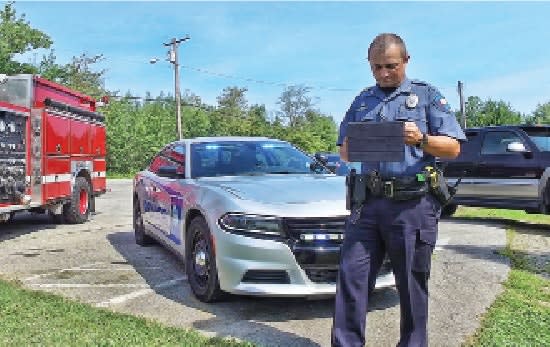
Not every agency is currently positioned to benefit from FirstNet, but that will change as more start issuing smartphones and other such devices to their officers. (Photo: FirstNet)
Shortly after the atrocities of 9/11, reports began to emerge that one of the reasons so many firefighters died in the World Trade Center attack was that police helicopters circling above the scene could not warn them the building was about to collapse. This communication breakdown was well documented in the 9/11 Commission Report, which was released in 2004. And ever since that report was issued interoperability between different agencies has been a major concern for public safety leaders.
What grew out of this concern was a massive initiative to create a cellular communication network just for first responders. And when all of the nation's television stations were required to transition to digital broadcast signals about a decade ago that freed up radio spectrum in the 700MHz band and triggered a bidding war among cellular providers. It also spurred public safety officials to argue that 20MHz of this precious radio real estate should be reserved specifically for use by first responders.
That's pretty much the birth of what would become the First Responder Network Authority, although at the time it went by names such as Public Safety Broadband and Band 14. Today, the Authority is known as FirstNet. Established by Congress as part of the Middle Class Tax Relief and Job Creation Act of 2012, FirstNet was funded with $7 billion and given the mission of establishing, operating, and maintaining a nationwide interoperable broadband network for first responders.
Today, FirstNet is finally becoming more than just a public safety pipedream. The backers of this initiative quickly realized that the federal government was not going to fund a nationwide cellular system for first responders alone. The cost would have been staggering. So instead, FirstNet put out a bid for cellular companies to build the network. In March it was announced that AT&T had won that contract by offering to spend $40 billion over the next 25 years to create and maintain FirstNet. That means FirstNet is about to go online and here's how that could affect you.
Too Much Traffic
FirstNet is to be a secure broadband cellular network that offers specific features for law enforcement. Mike Poth, FirstNet's CEO, says broadband cellular communications devices are becoming more and more prevalent in law enforcement operations. For example, some of the nation's largest agencies now issue smartphones to their officers. "Smartphones and other devices are becoming invaluable for patrol officers," says Poth, who served as an officer with the Corvallis, OR, and Tempe, AZ, police departments and retired a captain.
Broadband digital devices work great in day-to-day police work, according to Poth, but officers can have a hard time using them for mission critical communications during not only major incidents but also during special events. On existing networks officers have to compete with all the other cell traffic trying to access the network. Which can be a problem.
Ely Reyes, assistant chief of the Austin Police Department, says his officers have extensive experience with cellular communication issues at special events like the South by Southwest music festival and University of Texas football games. "When we have those large events, the cell network becomes congested, and it's difficult to make calls or use data," he says.
The HOV Lane
FirstNet is designed to let officers break through cellular gridlock by giving them usage priority and even letting them pre-empt access to the network by other cellular users.
As first envisioned after the release of the 9/11 Commission Report, public safety broadband was going to be a network where spectrum would be allocated for public safety use only. That proved impractical. So the concept of priority and pre-emption was developed.
What this means is that FirstNet provider AT&T can use all of the spectrum it is acquiring through its agreement with FirstNet for commercial purposes until it is needed by public safety users. Chris Sambar, SVP for AT&T-FirstNet, says officers should think of their access to FirstNet as an "HOV lane" for communications that gives them special access and priority. "When first responders need it, they get immediate access, and it's all theirs," he says. Sambar adds that in a major emergency AT&T is willing to allocate all of its spectrum, not just 20MHz, for public safety priority use.
Public safety professionals with access to FirstNet will use special SIM cards in their phones. These cards will identify their calls as priority on the network and when necessary they will push other users off of the network to give the FirstNet user access. Sambar says in most cases other AT&T customers will not even notice they have been pre-empted. However, in a major incident scenario, some commercial customers may get bumped. The exception to this is 911 calls, which will also have priority on the network.
Moving Forward
Now that AT&T has signed on to build FirstNet, how it will be implemented in each of the 56 states and territories will be decided by the governors. AT&T submitted buildout plans to the governor of each state and territory last month. Now the governors have 45 days to review the plans and 90 days after that to decide to opt in or opt out.
If a governor opts out of the AT&T plan, then the state or territory will have to build its own public safety broadband network that's as robust or more robust than the AT&T network as part of the nationwide mandate. If a state opts in to the FirstNet/AT&T plan then there is no cost to the state for building, operating, or maintaining the network. Sambar says the AT&T plan is "low risk" for states and territories, and they are not obligated to use it, once the system is built. "If we build it and they don't like it, they don't have to buy [the service]," he says.
Costs and Benefits
Once a governor agrees to AT&T's buildout plan, the company will begin offering FirstNet services in that state or territory. Individual public safety personnel will be allowed to subscribe to the service, as will agencies. "Price point and features for this service will be very attractive. This will be a very aggressively priced product," Sambar promises.
AT&T believes in the near future a smartphone will be as essential to law enforcement operations as a patrol car, according to Sambar. Currently, however, smartphones are not very prevalent in official police work. Officers carry their own personal phones on duty, but only about 30% of agencies issue phones or encourage their officers to acquire smartphones for official use through a stipend program.
That means not every agency is currently positioned to benefit from FirstNet. Even the Austin PD, which serves one of the nation's most technologically advanced cities, does not issue smartphones to officers. Assistant Chief Reyes says the Texas agency is currently "doing some cost analysis" to see how much issuing smartphones will cost and to identify funding. He adds that FirstNet coming online may be the catalyst to accelerate that process. "I believe this is a good opportunity for us to look into that further," he says.
For agencies to make such an investment, the benefits of providing smartphones and FirstNet service to officers will have to outweigh the costs. Proponents of the system say the ability for officers to receive secure high-speed data transmissions to their devices in the field will make the public and officers safer and make police work more efficient.
Reyes says FirstNet will have substantial impact on the way patrol officers respond to calls through intelligence-led policing. He sees officers receiving real-time visual information from the scene they are responding to and about the people involved before they arrive.
Poth, who served on a SWAT team, says FirstNet will give tactical responders a wealth of intelligence on a callout. He says users will be able to use Internet of things devices, surveillance feeds, drone video, and other streaming data to make critical decisions before executing an entry.
The Future
Such real-time intelligence tools are just the beginning of the benefits FirstNet may bring to law enforcement in the future according to Sambar. He envisions a time when FirstNet will be the connectivity behind a hub of video capture devices and artificial intelligence software that will reduce the amount of time law enforcement officers spend on report writing so that officers can spend more time on active patrol.
Sambar says that future is being developed today, but it probably won't be ready for law enforcement use until the next decade. Other innovations that could benefit from the connectivity provided by FirstNet are going to be part of daily police work very soon.
AT&T has committed to bringing as many innovative tools as possible to FirstNet, Sambar says. For example, the company says it will work with its partners to produce broadband devices specifically for the network. Also, it is hiring a team of app developers to produce public safety software for the FirstNet app store, which will not be available to the public. "This is not Angry Birds. Every app will be vetted for cyber security vulnerabilities and tested to ensure it works," Sambar says.
More Technology
A police agency's guide to data-driven fleet management
Costs are rising and the public expects more transparency into how their tax dollars are spent. This e-book shows how police agencies can use fleet data to take control of fleet expenses while improving officer safety and demonstrating fiscal responsibility to the communities they serve.
Read More →
AI and analytics for law enforcement: Turning data into insights
Law enforcement agencies are managing more video, sensor data and digital evidence than ever before. Discover how AI and analytics can help turn that data into actionable insights that strengthen situational awareness, accelerate investigations and support more informed decisions.
Read More →
Vasco Electronics Adds Automatic Language Detection to Vasco Translator Q1
Vasco Electronics’ software update introduces hands-free language switching and expanded offline translation across 45 language pairs, empowering law enforcement, healthcare, and front-office enterprise teams
Read More →
North Miami Police Department Deploys Mark43
The North Miami Police Department has deployed Mark43 as part of its Five-Year Strategic Plan that represents its collective vision and goals for a more proactive police department, anchored by a core commitment to leveraging modern technology to enhance efficiency and public safety.
Read More →
Cellebrite Genesis for Enterprise Now Generally Available
Made available to the public sector in June, Cellebrite Genesis is serving a growing mix of national, regional, and local agencies worldwide, including some of the largest regional and metropolitan police departments. It is now available for enterprise organizations.
Read More →
2026 Vision FirstNet Users Summit to Host Emerging Leaders Training on Grassroots Advocacy for Public Safety
“Emerging Leaders Training: Understanding the Importance of Grassroots Advocacy for Public Safety," a session during the 2026 Vision FirstNet Users Summit, will offer a roadmap for unified advocacy at the federal level.
Read More →
Motorola Solutions Completes Acquisition of D-Fend Solutions
Motorola Solutions has acquired D-Fend Solutions, an industry leader in counter-drone technology. This deal provides public safety and enterprise customers with access to advanced counter-unmanned aerial systems.
Read More →
ZeroEyes, Advantech & Camden Police Partner to Bring AI Gun Detection Technology to Delaware School District
ZeroEyes has partnered with Advantech and the Camden Police Department to deploy ZeroEyes’ AI gun detection and intelligent situational awareness platform at Delaware’s Caesar Rodney School District (CRSD).
Read More →
Leonardo U.S. Cyber & Security Solutions Introduces SignalTrace, the Next Evolution in Electronic Signature Detection Technology
SignalTrace reflects years of product refinement and a clearer expression of the technology’s purpose of recognizing and correlating electronic signatures in publicly broadcast wireless signals to reveal patterns, relationships, and trends that might otherwise go undetected.
Read More →
Pimloc Launches Secure File Sharing to Streamline Release of Redacted Video
Pimloc’s Secure File Sharing lets organizations deliver redacted video, audio, and documents through expiring, passcode-protected links, accelerating delivery while reducing security, compliance, and chain-of-custody risks.
Read More →