



First Look: The Next-Generation Dash Camera
Motorola Solutions’ M500 video system offers AI-enhanced capabilities that improve officer and citizen safety, video capture, and evidence management.

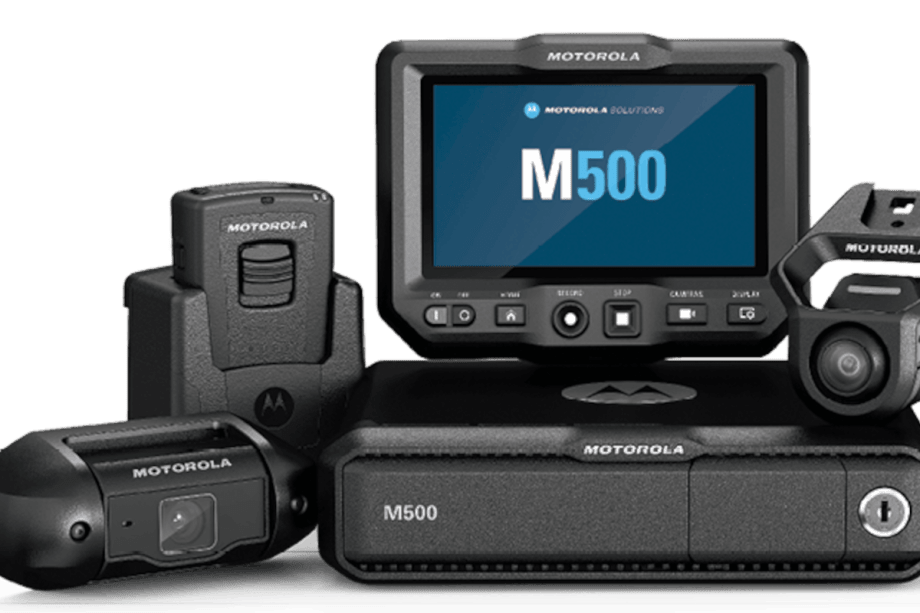
Motorola Solutions’ new M500 AI-enhanced in-vehicle video system captures high-definition video on both its front facing and cabin cameras. It integrates with the company’s V300 body-worn camera. Both use the Motorola Solutions CommandCentral Evidence software for backend management, storage, redaction, and file sharing.
A little more than two years ago, Motorola Solutions acquired WatchGuard Video—one of the world’s leading developers of law enforcement in-car video systems and body cameras. Shortly after Motorola Solutions acquired WatchGuard, development began on their new M500 in-vehicle video system. So it’s no surprise that the M500 incorporates a mixture of WatchGuard and Motorola Solutions’ technology, producing a next-generation dash camera.
The M500 offers a number of innovative features. Andres Lacambra, Motorola Solutions’ senior director, Mobile Video, says the goal from the beginning of the M500’s development was to “find ways to add more value” for law enforcement agencies into the system.
One of the “more value” features of the M500 is that its capabilities are enhanced by artificial intelligence. The AI enhanced capabilities are designed to support officers with actionable information that complements the human decision-making process, to ensure that the system reliably captures the evidence despite human error, and to ensure that the videos are better organized in the evidence management software for better analysis.
The M500’s front-facing 4K camera delivers 1080p video in panoramic or focused views. A cabin camera points at the back seat and also delivers 1080p resolution and features built-in infrared illumination.
That backseat facing camera is one of the capabilities of the M500 that is enhanced by AI. With most police in-vehicle video systems, the officer needs to turn on the cabin camera, which can lead to lost evidence. The AI ensures that the cabin camera is running when someone is in the back seat.
“The AI is not just looking for motion,” Lacambra says. “We wanted to make sure that something like a uniform hanging in the back seat would not trigger a recording. So instead of looking for motion, the AI looks for shapes. If it recognizes that shape as a person, it turns on the recording to make sure it is part of the record. That recording can be critical in some investigations. The cabin camera can capture conversations between individuals in the back seat or evidence that provides transparency and clarity around whether a complaint against an officer is true or false.
Another innovative capability of the M500 is its license plate recognition feature. The system can automatically read license plates and compare them to a “hit list.” It’s not designed to replace purpose-built ALPR systems, but Lacambra says the M500’s LPR feature can help officers stay safer during traffic stops. “If the license plate of the vehicle they are stopping turns out to be associated with a vehicle of interest, the way they may approach that vehicle is different if they know that information ahead of time,” he explains.
Recordings captured by the M500 system are organized by AI by leveraging metadata. “It makes videos easier to find and apply to the appropriate investigations,” Lacambra says.
Motorola Solutions’ CommandCentral Evidence software provides the evidence management for the M500. Using the software, agencies can aggregate and organize M500 and V300 body camera video, produce automated transcriptions of the audio, redact the video, and share it with authorized users such as prosecutors.
For playback CommandCentral Evidence allows officers to watch synced video captured by multiple devices at the same incident. As many as four different video feeds can be viewed simultaneously. “As you move the timeline, all four videos and all video sources move in sync so you can watch the same scene at the same time from different angles,” Lacambra says.
The Motorola Solutions M500 in-vehicle video system is expected to be available in early 2022. Learn more here.
More Technology

A police agency's guide to data-driven fleet management
Costs are rising and the public expects more transparency into how their tax dollars are spent. This e-book shows how police agencies can use fleet data to take control of fleet expenses while improving officer safety and demonstrating fiscal responsibility to the communities they serve.
Read More →
AI and analytics for law enforcement: Turning data into insights
Law enforcement agencies are managing more video, sensor data and digital evidence than ever before. Discover how AI and analytics can help turn that data into actionable insights that strengthen situational awareness, accelerate investigations and support more informed decisions.
Read More →
Vasco Electronics Adds Automatic Language Detection to Vasco Translator Q1
Vasco Electronics’ software update introduces hands-free language switching and expanded offline translation across 45 language pairs, empowering law enforcement, healthcare, and front-office enterprise teams
Read More →

North Miami Police Department Deploys Mark43
The North Miami Police Department has deployed Mark43 as part of its Five-Year Strategic Plan that represents its collective vision and goals for a more proactive police department, anchored by a core commitment to leveraging modern technology to enhance efficiency and public safety.
Read More →
Cellebrite Genesis for Enterprise Now Generally Available
Made available to the public sector in June, Cellebrite Genesis is serving a growing mix of national, regional, and local agencies worldwide, including some of the largest regional and metropolitan police departments. It is now available for enterprise organizations.
Read More →
2026 Vision FirstNet Users Summit to Host Emerging Leaders Training on Grassroots Advocacy for Public Safety
“Emerging Leaders Training: Understanding the Importance of Grassroots Advocacy for Public Safety," a session during the 2026 Vision FirstNet Users Summit, will offer a roadmap for unified advocacy at the federal level.
Read More →
Motorola Solutions Completes Acquisition of D-Fend Solutions
Motorola Solutions has acquired D-Fend Solutions, an industry leader in counter-drone technology. This deal provides public safety and enterprise customers with access to advanced counter-unmanned aerial systems.
Read More →
ZeroEyes, Advantech & Camden Police Partner to Bring AI Gun Detection Technology to Delaware School District
ZeroEyes has partnered with Advantech and the Camden Police Department to deploy ZeroEyes’ AI gun detection and intelligent situational awareness platform at Delaware’s Caesar Rodney School District (CRSD).
Read More →
Leonardo U.S. Cyber & Security Solutions Introduces SignalTrace, the Next Evolution in Electronic Signature Detection Technology
SignalTrace reflects years of product refinement and a clearer expression of the technology’s purpose of recognizing and correlating electronic signatures in publicly broadcast wireless signals to reveal patterns, relationships, and trends that might otherwise go undetected.
Read More →
Pimloc Launches Secure File Sharing to Streamline Release of Redacted Video
Pimloc’s Secure File Sharing lets organizations deliver redacted video, audio, and documents through expiring, passcode-protected links, accelerating delivery while reducing security, compliance, and chain-of-custody risks.
Read More →