



First Look: The CAD to CAD Translator
CentralSquare’s Unify allows different jurisdictions and agencies to mutually share emergency assets and eliminate time spent making phone calls for assistance.

CentralSquare's Unify software works with any CAD system and allows communicators to see assets from other jurisdictions and agencies and with permission send them to emergencies.
CentralSquare Technologies
Interoperability has long been a buzzword in the law enforcement and other public safety professions. Usually, the term applies to interagency radio or police and fire communications, but it can also apply to other communications tools.
Since 2008, CentralSquare has been developing and implementing an interoperability technology that allows 911 call centers to share computer-aided dispatch (CAD) information. Last year, this CAD to CAD software product was rebranded as Unify.
CentralSquare’s Unify works with any CAD system and allows emergency call center personnel to see assets from other agencies in the area. This means that with permission through a mutual aid agreement a dispatcher can send a unit from another agency, county, or city to an emergency right from their own CAD because it is closer to the people in need or because it possesses capabilities that are currently not available in their jurisdiction.
Unify allows agencies to build cooperative CAD networks in the same geographic region and among different call centers. “At some point an emergency call center needs to talk to somebody outside your zone, and they’re going to be on a different CAD systems, or could be,” says Scott Panacek, product manager for CentralSquare. “So that’s where Unify comes in; it provides a standard way to communicate.”
Panacek likens CentralSquare’s vendor agnostic Unify technology to a language translator. “Let’s say you had three law enforcement officers collaborating on the same incident. But one spoke English, one spoke Spanish, and one spoke Portuguese. They would need a translator. So that’s kind of what the Unify system does for different CAD systems. It allows CAD functions like dispatching units to happen from CAD vendor to CAD vendor.” Panacek stresses that none of the participants has to be using CentralSquare’s CAD in order to build a CAD to CAD network with Unify. They do, however, all have to have a subscription to Unify.
What makes Unify capable of communicating across so many different CAD systems from different CAD vendors is CentralSquare’s open application programming interface (API), according to Panacek.
“We’ve got open API that we provide to any CAD vendor, and it exposes the commands and rules that their system need to communicate with another agency’s system,” he explains. “There’s a data map that they can copy their data and their codes into. So everything maps to something common in the middle.”
When using Unify, an emergency communicator can see all of the CAD-visible assets from the participating agencies. With permission from the owners of the assets, the communicator can dispatch them to incidents in another response area or jurisdiction.
Panacek says the responding units are dispatched via their agencies existing mobile system . For the emergency communications personnel, using Unify does not change their procedures or what they see on the screen. The only difference is that it adds commands for mutual aid.
The primary benefit of Unify for the public, for emergency responders, and for 911 centers is that it saves time. Cross-jurisdiction dispatch of public safety assets can literally save lives by facilitating faster response. For emergency responders it can reduce travel time, making it easier for agencies with personnel shortages to answer more calls.
Emergency communications centers are also experiencing personnel shortages, and Unify can also help them save time. “They don’t have to hunt around searching for the proper person to call and spend time on the phone asking for assistance,” Panacek says.
Unify can also let an overwhelmed communications center ask for help from another in their CAD-to-CAD network. “If they’re linked together, one communications center can pick up the call and get the units on the way for the other center,” Panacek says.
Unify CAD to CAD is available now.
More Technology
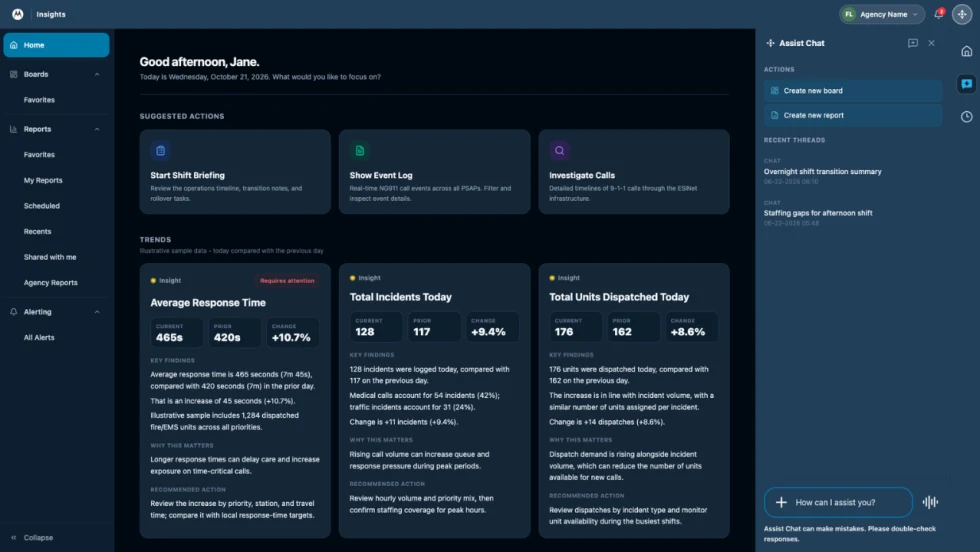
How Motorola Solutions’ New “Insights” Platform Helps Public Safety Agencies Identify Trends to Improve Their Operations
Motorola Solutions has introduced Insights, which leverages Assist, its mission-critical artificial intelligence (AI), to address these challenges and shape what’s next for public safety analytics and reporting technology.
Read More →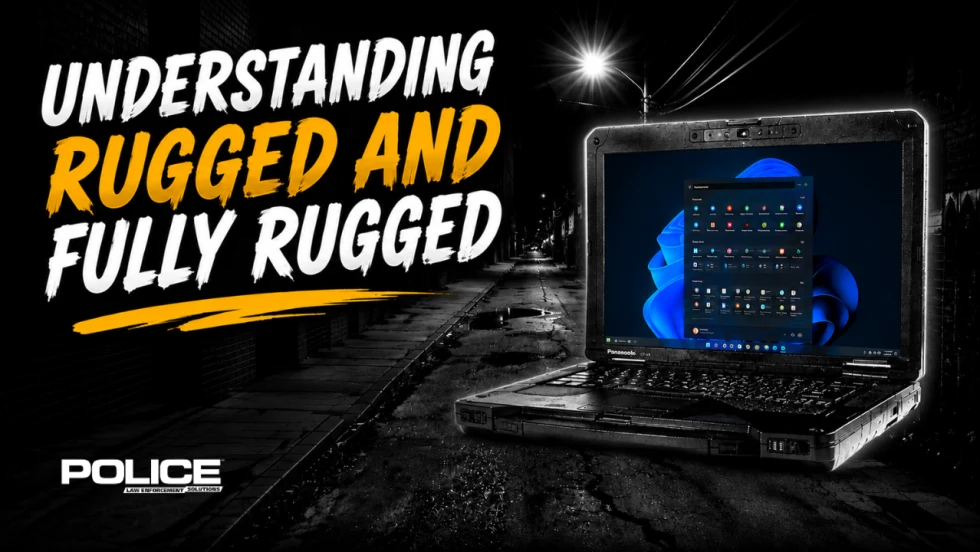
What Qualifies a Laptop as Rugged or Fully Rugged?
Police officers face a wide range of working conditions that can damage or even destroy a regular consumer laptop. Learn what qualifies a computer as rugged or fully rugged and why those devices are vital for law enforcement.
Read More →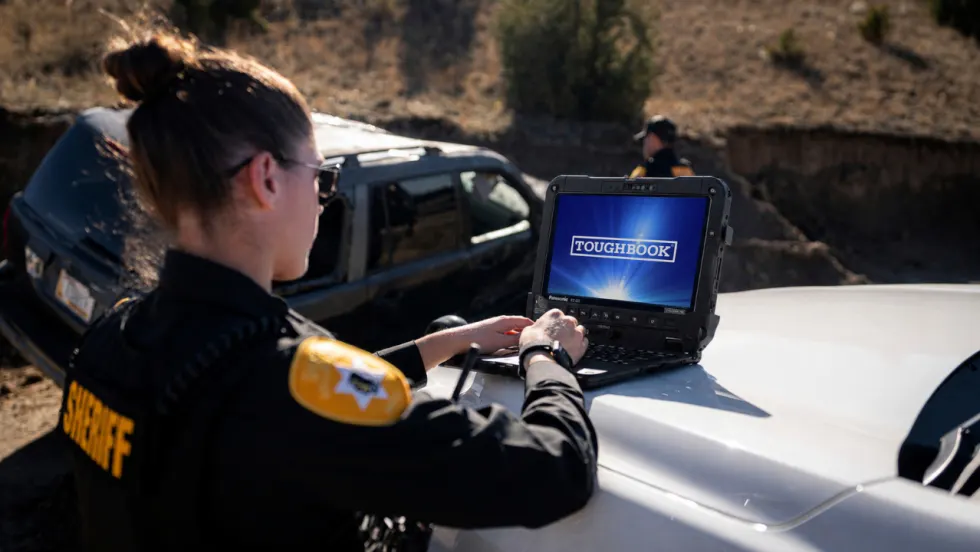
Panasonic Connect Launches the Toughbook 34 and Toughbook G3, Fully Rugged 2-in-1 Mobile Computers
Panasonic Connect has launched the Toughbook 34 and Toughbook G3 to facilitate in-vehicle dispatch, records management, and mobile command operations from any location.
Read More →

A police agency's guide to data-driven fleet management
Costs are rising and the public expects more transparency into how their tax dollars are spent. This e-book shows how police agencies can use fleet data to take control of fleet expenses while improving officer safety and demonstrating fiscal responsibility to the communities they serve.
Read More →
AI and analytics for law enforcement: Turning data into insights
Law enforcement agencies are managing more video, sensor data and digital evidence than ever before. Discover how AI and analytics can help turn that data into actionable insights that strengthen situational awareness, accelerate investigations and support more informed decisions.
Read More →
Vasco Electronics Adds Automatic Language Detection to Vasco Translator Q1
Vasco Electronics’ software update introduces hands-free language switching and expanded offline translation across 45 language pairs, empowering law enforcement, healthcare, and front-office enterprise teams
Read More →
North Miami Police Department Deploys Mark43
The North Miami Police Department has deployed Mark43 as part of its Five-Year Strategic Plan that represents its collective vision and goals for a more proactive police department, anchored by a core commitment to leveraging modern technology to enhance efficiency and public safety.
Read More →
Cellebrite Genesis for Enterprise Now Generally Available
Made available to the public sector in June, Cellebrite Genesis is serving a growing mix of national, regional, and local agencies worldwide, including some of the largest regional and metropolitan police departments. It is now available for enterprise organizations.
Read More →
2026 Vision FirstNet Users Summit to Host Emerging Leaders Training on Grassroots Advocacy for Public Safety
“Emerging Leaders Training: Understanding the Importance of Grassroots Advocacy for Public Safety," a session during the 2026 Vision FirstNet Users Summit, will offer a roadmap for unified advocacy at the federal level.
Read More →
Motorola Solutions Completes Acquisition of D-Fend Solutions
Motorola Solutions has acquired D-Fend Solutions, an industry leader in counter-drone technology. This deal provides public safety and enterprise customers with access to advanced counter-unmanned aerial systems.
Read More →