



First Look: Skydio’s Drone Traffic Controller
Skydio’s DFR Command software helps law enforcement agencies set up, operate, and manage drones for first response.
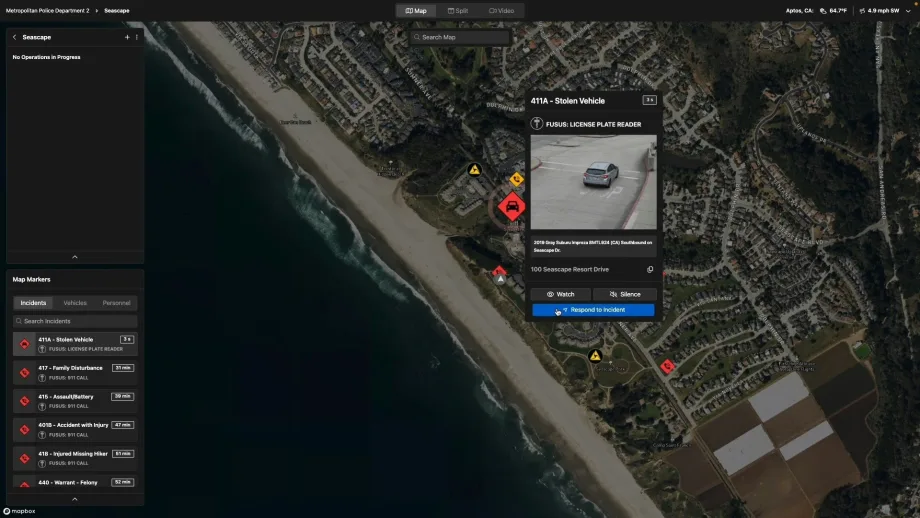
Skydio's DFR Command allows DFR teams to access images from license plate recognition systems.
Skydio
Early adopters of drone as first responder programs had to Frankenstein together the technologies needed to conduct DFR operations, often with each piece of the system produced by a different vendor.
That’s now changing as Skydio is offering a complete DFR solution, including X10 drones, drone docks, and new drone management software called DFR Command.
Noreen Charlton, Skydio’s senior manager of public safety strategy, says DFR Command was developed based on Skydio’s experience working with more than 500 public safety agencies and from the experience of the former law enforcement professionals who work at the company. Charlton is one of those law enforcement professionals. She served more than 10 years as a crime scene analyst for the Las Vegas Metropolitan Police Department where she first became interested in drones as a platform for capturing images of crime scenes.
What the team at Skydio decided to do with DFR Command was to create a tool that can facilitate the management of all aspects of DFR operations. This means it lets users control their drones, set up their drones to respond autonomously to specific types of calls and events, see critical information about the drones, and stream video feeds from the drones on multiple devices.
DFR Command even helps agencies plan where to deploy their drones for the most effective response. “We have developed this simulation algorithm to help agencies figure out where to put the docks to help them respond to 90% of their high-priority calls within two minutes,” Charlton says. The simulation determines the best places to put the docks using historical call-for-service data, she explains.
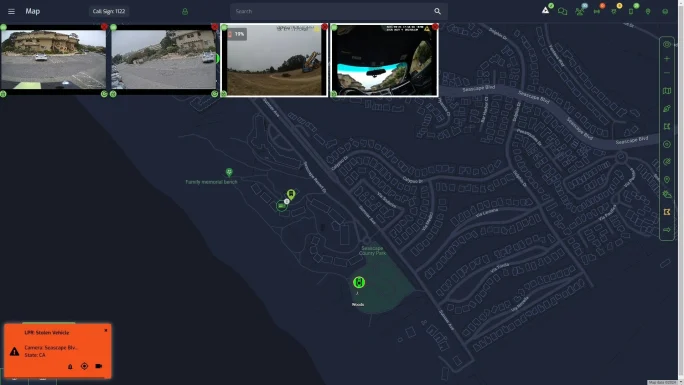
DFR Command integrates with Fusus' real time crime center software for greater situational awareness.
Skydio
DFR Command integrates with a wide variety of law enforcement technologies, including computer-aided dispatch systems, real-time crime center solutions, license plate readers, and gunshot detection tools, just to name a few. “Any system that can potentially trigger a call for service can integrate with DFR Command,” Charlton says. “The idea is to get the drone to the scene as quickly as possible and to eliminate the whole literal game of ‘telephone’ that happens when someone calls 911.”
The software not only shows the DFR team the location of the nearest drone, it also lets them know if it’s ready for the mission. “It will tell you the battery life on the drone, how far it is from the scene, and how long it will take the drone to get there,” Charlton says.
The capabilities of DFR Command also enhance officer safety. “Our partnership with Axon enables body-worn camera locations to populate in DFR Command,” Charlton explains. “The pilot can see the locations of officers who have activated their body cameras on the map, and it can tell the nearest drone to fly to the scene where an officer is not responding to dispatch. Multiple officers can then access the drone video and see if that officer’s OK of if they need additional help.”
Even if officers are carrying drones in their vehicles, DFR Command allows them to be remotely piloted by the pilots who operate the DFR drones. “If an officer is carrying a drone in the trunk of their vehicle, they can launch it, and the DFR pilot can take control,” Charlton says.
The development of DFR Command now means that Skydio can supply agencies with everything they need for a DFR program, including the X10 drone, the dock, and software for controlling and managing all of the assets, Charlton says. “We also offer training and regulatory assistance to help you build out a program that meets your needs and the needs of your community,” she adds.
More Technology

A police agency's guide to data-driven fleet management
Costs are rising and the public expects more transparency into how their tax dollars are spent. This e-book shows how police agencies can use fleet data to take control of fleet expenses while improving officer safety and demonstrating fiscal responsibility to the communities they serve.
Read More →
AI and analytics for law enforcement: Turning data into insights
Law enforcement agencies are managing more video, sensor data and digital evidence than ever before. Discover how AI and analytics can help turn that data into actionable insights that strengthen situational awareness, accelerate investigations and support more informed decisions.
Read More →
Vasco Electronics Adds Automatic Language Detection to Vasco Translator Q1
Vasco Electronics’ software update introduces hands-free language switching and expanded offline translation across 45 language pairs, empowering law enforcement, healthcare, and front-office enterprise teams
Read More →

North Miami Police Department Deploys Mark43
The North Miami Police Department has deployed Mark43 as part of its Five-Year Strategic Plan that represents its collective vision and goals for a more proactive police department, anchored by a core commitment to leveraging modern technology to enhance efficiency and public safety.
Read More →
Cellebrite Genesis for Enterprise Now Generally Available
Made available to the public sector in June, Cellebrite Genesis is serving a growing mix of national, regional, and local agencies worldwide, including some of the largest regional and metropolitan police departments. It is now available for enterprise organizations.
Read More →
2026 Vision FirstNet Users Summit to Host Emerging Leaders Training on Grassroots Advocacy for Public Safety
“Emerging Leaders Training: Understanding the Importance of Grassroots Advocacy for Public Safety," a session during the 2026 Vision FirstNet Users Summit, will offer a roadmap for unified advocacy at the federal level.
Read More →
Motorola Solutions Completes Acquisition of D-Fend Solutions
Motorola Solutions has acquired D-Fend Solutions, an industry leader in counter-drone technology. This deal provides public safety and enterprise customers with access to advanced counter-unmanned aerial systems.
Read More →
ZeroEyes, Advantech & Camden Police Partner to Bring AI Gun Detection Technology to Delaware School District
ZeroEyes has partnered with Advantech and the Camden Police Department to deploy ZeroEyes’ AI gun detection and intelligent situational awareness platform at Delaware’s Caesar Rodney School District (CRSD).
Read More →
Leonardo U.S. Cyber & Security Solutions Introduces SignalTrace, the Next Evolution in Electronic Signature Detection Technology
SignalTrace reflects years of product refinement and a clearer expression of the technology’s purpose of recognizing and correlating electronic signatures in publicly broadcast wireless signals to reveal patterns, relationships, and trends that might otherwise go undetected.
Read More →
Pimloc Launches Secure File Sharing to Streamline Release of Redacted Video
Pimloc’s Secure File Sharing lets organizations deliver redacted video, audio, and documents through expiring, passcode-protected links, accelerating delivery while reducing security, compliance, and chain-of-custody risks.
Read More →