



The Money Crunch: Staffing Shortage
When times are tough, staffing takes the brunt of the cuts. That's true in business. That's true in law enforcement.

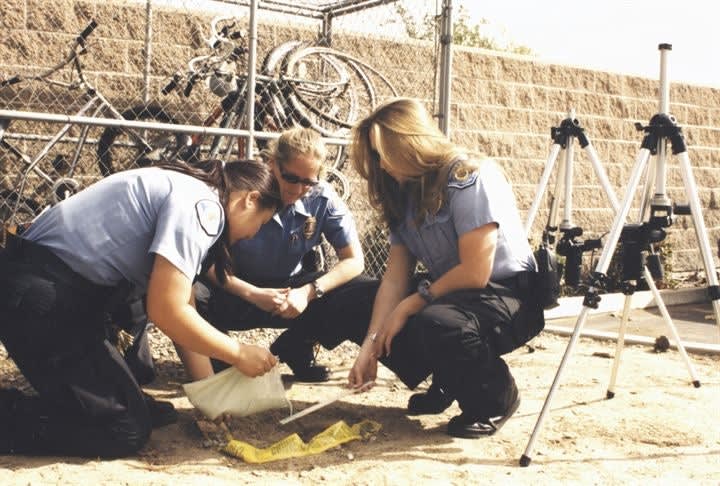
Volunteers often help departments by taking on jobs such as collecting forensic evidence after officers clear a scene.
When times are tough, staffing takes the brunt of the cuts. That's true in business. That's true in law enforcement.
The lagging economy and increased requirements for homeland security equipment and training following 9/11 have left law enforcement agencies little money with which to pay officers' salaries.
"When you're already maximizing your resources with grants and volunteers, when the money that you've been using to help offset shortages starts drying up, it's not just programs that go away; it's people," says Chief Joseph Polisar of the Garden Grove (Calif.) Police Department.
The grants that are available through Homeland Security cover technology and equipment, not personnel. Having served as his state's Homeland Security Advisor to the governor, Ron Ruecker, superintendent of the Oregon State Police, understands and agrees with this stance, but it doesn't help him obtain funding for more troopers.
"If you don't have the people, a parking lot full of cars isn't going to do you much good," Ruecker quips.
Michael Moore's controversial documentary, "Fahrenheit 9/11," publicized the budget woes of the Oregon State Police by capturing state troopers on film talking about how few of them were left to police the state. Although critics of the filmmaker say he sensationalized the issues to further his agenda, Ruecker can't fault Moore for his reporting on this point.
"The fact is that what appeared in the film might even be a rosier picture of the truth," he says. "There are times right now where we don't have 24-hour coverage in the Oregon State Police anywhere in the state, which is something I never thought I'd see in my career."
But while the law enforcement community nationwide laments the dearth of police officers, Ruecker admits that sometimes cutting sworn officers can be the lesser of two evils, something he's learned the hard way.
"The public expects a state trooper to be out doing police work. But after such drastic support staff layoffs in the 1990s, they were in the office doing clerical work at two times the cost of the support staff."
This time the state did lay off troopers, as well as an unprecedented number of crime lab scientists.
Oregon is a particularly sad case. The state police used to derive much of its funding from highway taxes, but a vote in 1980 made the general fund dependent on personal income tax and property tax. A second vote in the 1990s further limited state police funding by lowering property taxes. After the economic decline following 9/11, the Oregon State Police lost much of the remaining funding it depended on. Additionally, it had to compete with the state's healthcare and education systems for the money that was left in the general fund they share.
In early 2003, when voters again refused to OK raising taxes to create protected designated funds for the state police, there wasn't enough money in the state coffers to pay for the budget. With two months left in the two-year budget cycle, the only thing the state could do to come up with extra money was cut jobs. The solution hit the State Police hard.
But after five weeks, the legislature found a way to fund the rehiring of two-thirds of troopers and almost all of the crime lab employees. Unfortunately, not all of them were willing to come back.
The repercussions of the 2003 layoffs are still being felt almost two years later. The state's seven crime labs, which lost two-thirds of their staff members for the five-week period of layoffs, still aren't receiving as much evidence to analyze as before. But that might be a product of the streamlined process still in place after the layoffs.
The Fremont (Calif.) Police Department is in a similar situation right now. But Chief Craig Steckler is hoping that educating the public will result in a vote to raise taxes to support the local police.
Volunteers
While they might not always work for every agency, ways do exist to avoid laying off sworn officers. The most popular option is to find civilians who will work for nothing.
A varied staff of more than 200 volunteers supplements paid workers in almost every area of the Garden Grove Police Department. For example, some community service officers (CSOs) work as field report writers, responding to traffic accidents and burglaries after sworn officers have cleared the scenes. They perform such crucial tasks as taking fingerprints and bagging evidence.
The Garden Grove PD volunteer program was put in place 10 years ago when a wave of budget cuts left the department understaffed. The agency wouldn't be able to deliver nearly as many services to the public without the volunteers' help.
The Bellevue (Wash.) Police Department has a similarly widespread civilian volunteer program that started around the same time.
Marji Trachtman, a full-time civilian employee, heads the Bellevue volunteer program.
"Our volunteers work in every area of the department, from crime analysis, to records, to staffing our community stations. We have folks who maintain the vehicle fleet and we have a team of volunteers that assist officers in handing out sex offender notifications to the community when a level-two or level-three offender moves into a neighborhood."
Just about the only things these volunteers can't do are carry a gun or arrest someone. With all they do for the department, volunteers rack up a lot of hours without racking up a huge bill.
"We usually have about 60 people who work about 11,000 volunteer hours a year," says Trachtman. "We usually save $17 an hour by using volunteers instead of officers for these jobs."
Labor Issues
Volunteers aren't always available to use. Some unions place stringent restrictions on how many, if any, volunteers will be allowed at an agency.
Chief William Harvey of the Lebanon (Pa.) Police Department has no volunteers on staff because unions won't allow their use.
In Lebanon, deemed a "city of third class" based on its size, unions place restrictions on the unpaid jobs that can be filled, to safeguard the number of paid jobs in a certain area. While Harvey understands the limitations, he knows from experience that volunteers can be a great asset to a department and he wishes they were at his disposal in Lebanon. But he knows there's not much he can do to change the situation.
"Being in a state where you have union contracts, protections can be prohibitive. It's not always bad, it's not always good; you just have to learn to play the ground rules in your area," says Harvey.
Union guidelines also prohibit the Lebanon Police Department from making use of reserve officers.
The Bessemer (Ala.) Police Department has a different reason for not using volunteers, reserve officers, or any other type of unpaid position: liability. The small department is currently spending most of its money maintaining its rapidly decaying station building and repairing aging cars, and it can't risk incurring a costly lawsuit.
Fremont PD has found a way to work with local union representatives, the department's biggest concern in using volunteers.
"We work very closely with the various bargaining units and we've never had any problems with it," says Chief Steckler, "because our volunteers put in only eight hours a week or 16 hours a week and they do a lot of the stuff the employees would rather not do."
While certain issues can prevent the use of nonpaid employees, many agencies rave about the benefits of having dedicated staff members that cost little or nothing, allowing available funding to be used to pay sworn officers and paid civilian employees as well as for other necessary costs to run a police department. Volunteers, reserve officers, and police Explorers can be great resources.
Service Triage
In addition to supplementing paid employees with unpaid staff, rethinking the ways of responding to calls for service can tremendously enhance law enforcement officers' ability to serve their communites.
Prioritizing calls for service is necessary when sworn personnel are stretched thin.
"We went through all of our calls for services and decided which ones would go to online reporting and then we've given the watch commander the authority that if workload dictates it we'll drop priority 3 calls," says Steckler of Fremont PD's new system.
"We just tell the citizen that we're too busy with priority 2 and 1 calls and that they're not going to get service on this. We let them know what their options are, i.e. online reporting. Or they can call the next day and see if there are people available to deal with their issue," Steckler says.
It's been almost 10 years since Garden Grove PD stopped sending police officers out to respond to minor "fender benders." If there is very little property damage and no one involved in the car accident is hurt, the police let the involved parties deal with the situation.
"Really what we were doing was the insurance companies' work," says Chief Polisar. "Not responding to these calls helps free up police officers to be available for more serious crimes and calls for service."
Garden Grove PD hasn't had any problems with citizens complaining about the change in service, but Polisar warns that educating the public about such a change in policy is essential to success.
"It's certainly a political issue, and it has to be approached with that in mind. I've seen some cities where it backfired because the public hadn't been informed about why the department needed to make the policy change. The chief had to rescind it."
Mutual Aid
Organizing regional task forces and SWAT teams can allow agencies to have trained squads at their disposal when necessary without devoting the time and dollars to a full-time unit at any one agency. Sharing the personnel can save money on equipment, training, and overall operating costs.
Garden Grove has its own SWAT team, but it also lends assistance to nearby agencies when they need help. The chief recognizes the value of working together.
"If I were a chief at a smaller agency I'd look at regionalizing, trying to maximize my own agency's benefits by getting together with two or three local agencies' chiefs to pool our resources and create a joint SWAT team," says Polisar.
Even if your agency has its own SWAT team or other similar unit, maximizing sworn officers' time on the job is essential.
"My 20-officer SWAT force does SWAT on top of patrol," says Fremont PD's Steckler. "They have regular jobs on the department and then when there is a need for some kind of tactical response they have the extra training to do that."
While some solutions to personnel shortages might seem extreme or unnecessary, especially if you currently have sufficient funding for your department, a growing number of law enforcement agencies are doing everything in their power to efficiently run their departments with very few employees. And they need all the help-hired or volunteer-that they can get.
More Patrol

Streamlight Portable Scene Light III Wins 2026 OH&S New Product of the Year Award
Streamlight’s Portable Scene Light III has won the 2026 Occupational Health & Safety (OH&S) New Product of the Year Award in the Lighting category.
Read More →
Adept Armor Introduces Two New Rifle Plates
Adept Armor has launched two new Level IV ballistic plates, the Emperor and the Archon Mark 2, which brings Adept Armor’s new Quatroid ceramic to the high-threat, performance-value center of the range at 5.2 pounds.
Read More →
POLICE Product Test: Benchmade Bailout
The Benchmade Bailout is a slim, lightweight carry knife with a deep-ride pocket clip and comes in a variety of blade steels and scales. Here is a detailed review of the Taiga Green Bailout, released earlier this year.
Read More →
NLEOMF Announces July 2026 Officer of the Month
NLEOMF honored a Michigan deputy sheriff as the July 2026 Officer of the Month for rescuing a trapped driver from a burning vehicle following a Fourth of July crash.
Read More →
Streamlight to Showcase Newest Lighting Products at National Safety Council’s Safety Congress & Expo 2026
Streamlight will showcase its latest lights, including the Portable Scene Light III and the LiteBox 1Million, at the 2026 National Safety Council (NSC) Safety Congress & Expo.
Read More →
The 2027 World Police & Fire Games Set for Perth, Australia
The 2027 World Police & Fire Games (WPFG) will take place in Perth, Western Australia, from Friday, March 12 through Sunday, March 21, 2027.
Read More →
5.11 Partners with National Fallen Firefighters Foundation to Support #ForThe343
5.11 has joined the nationwide movement honoring the 343 New York City Fire Department firefighters lost on Sept. 11, 2001.
Read More →
Team Wendy Announces Title Sponsorship of the Jorge Pastore Foundation
Team Wendy’s 3-year partnership with the Jorge Pastore Foundation expands access to programs that strengthen those who serve.
Read More →
National Law Enforcement Memorial and Museum Hosting 9/11 25th-Year Commemoration Ceremony
The National Law Enforcement Memorial and Museum is hosting a 9/11 25th Year Commemoration Ceremony on Sept. 11 at 4 p.m.
Read More →
National Law Enforcement Officers Memorial Fund Announces June 2026 Officers of the Month
The National Law Enforcement Officers Memorial Fund (NLEOMF) named 15 officers of the Chico Police Department (California) as the Officers of the Month for June 2026 for their roles in responding to an active-shooter incident at a public library.
Read More →