



Never Go Gently
While working out in the gym is commendable, it is not going to save you in and of itself. You need to train for the incident.

You are dispatched to a domestic. A caller has reported screams coming from a neighbor's home. A shared glance with your partner communicates the same thought: "Same-old, same-old." You arrive at the home and follow standard protocol, a knock and notice followed by your entry where you separate a visibly agitated couple. You're speaking to the husband when your partner signals that there are signs of physical abuse to the wife. You inform the guy that he is under arrest and—bang—he flips out. There's a struggle. You've been here, too.
But whereas in the past you've been able to quell the problem with relative ease, this time it's different. It's not just a half-hearted shrugging off of your hands by the suspect. He is taking the fight to you. Suddenly, you find that you've been tackled, are on your back, and are feeling more vulnerable than you've felt in years.
What do you do?
Romantic notions of "I'm gonna kick his ass!" might come to mind. But are you truly physically and mentally prepared to do just that? It's a legitimate concern, as there are doubtlessly any number of officers whose names adorn memorial walls who probably entertained such thoughts in the waning moments of their lives.
For like them, you might find it difficult to land an effective punch while upended on your back like a turtle without the benefit of a protective shell. And unless you've trained properly, you will not know how to defend yourself while on the ground.
About the only thing going for you is that your partner will undoubtedly respond within seconds. But is this necessarily a plus when he stands to add an extra couple hundred pounds atop of you? When you're at the bottom of the dog-pile getting punched, bitten, and spat at?
Let's not forget about the suspect loyalties of the beaten wife. What is she doing? Jumping on top of the partner maybe? Searching for a gun, a knife?
This much we know—it's going to be a bad day.
Plan and Train Ahead of Time
Fortunately, being grounded does not necessarily translate into being at the questionable mercy of your attacker. Indeed, if you've trained properly, you can exploit the mistakes your attacker will be making.
The key to coming out on top in this situation is preparation and training. While all officers have a vested interest in developing fighting skills, those working in sparsely populated areas might find themselves particularly vulnerable. Certainly, they haven't the advantage of officers whose backup is a block or two away. From my experience, rural or small town officers often work alone without backup. This means they are at higher risk of becoming injured or killed on duty.
Statistically, the average officer killed on duty has an estimated tenure of 10 years. If he or she has been saddled with working for a department that has relegated whatever training money it has to cultural sensitivity training or gender equity courses, this means it has been a decade since the officer has had any training in self-defense, and that may have been in the basic training given was at the academy.
In the interim, Joe Bad-Ass has been in prison lifting and training for the day he would go mano-a-mano with some street cop—all to make damn sure he wouldn't be going back to the Pen.
Hedging Your Bet
If a six-month sentence is long enough for some dirtbag to get himself in exceptional shape, then a cop can certainly do as much.
Additionally, if an officer is fortunate enough to be working with a partner, then he or she should make the most of the opportunity by training with one another. By knowing what each other is capable of doing, and what they intend to do when the bad stuff hits, they maximize their chances for successfully getting the better of the bad guy while minimizing injury to themselves or one another.
Communication is key. If you are trained and feel confident of your abilities to overcome the offender, verbalize it. If you need another officer's help, instruct him on what you want done so that you work in unison. This leads to effective arrests, the lawsuits are nullified, and Internal Affairs is off your back.
While working out in the gym is commendable, it is not going to save you in and of itself. You need to train for the incident. A bodybuilder will not win a cage fight. He may hold his own, but at the cost of fighting for his own weapon or being injured in some other way. Strength train all you want if it's your passion, but learn some tactics to increase your longevity. Think back to your last few scuffles. Were you inordinately exhausted? Take it as a sign that you need to train for muscular endurance, and not just power.
Having been practicing and instructing self-defense for more than 19 years, I want to share the following training drill. It factors in the reality of your duty belt and its contents, is relatively easy to understand, and, when practiced, a very effective means of weapon retention and getting the upper hand in a situation such as the one described here.
Training Drill
1. If you find yourself being tackled to the ground by an offender, this is the point of no return and all bets are off. Make sure that when you land on the ground, you do it safely. I know it sounds hard to do, but with some practice you can anticipate the way you fall and counter the shock. When falling, hug the back of the offender's neck. If he comes down with you he won't be able to kick or strike you with a foreign object.
2. As soon as you are tackled, trap the subject's hand; make sure you have a strong grip. Grab at his wrist and do not let go; you are taking away one of his weapons and also controlling him. By grabbing the wrist you have made the subject think of his arm, which momentarily takes his focus off of your sidearm or the idea of striking you with his fists. Every second counts.
3. There is always a struggle. Take this opportunity to shimmy your body to the side of the trapped arm. Make a little room for yourself by using your knees and heels to shift his body and move your own. You can use the crease of his upper hip and lower midsection as a push-off point for your heel. Make note: You have moved away from his free striking hand, have control of his right arm [probably his strong side; most people are right handed], and your gun side is moving away from him. If you shoot left, you can do this technique in reverse or do it as is, keeping your weapon in mind.
4. Punching is very difficult from such close range. Strike the offender with your forearm across his temple and eye region. If you happen to catch his jaw or other part of the face, it's OK. Both strikes will stun him briefly, and if done correctly across the eyes in a slashing motion, it will irritate his eyes, temporarily blinding him. When you strike, hit with the bony side of your forearm; the bony side is the pinky side of your forearm.
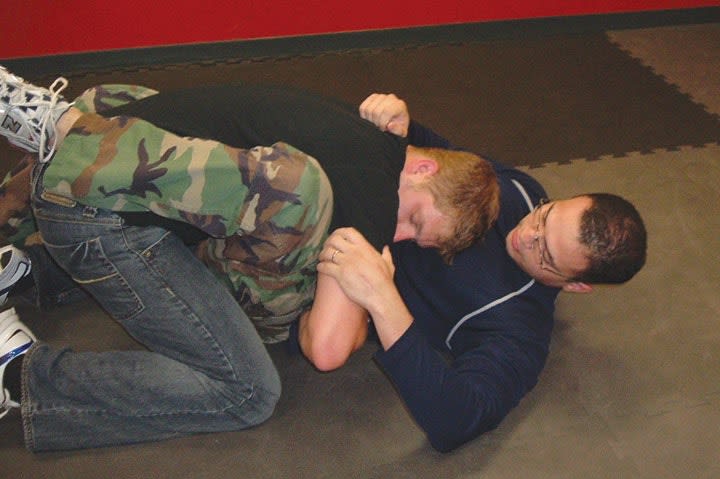
5. When you strike the head, you should do so with considerable force. If it is deemed necessary, strike him a couple of times with the forearm. After striking the offender, quickly bring your right hand over his left shoulder and grab your left wrist, creating a lock. See photo, ABOVE, for effective hand positioning. This will place the power of two arms up against one.
6. When you lock the individual's arm, do not straighten it! Make sure the elbow remains bent and crank his wrist and arm toward his upper spine. He will naturally move to your right but you will have him trapped with your right leg. Your left leg will come up onto his back, controlling him further. Note: your gun side has been completely moved away from him.
7. From the top view you can see the lock clearly. The guy in the BELOW photo is in complete pain. He has nowhere to go, his left arm is trapped, his right arm is locked up, and he is resting on his head and neck. If you're a lone officer, remember, all bets are off and cranking this guy's shoulder to end the fight is justified. If he is going for your gun for the obvious reason of killing you, tearing his arm is justified, but it's up to you to make the call; every situation is case-by-case.
In the event of this being a two-officer situation, the prisoner is in position for your partner to handcuff. Have your partner reach for the prisoner's non-locked arm first. If there is further resistance, a little directional initiative can be given by cranking the locked arm.
Remember, taking a proactive approach toward your survival and the survival of your fellow brothers and sisters is paramount.
Above all, train hard—and never go gently.
Ramon Rosario is a former police officer currently assigned as a Gunner for the 28th Military Police Company. He has more than 19 years of martial arts experience and has competed in several disciplines, including kickboxing and grappling.
More Patrol
The First Responders Children’s Foundation National First Responders Day Roll Call of Heroes Ceremony Returns to Times Square, NYC
First Responders Children’s Foundation (FRCF), in collaboration with T-Mobile, will host the Roll Call of Heroes ceremony in Times Square to commemorate National First Responders Day on Wednesday, Oct. 28. During the event, FRCF will present 18 Hero Awards.
Read More →
Streamlight to Showcase Newest Lighting Products for Law Enforcement Professionals at IACP 2026
Streamlight will showcase its newest lights for law enforcement at the International Association of Chiefs of Police Annual Conference & Expo. Featured lights will include the TLR-3 X, the PolyTac 1X, and more.
Read More →
Streamlight Portable Scene Light III Wins 2026 OH&S New Product of the Year Award
Streamlight’s Portable Scene Light III has won the 2026 Occupational Health & Safety (OH&S) New Product of the Year Award in the Lighting category.
Read More →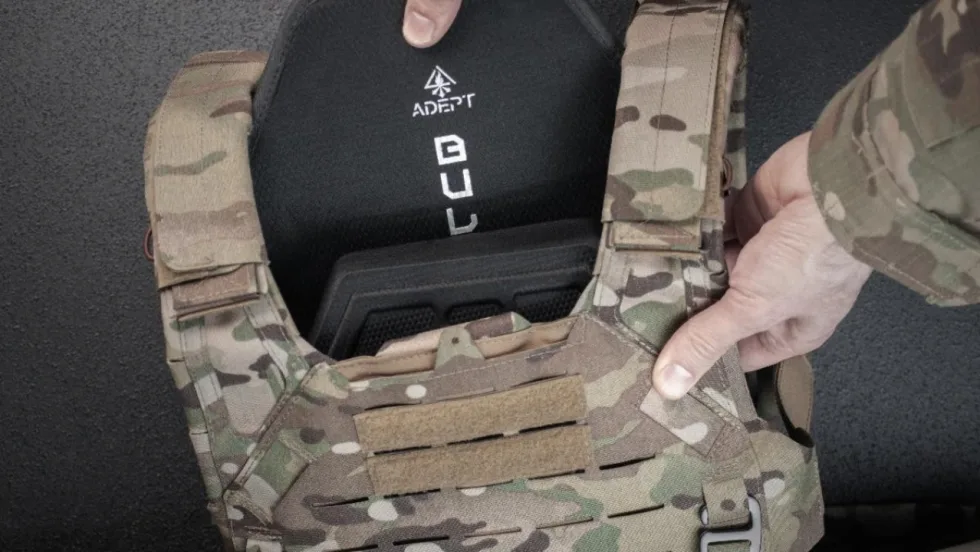
Adept Armor Introduces Two New Rifle Plates
Adept Armor has launched two new Level IV ballistic plates, the Emperor and the Archon Mark 2, which brings Adept Armor’s new Quatroid ceramic to the high-threat, performance-value center of the range at 5.2 pounds.
Read More →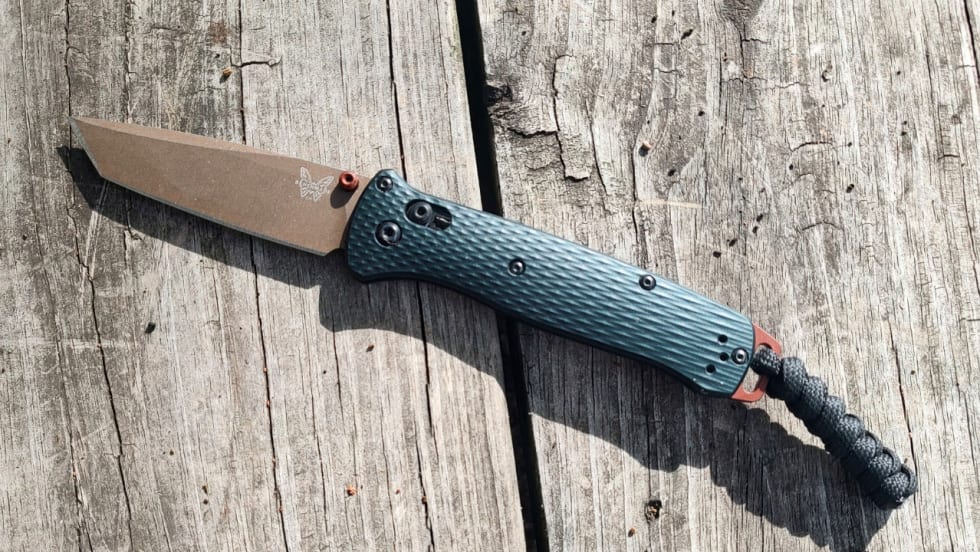
POLICE Product Test: Benchmade Bailout
The Benchmade Bailout is a slim, lightweight carry knife with a deep-ride pocket clip and comes in a variety of blade steels and scales. Here is a detailed review of the Taiga Green Bailout, released earlier this year.
Read More →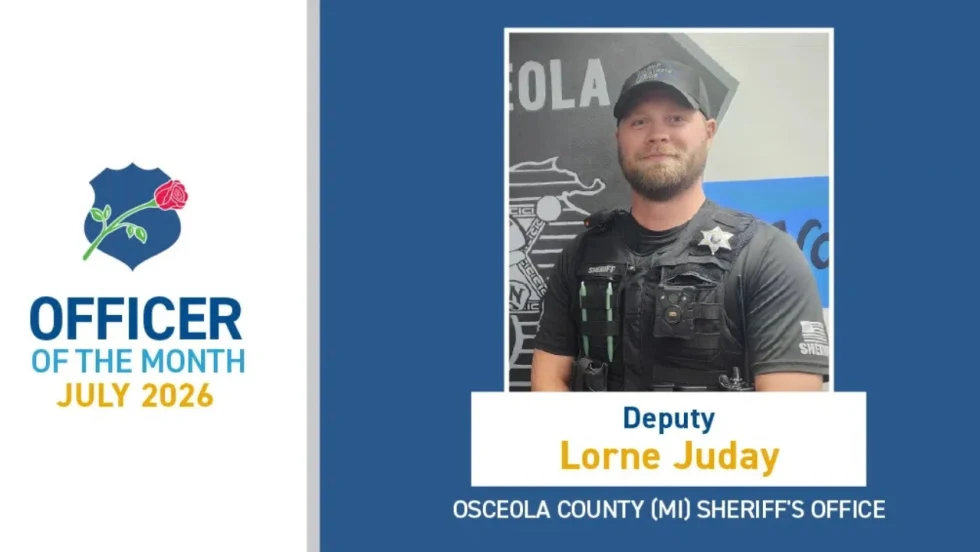
NLEOMF Announces July 2026 Officer of the Month
NLEOMF honored a Michigan deputy sheriff as the July 2026 Officer of the Month for rescuing a trapped driver from a burning vehicle following a Fourth of July crash.
Read More →
Streamlight to Showcase Newest Lighting Products at National Safety Council’s Safety Congress & Expo 2026
Streamlight will showcase its latest lights, including the Portable Scene Light III and the LiteBox 1Million, at the 2026 National Safety Council (NSC) Safety Congress & Expo.
Read More →
The 2027 World Police & Fire Games Set for Perth, Australia
The 2027 World Police & Fire Games (WPFG) will take place in Perth, Western Australia, from Friday, March 12 through Sunday, March 21, 2027.
Read More →
5.11 Partners with National Fallen Firefighters Foundation to Support #ForThe343
5.11 has joined the nationwide movement honoring the 343 New York City Fire Department firefighters lost on Sept. 11, 2001.
Read More →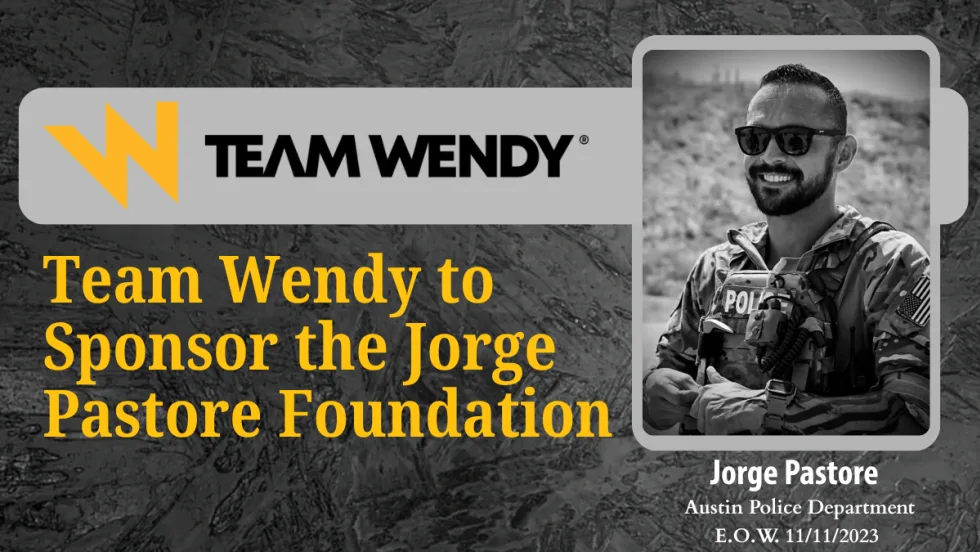
Team Wendy Announces Title Sponsorship of the Jorge Pastore Foundation
Team Wendy’s 3-year partnership with the Jorge Pastore Foundation expands access to programs that strengthen those who serve.
Read More →