



Cuffing with Useful Force
Tragically, the lives of many officers have been lost at the hands of suspects who attacked without warning as the officer attempted to apply handcuffs. Fortunately, there is a safer way to gauge a suspect's resistance while effectively controlling him.

Earlier this year in New Orleans, a vagrant wanted for questioning in a rape overpowered a police officer who was trying to handcuff him. He then shot her to death with her own weapon.
Tragically, the lives of many officers have been lost at the hands of suspects who attacked without warning as the officer attempted to apply handcuffs. The handcuffing process is perhaps the most opportune time for a suspect to attack an officer because of the officer's close proximity to the suspect and the fact that the officer's attention is divided between controlling the suspect and applying handcuffs.
Until now, there have been two basic methodologies for handcuffing presumably compliant suspects. Although there are advantages to these methods, each is inherently flawed.
Fortunately, there is a safer way to gauge a suspect's resistance while effectively controlling him. Before examining this tactic, let's consider the shortcomings of the two commonly used tactics.
Put Your Hands Behind Your Back
Often, when tasked with arresting a seemingly compliant suspect, an officer will instruct the suspect to turn around and place his hands behind his back or head. From there, the officer can approach and place the suspect in a control hold or simply grab the suspect's fingers or thumbs to facilitate what is commonly referred to as "speed cuffing."
With this approach, anything other than immediate compliance should be considered a red flag. Hesitation on the part of the suspect should make those little hairs on the back of your neck stand up. If you've maintained an appropriate distance, you might be able to access one of the tools on your duty belt to help persuade the suspect to comply.
The problem with this tactic is that you are in essence challenging the suspect to submit to your authority. Since you haven't established any physical control before revealing your intent to arrest the suspect, he has the opportunity to either fight or flee.
Control Hold First
The advantage of grabbing the suspect before telling him he's under arrest is that he has less time to formulate and execute a plan to assault you or flee. Grabbing the suspect first enables you to apply a control hold such as a rear wrist lock, twist lock, or bar arm. Of course, successfully applying a control hold against a resistive suspect is easier said than done.
Another consideration with this approach is that you will likely be dangerously close to the suspect when you realize he's not going along with the program. Lag time would make it nearly impossible for you to perceive the threat, let alone formulate and implement an effective counter from this distance.
Many martial arts-based defensive tactics systems advocate grabbing the suspect's wrist initially. This approach is problematic for two reasons. First, since the wrist is a relatively small target and situated a considerable distance from the core of the body, grabbing it can be difficult when the suspect is moving. Second, merely grabbing the wrist does not necessarily translate to controlling the suspect. As most officers will attest, holding onto a flailing suspect's wrist can be like trying to hold a tiger by the tail.
The L.A.T.C.H. Technique
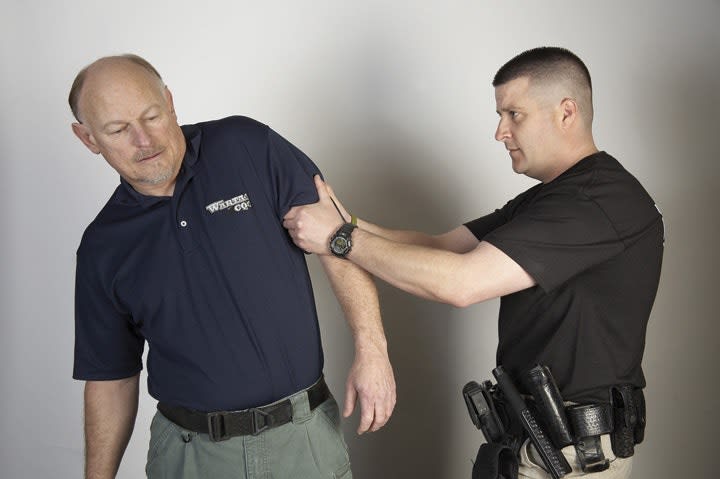
The Lateral Arm Transitional Control Hold (L.A.T.C.H.) places you in a position of relative safety while enabling you to anticipate a suspect's resistance.
Begin with your elbows close to your body and your arms up to protect your head. Step off line so that you are less vulnerable to being struck by the suspect. Firmly grasp the suspect's upper arm (biceps/triceps) and apply slight pressure upward and toward the suspect to compromise his balance. Now order the suspect to place his opposite hand on his head.
There are two significant advantages to grabbing the upper arm as opposed to the wrist initially. Since the upper arm is a larger surface and closer to the core of the body, it is much easier to grab than the wrist. Equally as important is that by establishing a firm hold on the upper arm, you can effectively control the suspect's entire body.
This can be attributed to the fact that the humerus bone connects directly to the shoulder socket. As a result, any pressure applied to the upper arm is transferred to the shoulder, which in turn inhibits upper body movement. If the upper body is anchored, lower body movement is severely limited.
To understand this concept, imagine one shoulder being held firmly in place while the legs try to propel the body toward the trapped shoulder. Obviously, the body's range of motion would be minimal.
By simply stepping off line and securing a firm, two-handed grip on the suspect's upper arm, you have established a significant degree of control without the use of any complex techniques reminiscent of martial arts-based defensive tactics systems.
Even more beneficial is the fact that you are able to control the suspect using leverage and positioning rather than pain.
The problem with techniques requiring the infliction of pain to achieve compliance is that if the suspect does not feel pain, there is no motivation for him to comply. Emotionally disturbed suspects, suspects under the influence of alcohol or drugs, or suspects who are highly committed to their cause may be impervious to pain.
At the other end of the spectrum are suspects who are extremely sensitive to the pain stimulus associated with these types of techniques. When dealing with a non-compliant suspect, it's possible to inadvertently apply more pressure than intended.
Remember that when applied too forcefully or at the wrong time, pain compliance techniques can actually trigger a violent response from a suspect who might have otherwise complied.
If the suspect complies when the L.A.T.C.H. is applied, simply transition to a rear wrist lock or twist lock and subsequent handcuffing.
Transitional Techniques
If the suspect resists after you've established a grip on his upper arm, you are in position to perceive the threat and respond before the situation further deteriorates, which could ultimately require the application of a greater degree of force to achieve or maintain control.
Shove-off—Once you have achieved the L.A.T.C.H., apply moderate pressure on the suspect's arm to compromise his balance. If he is going to resist, it will probably be at this point. Based on your position, you are relatively safe from any attempt by the suspect to strike you or grab your firearm.
Should the suspect become resistive, you can forcefully shove him away in a lateral direction, likely causing him to stumble. At the same time, you can combine your own rearward and lateral movement to create distance. This should give you time to access an appropriate tool from your duty belt.
Knee Strike—Another viable option when faced with a resistive suspect is to strike the outer portion of his thigh with your knee. The common peroneal nerve runs along the side of the leg and is a readily accessible target from the L.A.T.C.H. A forceful knee strike to the common peroneal nerve should cause the suspect's leg to buckle, momentarily distracting him and enabling you to execute a takedown or to transition to an appropriate control hold.
Since a knee strike delivered to this area is not likely to result in significant or permanent damage, it is considered a relatively low-level force option.
Head-butt —When considering portions of our anatomy to strike with, the head might not immediately come to mind (no pun intended). After all, we go to great lengths to avoid being struck in the head. However, the head can be a devastatingly effective personal body weapon when used properly.
To deliver an effective head-butt from the L.A.T.C.H., simply tuck your chin, shrug your shoulders (this action reduces the risk of injuring your neck upon impact), and pull the suspect's arm toward you. This should result in the top portion of your head impacting the suspect's face. Clenching your teeth prior to impact could save you a trip to the dentist.
Since the top of your head is much harder than the suspect's face, the impact is likely to stun the suspect, providing a window of opportunity for you to take him to the ground for prone handcuffing.
Due to its potential to inflict significant damage, the head-butt should only be used in situations where a substantial degree of force is required to control the suspect or ensure your safety.
Supine Takedown—Initiate this takedown by rotating your body to the suspect's rear, twisting his arm in the same direction to further inhibit his range of motion. While maintaining a tight grip on the suspect's upper arm, jerk his arm rearward and step past him with your inside leg. This should result in the suspect falling onto his back in a supine position.
As an alternative, especially against a larger suspect, you could execute a reap throw rather than just stepping past the suspect. The reap involves swinging your leg past the suspect's leg and striking your calf against the suspect's calf as you retract your leg. This should generate additional momentum to effect the takedown.
By maintaining control of the suspect's arm during the takedown, you will have the option of directing him into a prone position for handcuffing.
Prone Takedown—The advantage to this technique is that it enables you to take the suspect directly into a prone position, where he can more easily be controlled and handcuffed.
Starting from the L.AT.C.H., yank down on the suspect's arm to unbalance him. Step behind the suspect with your leg nearest his back. Step behind your front leg with your rear leg and pivot on the balls of your feet to face in the opposite direction while continuing to pull down on the suspect's arm. The momentum generated from your body rotation coupled with pulling downward on the suspect's arm should spiral him down into a prone position.
Until now, officers were limited to either telling the suspect he was under arrest from several feet away or attempting to place the suspect in a control hold prior to advising him that he was under arrest. Each methodology is inherently flawed and could ultimately jeopardize your safety.
The L.A.T.C.H. affords you a position of relative safety from which to identify potential resistance prior to handcuffing. In addition, it enables you to smoothly transition to familiar techniques to handcuff, create distance, or take the suspect to the ground.
Richard Nance and David Hallford are the co-founders of WARTAC. Nance is a SWAT team member, defensive tactics instructor, firearms instructor, and Karate black belt. Hallford is a defensive tactics instructor and black belt martial artist.
More Patrol

Streamlight Portable Scene Light III Wins 2026 OH&S New Product of the Year Award
Streamlight’s Portable Scene Light III has won the 2026 Occupational Health & Safety (OH&S) New Product of the Year Award in the Lighting category.
Read More →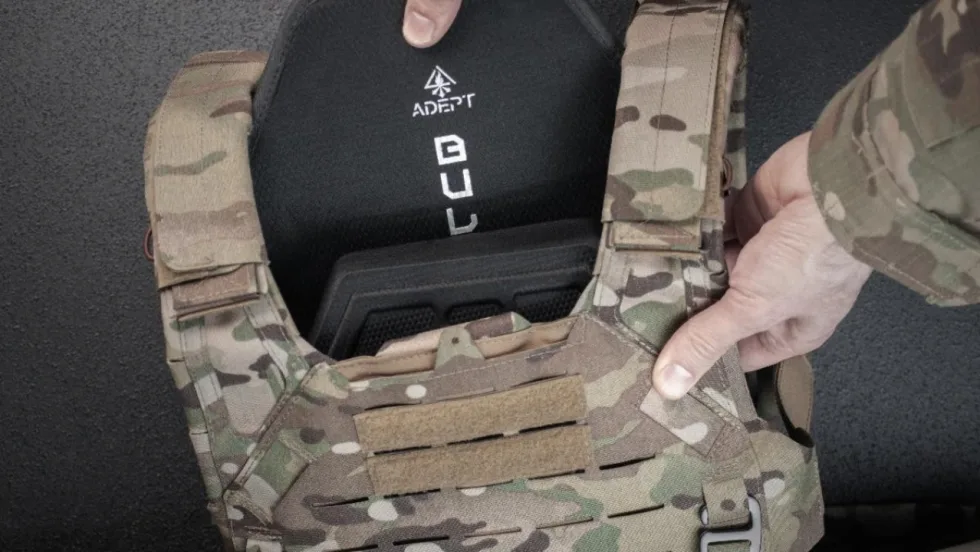
Adept Armor Introduces Two New Rifle Plates
Adept Armor has launched two new Level IV ballistic plates, the Emperor and the Archon Mark 2, which brings Adept Armor’s new Quatroid ceramic to the high-threat, performance-value center of the range at 5.2 pounds.
Read More →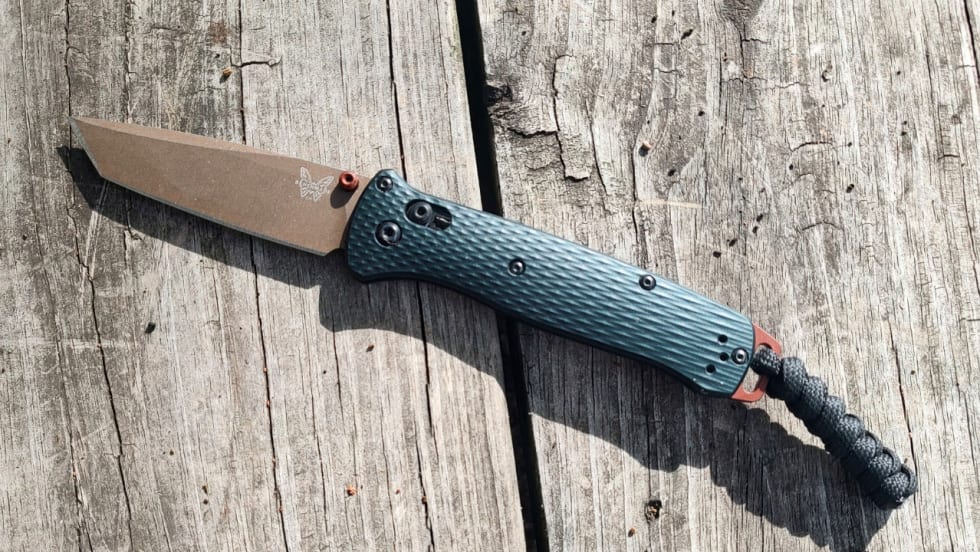
POLICE Product Test: Benchmade Bailout
The Benchmade Bailout is a slim, lightweight carry knife with a deep-ride pocket clip and comes in a variety of blade steels and scales. Here is a detailed review of the Taiga Green Bailout, released earlier this year.
Read More →
NLEOMF Announces July 2026 Officer of the Month
NLEOMF honored a Michigan deputy sheriff as the July 2026 Officer of the Month for rescuing a trapped driver from a burning vehicle following a Fourth of July crash.
Read More →
Streamlight to Showcase Newest Lighting Products at National Safety Council’s Safety Congress & Expo 2026
Streamlight will showcase its latest lights, including the Portable Scene Light III and the LiteBox 1Million, at the 2026 National Safety Council (NSC) Safety Congress & Expo.
Read More →
The 2027 World Police & Fire Games Set for Perth, Australia
The 2027 World Police & Fire Games (WPFG) will take place in Perth, Western Australia, from Friday, March 12 through Sunday, March 21, 2027.
Read More →
5.11 Partners with National Fallen Firefighters Foundation to Support #ForThe343
5.11 has joined the nationwide movement honoring the 343 New York City Fire Department firefighters lost on Sept. 11, 2001.
Read More →
Team Wendy Announces Title Sponsorship of the Jorge Pastore Foundation
Team Wendy’s 3-year partnership with the Jorge Pastore Foundation expands access to programs that strengthen those who serve.
Read More →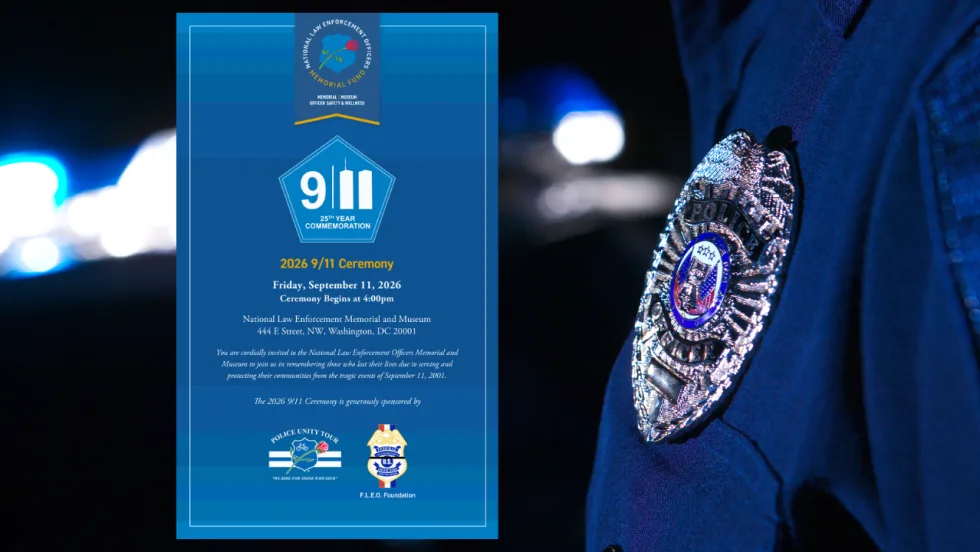
National Law Enforcement Memorial and Museum Hosting 9/11 25th-Year Commemoration Ceremony
The National Law Enforcement Memorial and Museum is hosting a 9/11 25th Year Commemoration Ceremony on Sept. 11 at 4 p.m.
Read More →
National Law Enforcement Officers Memorial Fund Announces June 2026 Officers of the Month
The National Law Enforcement Officers Memorial Fund (NLEOMF) named 15 officers of the Chico Police Department (California) as the Officers of the Month for June 2026 for their roles in responding to an active-shooter incident at a public library.
Read More →