As the role of the police dog expands, training has taken on more importance, even as economic times threaten the funding for the dogs and their handlers.
Since 9/11, law enforcement agencies have been more vigilant about using K-9s to find explosives to thwart terrorist attacks, in addition to aiding in patrol duties and sniffing out narcotics. As the role of the police dog expands, training has taken on more importance, even as economic times threaten the funding for the dogs and their handlers.
"One of the first details that gets its budget cut tends to be the K-9 units," says Andy Jimenez, a former K-9 handler who is now owner and CEO of Falco K9 Academy in Southern California. "The thing that makes that strange is detection dogs actually save man hours, and therefore save the department money. And oftentimes narcotics dogs make departments money. It's an unfortunate situation."
But many agencies are still reaping the benefits of K-9 units, financial and otherwise. And as Jimenez notes, detection is at the top of the list.
The Nose Knows
"It used to be, back in the '60s and '70s, we had dogs because of their teeth. Now we've realized the nose is the most important thing," says Jim Matarese, president of the United States Police Canine Association (USPCA).
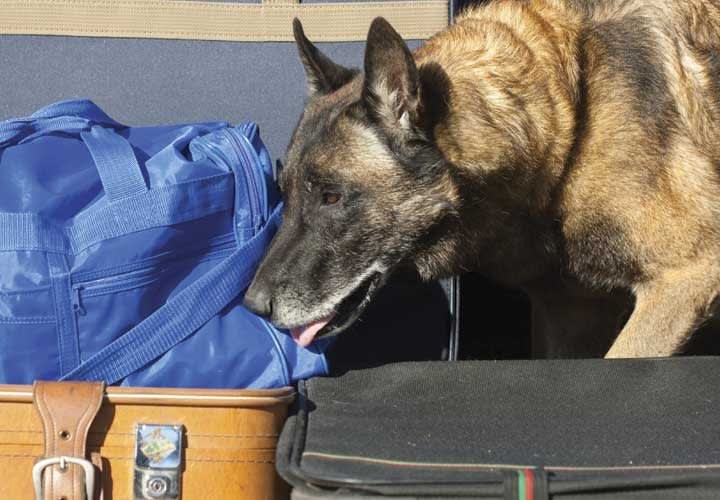
Although police departments have been using dogs' noses to sniff out narcotics and explosives for decades, Jimenez says in recent years he's seen an increase in the use of explosive detection dogs by the TSA and Department of Homeland Security as well as police departments with airports and Fed-Ex and UPS hubs in their cities. And those agencies who were already using dogs for detection have upped their training, especially since 9/11.
"I think a lot of agencies that used to be [more lax] on the detector side realized for maintenance more training needs to be done, at least once a week," says Matarese.
More training requires a steady supply of substances for the dogs to sniff and alert to, which poses certain problems for agencies. Using real drugs and explosive materials requires special licenses, which can be expensive. For this reason some agencies use each other's narcotics and explosives for training purposes. But it can also be a logistical nightmare to safely store these supplies so that they can't cause harm or be stolen, and sharing among agencies complicates matters.
"In the DC metro area where I live, I see that more departments are getting a bunker to store their own explosives to not rely on another agency to provide training aids," says Matarese.
One solution to these problems is the use of pseudo scents, which mimic the odor of a narcotic or explosive. For example, the hydrogen peroxide-based explosive favored by such terrorists as the "shoe bomber" is extremely unstable, and thus very dangerous to use for training purposes. But K-9s need to know the scent so they can detect it in airports and elsewhere to protect the public.
"Scientists have developed a training aid that has the odor necessary to train the dog, but not the danger. There's no chance of it exploding," explains Jimenez. "It's something that we've needed for several years that they just came up with. We're currently using it in training."
This boon is not without its downside, however. Because pseudo scents are manufactured, they are not going to be exactly the same as a real drug or explosive. In fact, one of the issues with pseudo scents is that they always smell the same, which is great for consistency, but not an accurate portrayal of the full array of scents that can be found in, say, different formulations of cocaine that K-9s need to be able to recognize on the street. Using only simulated odors can be problematic, but even using both for training can pose problems in the courtroom.
"Using Pseudo scents for explosives and narcotics works, but it's a different scent. If you're testifying in court, you'll have to explain this," cautions Russ Hess, USPCA executive director. "It can put doubt in the jury's mind. For example, in court you could be asked, 'Has your K-9 ever alerted to anything else [other than real drugs or explosives]?' And you'd have to say, 'Yes.' It's easier to testify without using simulated scents."
[PAGEBREAK]Positive Reinforcement
Regardless of the skills being taught, positive reinforcement is a key component in training K-9s today. Unfortunately, this wasn't always the case. In fact, as recently as last year a K-9 handler in North Carolina was in the news for hitting his dog during routine training. This incident brought renewed interest to the discussion of how to properly and humanely teach police dogs the skills necessary for the job. Especially because the officer's abusive tactics were those approved by his agency.
"Compulsive training is necessary, but cruel treatment is not," says Hess. "The only time an officer should respond with that amount of force is if the dog attacks him. For training exercises, there are more humane tactics."
Jimenez agrees. In teaching dogs to clear buildings he favors surprising them with either a toy or a bite on a "bad guy" as the reward. He's found that not knowing the result not only keeps K-9s interested, but it also prevents dogs who become stressed by being expected to bite a "bad guy" every time from dreading a search. The prospect of playing with a toy provides enough incentive that the act of searching is no longer stressful.
This is important because stressed dogs aren't effective. Jimenez recognizes dogs that have been trained using more negative reinforcement than positive in his travels as a trainer. Such K-9s can have difficulty getting over their learned behavior.
"It's harder to fix a dog that's been 'overcompulsed' than it is a dog that has been overly praised," says Jimenez.
Although it might seem counterintuitive, most trainers agree that modern electronic collars can easily exist alongside positive reinforcement. Also known as "shock collars," these devices deliver a low voltage electric shock to the dog as a part of training and maintaining proper behavior on the job. A trainer or handler initiates the shock via a remote control.
"The way the e-collars are made now, they can be probably the most humane way of training a dog," says Falco K9 Academy's Jimenez. He uses them in training, although not all of the time. As always, the emphasis needs to be on proper technique, he says.
"They're not used to punish the dog," explains Matarese. "At very low volts it's less intrusive than having a choke chain on the dog and giving him a hard pull. Like anything else, it's a great tool as long as the person has been trained in its use."
Embracing Technology
An e-collar is just one of many innovative tools now available to K-9 handlers and trainers that have changed the way K-9 units do their jobs.
For his part, Jimenez and his team have found that video has opened a whole new world of training feedback that wasn't possible before.
"We implement a lot of video in our training to help the handlers see themselves," says Jimenez. "They're too close to the action sometimes, and they don't believe that they did something, like talk too much to their dogs. So when they see it for themselves it's helpful."
Falco K9 also posts the videos of training in action on YouTube so others can benefit from the lessons taught. Luckily, the featured handlers don't seem to mind, and in fact appreciate the feedback .
"The handlers really enjoy reviewing the video and seeing themselves," Jimenez says.
Fitting dogs with cameras on the job to provide officers stationed remotely with a tactical edge is a completely different technology that is still in its infancy, and very expensive.
"Some of them are so complex that they can give the dog commands from the camera and see what he sees," says Matarese. But he doesn't expect for them to be used in his local K-9 units any time soon. "I don't think it's going to be a normal thing."
Technology developed specifically to protect K-9s has been around for a while, but it's continually being improved. Of course, like cameras, such products are only effective if they're used.
"Heat alarms for motor vehicles are well worth their weight in cost. I can't recommend them any more than a leash itself," says the USPCA's Hess. "They're especially important in a hot climate; even new cars break."
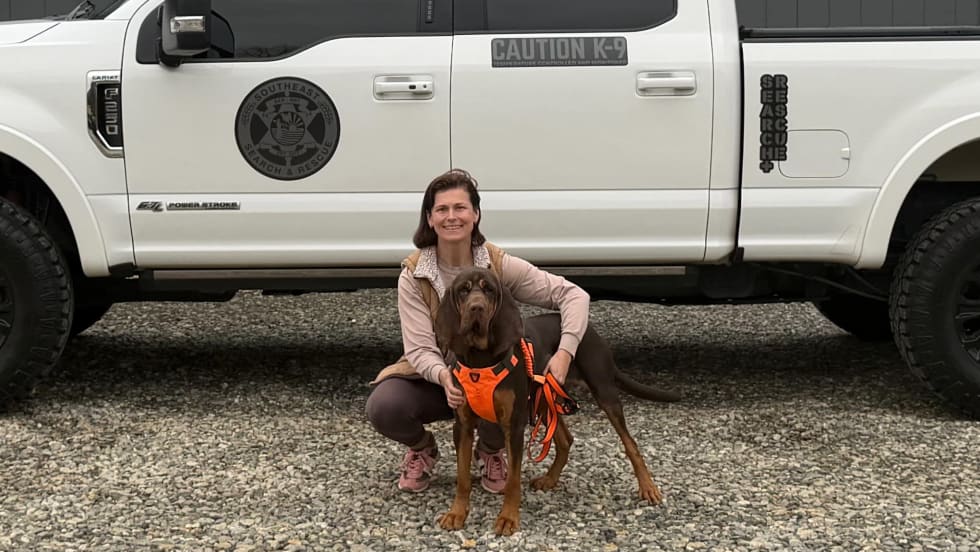
Just as parents are warned to never leave their children inside a hot car, handlers must be sure that K-9s are protected from excessive heat inside cruisers. Specialized systems monitor the temperature inside a K-9 vehicle by adjusting the air conditioning. If the AC fails the system turns fans on, rolls windows down, and alerts the handler of the failure via an alarm and a paging device. Unfortunately, there are still instances of K-9s dying from heat exhaustion when handlers fail to use these systems.
"The dog is an expensive tool for the department, so it's important to protect them," says Matarese.
Another protective tool for K-9s, ballistic vests are currently used sparingly. They are heavy, hot, and cumbersome, and so can hamper a dog's ability to work or lead to overheating. For these reasons they're generally used in case of a specific threat of gunfire or stabbing directed at the K-9 entering a situation.
"They're working on making them lighter," says Hess. "In a couple cases they've been credited with saving a dog. But they're not yet accepted because the technology hasn't advanced enough. With more technological advances, we'll be seeing ballistic armor for dogs more in the future."
Another technological innovation for K-9 units is software that keeps a log of K-9 training and call-outs. It can be done with a paper and pencil as was the practice in the past, but an electronic record can be easily shared and backed up departmentwide. Of course, it's up to handlers and trainers to maintain these records, which are invaluable in the courtroom.
"If you're the best team in the world but you haven't done your documentation, you're going to lose that case," says Jimenez. "As long as you use it, the software makes things a lot easier."
[PAGEBREAK]Future Uses
As for what the future holds for law enforcement K-9s, more avenues for their use keep opening up.
"It's amazing what the dogs can do," says Matarese. "Even in the private sector, they have the bedbug detecting dogs in New York City where that's become a big problem."
In prisons and jails, corrections officers use dogs to sniff out contraband cellular phones. Matarese says a dog can detect a phone just by walking past a prison cell. There are even dogs law enforcement uses to conduct a "scent ID line-up." More common in Europe, this practice is "still in its infancy of being done correctly" according to USPCA's Hess, but a bloodhound in Texas is currently being used in this way.
"Dogs can now detect cancer, pipeline leaks, and termites, from what I hear," says Hess. "We haven't reached the capabilities of the dog and what he can do with scent."
K-9 Equipment and Services:
ACEk9.com
Criminalistics
Elite K-9
Ray Allen
Scent Logix
Securesearch Inc.
Tripwire Operations Group
U.S. Explosive Storage