



The Mission After the Moment
The mission of the Jorge Pastore Foundation is to support first responders through essential training, stronger community engagement, and mental wellness resources, all accessible and funded through donations, sponsorships, and foundation-led fundraising. It works closely with Team Wendy in the discussions about developing better protective gear for officers.
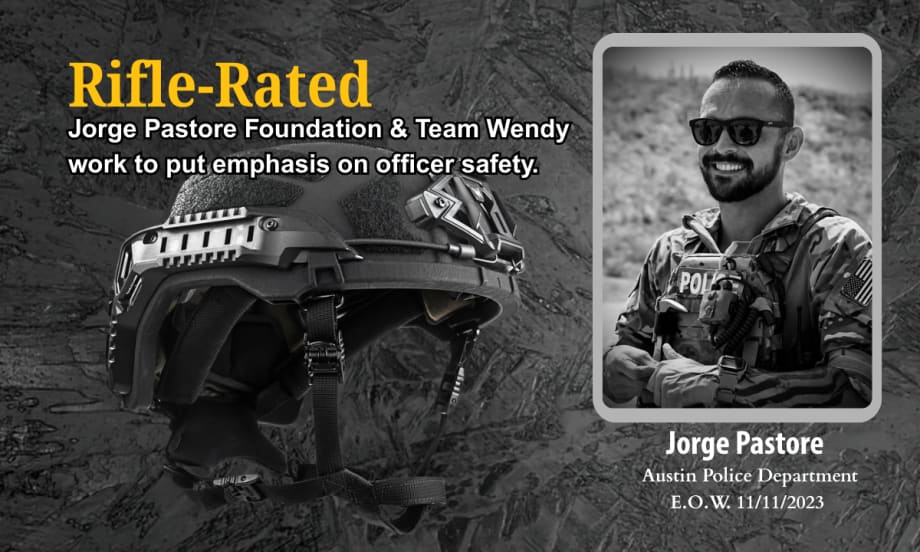
The Jorge Pastore Foundation took shape because Kim Pastore saw what wasn’t in place after her husband, Jorge “George” Pastore, was lost during a SWAT hostage rescue in 2023.
Team Wendy/POLICE
- The Jorge Pastore Foundation supports first responders with training, community engagement, and mental wellness resources.
- Funding for the mission is provided through donations, sponsorships, and foundation-led fundraising efforts.
- Collaboration with Team Wendy aims to enhance protective gear for officers.
*Summarized by AI
Jorge “George” Pastore didn’t step into duty all at once. He started in EMS and the fire service, where you learn that competence is built through repetition, discipline, and trust in the people beside you. Those roles also teach a certain kind of steadiness: show up, do the work, and carry the weight without seeking credit.
Following the Pulse nightclub tragedy in 2016, and later incidents like Parkland and the Fort Lauderdale airport shooting, Jorge began to see law enforcement as the path to bringing lifesaving care closer to the moment it’s needed. For him, those events clarified the weight of responsibility he was ready to own.
Sadly, Jorge’s watch ended in 2023 during a SWAT hostage rescue. With deep respect for his life and service, the Jorge Pastore Foundation now carries his legacy forward, strengthening readiness and support for those who would answer the next call.
For first responders, readiness is never something you “turn on” when the call comes in. Rather, it’s built in the quiet hours through repetitions and routines that add up to capability. And when the worst day arrives, the need doesn’t end when the scene does, because support is often needed long after the radios go quiet.
The Jorge Pastore Foundation
The Jorge Pastore Foundation exists to make that reality more manageable. Its mission is to support first responders through essential training, stronger community engagement, and mental wellness resources that are reachable, financed through donations, sponsorships, and foundation-led fundraising.
At its core, the foundation is a response to the obstacles that keep professionals from getting better, from tight schedules and thin staffing to limited seats and costs that often fall to the individual. It tackles those constraints with no/low-cost training, grants that help cover expenses, and wellness resources that fit the realities of the work.
The goal is to keep good plans from falling apart when shift coverage, travel, and budget trade-offs get in the way, and founder Kim Pastore said the first year shows the model is working. She estimates the foundation has supported more than 500 officers from over 45 agencies since 2024, while providing roughly $80,000 in training assistance.
“The demand for training is real,” Kim said. “And so is the appetite for quality and meaningful training that ensures readiness moving forward.”
What Must Change Next
The Jorge Pastore Foundation took shape because Kim Pastore saw what wasn’t in place after her husband, Jorge “George” Pastore, was lost during a SWAT hostage rescue in 2023. She tells her story quietly, often in small rooms or into a microphone, before turning to the practical question: What needs to be better for the next call?
For Kim, that question became more specific when Jorge’s gear was returned, and she noticed damage to his helmet. That moment sparked a deeper search for answers about rifle threats, what protective gear claims really mean, and whether the language matches reality.
“A big part of our work is education,” she explained. “The problem is that ‘rifle-rated’ is a term people repeat, but the details that give it meaning—the standards, test conditions, and trade-offs—often don’t travel with the label. Without that context, equipment comparisons can get muddy.”
For her, the point is bigger than helmets alone, as the PPE landscape is changing. Options and technologies exist now that, in Kim’s view, weren’t available when Jorge needed them, and she believes the community must keep pace with what protection can and should look like.
That’s why she approaches her work as an ongoing conversation.
“Readiness is hours in training, sure,” Kim says. “But it’s also the choices that get made about what you wear and what you’re counting on. Our job is to keep those decisions tied to real requirements and to give people the language to ask better questions.
Where Gear Talk Gets Real
PPE decisions are often shaped in the middle ground between testing data and purchase approval. As Kim described, that can be during a training day, or in a debrief, or anywhere there’s back-and-forth between the people who wear the gear and those who fund it. This is where priorities get set, where assumptions harden, and where “good enough” can become the default if no one asks the hard questions.
More and more, the Jorge Pastore Foundation is focused on making sure those conversations happen face to face. That’s why Kim stays close to the voice of the industry, from conferences to podcasts to small-group settings with individual units. In all cases, she keeps the focus on practical questions that decision-making depends on:
- What is the equipment expected to do?
- Under what conditions?
- Against what threats?
- What trade-offs come with the choice?
The goal is not argument or debate, but rather to help decisions stand up to scrutiny.
Team Wendy is one example of how that industry engagement can work when it stays education-led.
Kim connected with the Team Wendy team through speaking opportunities tied to her outreach, and the collaboration has focused on clear definitions up front, from helping organizations understand how to think about “rifle-rated” protection in plain language, to the details that matter when comparing options.
The value is what happens when field experience, training priorities, and product-side specifics are discussed together. Within that context, vague labels get unpacked, assumptions get tested, and the choices that follow are easier to stand behind.
Show Your Work
If there is one phrase that captures the confusion around protective helmets, it may be “rifle-rated.”
"It's used loosely without a true understanding of what it actually means,” Kim said. “But it can mean very different things depending on what standard is being referenced, what threats were used, and what the test conditions were. That means two products can share the same label, but still be worlds apart, depending on the benchmarks they were measured against.”
As Team Wendy framed it, velocity is one of the details that too often gets lost. Some rifle-rated labeling in the market may be based on reduced-velocity approaches, including reduced-load ammunition, lower-velocity rifle cartridges, or specific rounds such as .300 Blackout.
Those approaches may fit certain needs, but they are not the same as testing at full muzzle velocity.
That distinction sits at the center of the company’s broader approach: “rifle-rated” should only be used alongside the test conditions and definitions that give the term real meaning, especially when equipment decisions are on the line.
There is also a close-range reality that makes this more than an academic debate. FBI LEOKA reporting (2005–2014) found that 62.2% of officers killed by firearms were shot from 0 to 10 feet away, underscoring why definitions and test conditions matter when the environment compresses time and distance.
What “Rifle-Rated” Really Means
RIFLETECH enters the conversation here as an example of what Kim keeps pushing for in the field, moving past the label and into specifics. People hear rifle-rated, assume it’s a single definition, and later discover the term can vary. It’s a reflection, in her view, of how mission-critical PPE has entered a new era: more technology, more nuance, and more need to evaluate options with discipline.
One way to make that discussion more concrete is to look at how a manufacturer defines its own claims.
RIFLETECH is Team Wendy’s rifle-rated ballistic helmet line, built to address rifle threats rather than stopping at handgun-level protection. The company anchors the claim by detailing the references and conditions the platform is tied to:
- Team Wendy cites NIJ RF1 (NIJ STD 0123.00) and NIJ Level III (NIJ STD 0108.01), with testing referenced to NIJ STD 0106.01, and it specifies the threat set it associates with the helmet: 7.62×39 MSC, 7.62×51 FMJ/M80, 5.56 M193 BT, and 9mm FMJ RN.
- The company also includes a fragment metric—17gr FSP V50 at or above 4,430 fps (1,350 m/s)—to make the performance discussion more concrete. V50 testing provides valuable comparative insight into a helmet’s resistance to penetration and its overall material capability. For reference, an Aramid IIIA helmet has a V50 performance of 650 m/s.
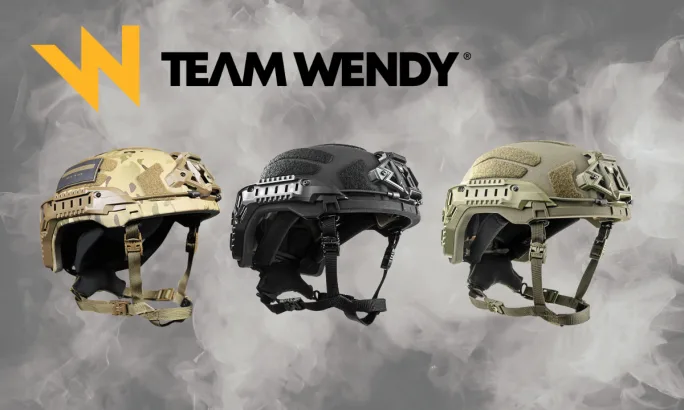
The RIFLETECH ballistic helmet line is one example of how “rifle-rated” can be defined with
specific NIJ references, a stated threat set, and design choices that reflect real use, from accessory
integration to heat management during extended wear.
Team Wendy/POLICE
That legibility matters because “rifle-rated” messaging can be tied to reduced-velocity approaches or different rounds that do not necessarily represent full muzzle-velocity rifle threats.
Team Wendy’s approach is to keep the conversation specific:
- What was fired?
- At what velocity?
- At what distance?
- Using what standard reference?
This forces a more useful question than “Is it rifle-rated?” The better question becomes “Rifle-rated against what, exactly?”
Rifle-rated discussions can’t stay limited to ballistic performance alone, however. Helmets are worn in heat, under movement, with comms and accessories, for as long as the job demands, and any serious evaluation must account for those operational realities alongside the stated threat.
For these reasons, RIFLETECH uses a UHMWPE shell and includes features meant to support real-world wear and configuration, including a non-penetrating accessory approach (“no thru holes”) and a liner system incorporating air channels and cooling pads. The point is that ballistic protection must be considered alongside wearability, heat management, and how the helmet is configured and worn.
Bridging the gap
The rifle-rated conversation keeps circling back to a broader reality in public safety: equipment decisions are often made by people who won’t wear the gear, while the people who do wear it don’t always have the same information or seat at the table.
Procurement has its own pressures and timelines. The field has its own requirements and consequences. When those worlds are not sharing the same information, decisions can become more about habit, budget cycle, or whatever sounds simplest to explain.
That is where the trouble starts. People remember the label but forget the fine print. And soon enough, rifle-rated can sound definitive, even when no one has pinned down what was tested and how.
“Without those specifics, the choice often defaults to precedent or price,” Kim said. “That’s not anyone trying to cut corners. It’s how decisions get made. But under pressure, those shortcuts can cost you.”
Both the Jorge Pastore Foundation and Team Wendy are making better choices the norm. In the rooms where gear gets discussed, Kim Pastore has a story to share, and where agencies talk shop, Team Wendy’s product specialists keep claims grounded in plain language.
“We need to change the question from ‘What do we always buy?’ and ‘What is the most cost effective?’ to ‘What fits the mission?’ and ‘What is the latest, most effective technology?’” Kim said. “When the people who wear the gear, the people who train, and the people who build it are in the same conversation, not only does it make sense and lead to better decisions, but it gets harder for vague language to skate by because assumptions get challenged.”
“The constraints don’t disappear, but there’s less guesswork and a better chance that decisions all pull in the same direction,” she added.
Watch Team Wendy Shoot a RIFLETECH Helmet
Some manufacturers claim rifle ratings but only test their helmets at lower muzzle velocities. This means that while the helmet might stop a round under certain conditions, it requires the shooter to be at a distance where the bullet’s velocity has decreased. In extreme terms, almost any helmet could be called “rifle-rated” if the bullet is slow enough due to distance.
Team Wendy’s approach is different: The RIFLETECH helmet is rated to stop rifle rounds at muzzle velocity, reflecting the realities of close-quarters encounters. This distinction matters because many encounters unfold at close range.
What Comes Next
The Jorge Pastore Foundation is building toward the next phase with the same mindset it started with: more opportunities to train, deeper wellness support, and a focus on helping departments navigate equipment questions with less guesswork.
For those who want to help move that work forward, support can take several forms, from donations and sponsorship to partnerships that expand what the Foundation can offer.
The mission after the moment is built out of repeatable steps: Training that gets done. Support that is reachable. Education that makes decisions stronger.
Team Wendy remains one part of the larger conversation in the background, contributing a manufacturer’s perspective to PPE evaluations when it’s helpful, alongside the training and operational voices that set and keep a high standard.
In the end, the story is about the Foundation putting purpose to work, widening its impact, and reinforcing readiness before the next call ever comes.
More Patrol
Streamlight Portable Scene Light III Wins 2026 OH&S New Product of the Year Award
Streamlight’s Portable Scene Light III has won the 2026 Occupational Health & Safety (OH&S) New Product of the Year Award in the Lighting category.
Read More →
Adept Armor Introduces Two New Rifle Plates
Adept Armor has launched two new Level IV ballistic plates, the Emperor and the Archon Mark 2, which brings Adept Armor’s new Quatroid ceramic to the high-threat, performance-value center of the range at 5.2 pounds.
Read More →
POLICE Product Test: Benchmade Bailout
The Benchmade Bailout is a slim, lightweight carry knife with a deep-ride pocket clip and comes in a variety of blade steels and scales. Here is a detailed review of the Taiga Green Bailout, released earlier this year.
Read More →
NLEOMF Announces July 2026 Officer of the Month
NLEOMF honored a Michigan deputy sheriff as the July 2026 Officer of the Month for rescuing a trapped driver from a burning vehicle following a Fourth of July crash.
Read More →
Streamlight to Showcase Newest Lighting Products at National Safety Council’s Safety Congress & Expo 2026
Streamlight will showcase its latest lights, including the Portable Scene Light III and the LiteBox 1Million, at the 2026 National Safety Council (NSC) Safety Congress & Expo.
Read More →
The 2027 World Police & Fire Games Set for Perth, Australia
The 2027 World Police & Fire Games (WPFG) will take place in Perth, Western Australia, from Friday, March 12 through Sunday, March 21, 2027.
Read More →
5.11 Partners with National Fallen Firefighters Foundation to Support #ForThe343
5.11 has joined the nationwide movement honoring the 343 New York City Fire Department firefighters lost on Sept. 11, 2001.
Read More →
Team Wendy Announces Title Sponsorship of the Jorge Pastore Foundation
Team Wendy’s 3-year partnership with the Jorge Pastore Foundation expands access to programs that strengthen those who serve.
Read More →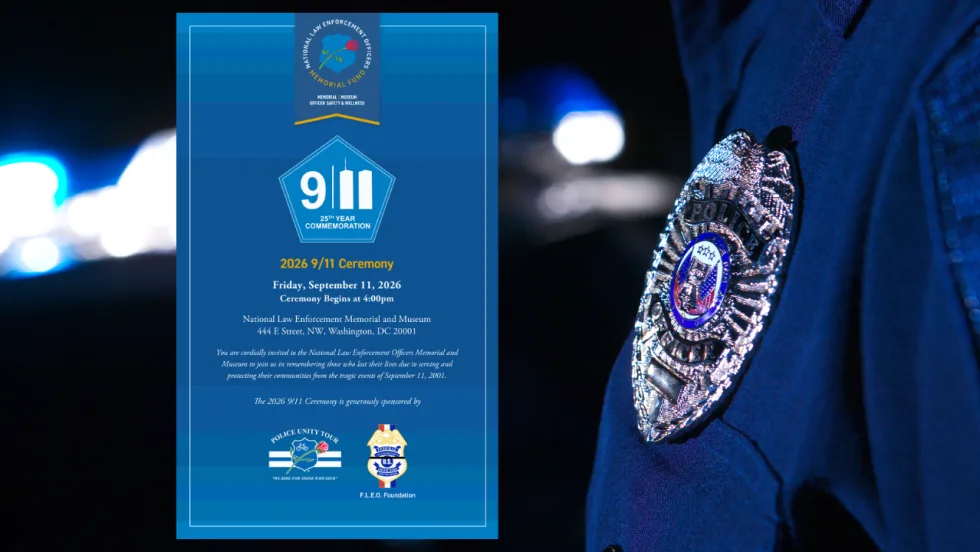
National Law Enforcement Memorial and Museum Hosting 9/11 25th-Year Commemoration Ceremony
The National Law Enforcement Memorial and Museum is hosting a 9/11 25th Year Commemoration Ceremony on Sept. 11 at 4 p.m.
Read More →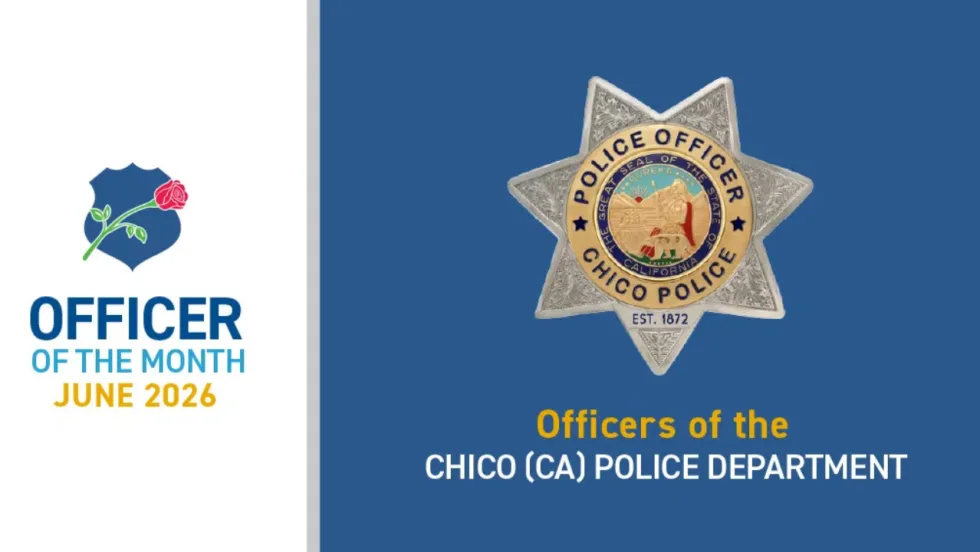
National Law Enforcement Officers Memorial Fund Announces June 2026 Officers of the Month
The National Law Enforcement Officers Memorial Fund (NLEOMF) named 15 officers of the Chico Police Department (California) as the Officers of the Month for June 2026 for their roles in responding to an active-shooter incident at a public library.
Read More →