



A Use-of-Force Continuum for Dealing with Dogs
If the owner or another person known to the dog is not available, you may be able to gain the dog’s acceptance by softening your approach. Dog experts recommend you stop moving toward the dog, assume a bladed stance sideways to the dog, and avoid eye contact, while talking to him in a strong, reassuring tone. This may have a calming effect that will allow you to safely conduct your business and leave.

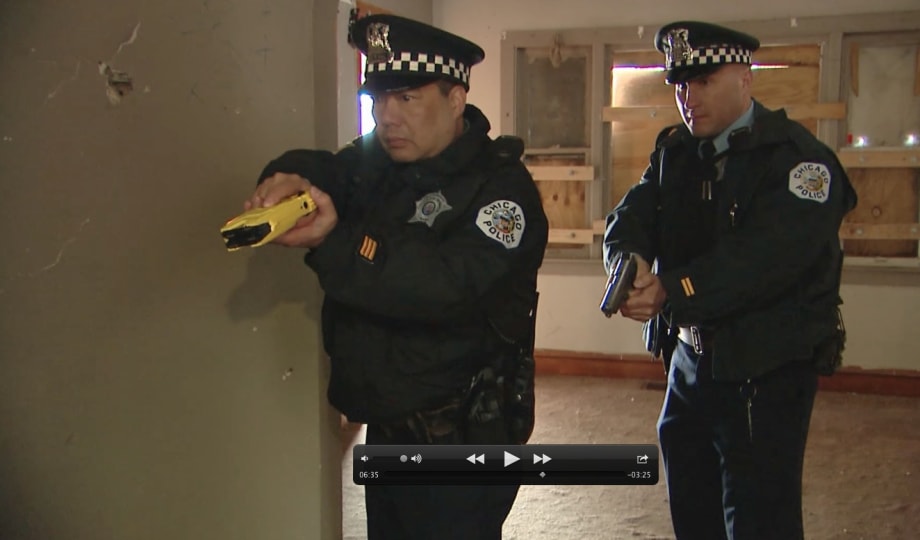
Chicago officer demonstrate how to use a TASER on a dog. Note the cant of the device, so that the prongs spread horizontally on the animal's body. (Photo: National Canine Research Council)
Some dog behavior experts and police use-of-force specialists recommend that law enforcement officers and agencies consider adopting a use-of-force continuum for dealing with hostile canines.
Officer safety concerns have been raised about this idea, but it's important to remember it's a continuum and not a scale. If an officer is in reasonable fear of serious bodily injury or death, then deadly force is warranted, even if no other force options have been employed.
Officer Presence—You are on the scene. This is what is upsetting the dog. One of the best ways to deal with this is get someone the dog knows, preferably the owner, to restrain or lock up the animal.
If the owner or another person known to the dog is not available, you may be able to gain the dog’s acceptance by softening your approach. Dog experts recommend you stop moving toward the dog, assume a bladed stance sideways to the dog, and avoid eye contact, while talking to him in a strong, reassuring tone. This may have a calming effect that will allow you to safely conduct your business and leave.
Verbal Commands—Dog expert and former officer Jim Osorio, founder of Texas-based police training company Canine Encounters, says speak to the dog throughout the interaction in a firm, conversational tone. "If you yell and scream at a dog, you are asking to be bit," he warns.
Soft Technique—Draw a weapon with your weak hand, but don't show it to the dog. Osorio who teaches this use-of-force continuum in his classes, recommends a closed expandable baton. He says to keep it closed, unless you need to escalate.
Hard Technique—Deploy the tool once the angry dog gets within 8 to 10 feet of you. It could be a baton, TASER, or OC. If you choose a TASER or OC, then canine behavior expert and author Brian Kilcommons recommends you not push the weapon toward the dog. Doing so may force the dog to bite the tool and perhaps your hand and arm. In one case in California, an officer tried to strike a dog with his duty gun. The dog bit the gun and the officer’s arm, and the officer shot the dog to death.
The baton is a different story, however, because it gives you distance and you want the dog to bite it. Dog trainers say sometimes even the most hostile dog is happy biting anything and may withdraw after doing so. Osorio recommends that you move the baton side to side in a swinging arc while standing still. "Whatever is moving is what the dog will bite," he says.
If the dog comes in closer, you may have to strike it with the baton. Osorio recommends that you give the dog orders like "Stop!" and "Get back!" in a firm voice as you strike. This lets people know that you are being attacked by the dog, in case you have to use deadly force.
Deadly Force—Sometimes you have no other option. And remember you do not have to use all of the other options in the continuum before you shoot, if it's objectively reasonable to do so.
Just be sure other officers and civilians are not in your line of fire. And if you are in a building, give serious consideration to what may be behind the walls and in other rooms, including children.
One thing that is apparent in many reports of police shooting dogs is that officers often lose sight of the risks of firing at a dog when other officers and civilians are in the area. POLICE could not find evidence that anyone has been killed as a direct result of an officer shooting at a dog, but there have been close calls. And people have been hit.
Very few police officers have been trained to shoot fast-moving, low-to-the-ground animals. So it’s not uncommon for officers to fire many rounds before hitting the dog.
And sometimes they lose fire discipline. In a well-documented 2011 case in Camden, N.J., officers responding to a street fight between teenagers were approached by a dog described as an 8-month-old pit bull. When the dog, which had darted out of the owner’s door, came toward them, the officers opened fire. It is reported that more than 30 rounds were expended. Bullets hit cars in driveways and houses on the street. No one was injured. The dog was killed.
More Patrol

Streamlight Portable Scene Light III Wins 2026 OH&S New Product of the Year Award
Streamlight’s Portable Scene Light III has won the 2026 Occupational Health & Safety (OH&S) New Product of the Year Award in the Lighting category.
Read More →
Adept Armor Introduces Two New Rifle Plates
Adept Armor has launched two new Level IV ballistic plates, the Emperor and the Archon Mark 2, which brings Adept Armor’s new Quatroid ceramic to the high-threat, performance-value center of the range at 5.2 pounds.
Read More →
POLICE Product Test: Benchmade Bailout
The Benchmade Bailout is a slim, lightweight carry knife with a deep-ride pocket clip and comes in a variety of blade steels and scales. Here is a detailed review of the Taiga Green Bailout, released earlier this year.
Read More →
NLEOMF Announces July 2026 Officer of the Month
NLEOMF honored a Michigan deputy sheriff as the July 2026 Officer of the Month for rescuing a trapped driver from a burning vehicle following a Fourth of July crash.
Read More →
Streamlight to Showcase Newest Lighting Products at National Safety Council’s Safety Congress & Expo 2026
Streamlight will showcase its latest lights, including the Portable Scene Light III and the LiteBox 1Million, at the 2026 National Safety Council (NSC) Safety Congress & Expo.
Read More →
The 2027 World Police & Fire Games Set for Perth, Australia
The 2027 World Police & Fire Games (WPFG) will take place in Perth, Western Australia, from Friday, March 12 through Sunday, March 21, 2027.
Read More →
5.11 Partners with National Fallen Firefighters Foundation to Support #ForThe343
5.11 has joined the nationwide movement honoring the 343 New York City Fire Department firefighters lost on Sept. 11, 2001.
Read More →
Team Wendy Announces Title Sponsorship of the Jorge Pastore Foundation
Team Wendy’s 3-year partnership with the Jorge Pastore Foundation expands access to programs that strengthen those who serve.
Read More →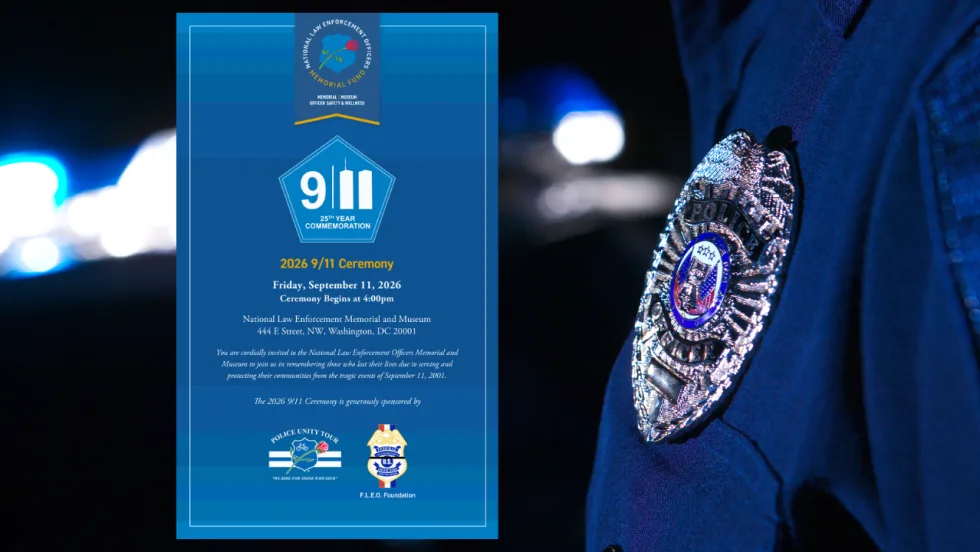
National Law Enforcement Memorial and Museum Hosting 9/11 25th-Year Commemoration Ceremony
The National Law Enforcement Memorial and Museum is hosting a 9/11 25th Year Commemoration Ceremony on Sept. 11 at 4 p.m.
Read More →
National Law Enforcement Officers Memorial Fund Announces June 2026 Officers of the Month
The National Law Enforcement Officers Memorial Fund (NLEOMF) named 15 officers of the Chico Police Department (California) as the Officers of the Month for June 2026 for their roles in responding to an active-shooter incident at a public library.
Read More →