



Mistake of Law: To Err Is Human
In a series of cases, the court has upheld searches and seizures made by officers who were mistaken in their understanding of the facts they confronted, or as to the law to be applied.


Photo: POLICE File
Nobody's perfect. Despite all the ongoing training you get on the numerous search-and-seizure rules and exceptions, it isn't realistic to expect that you never make a mistake.
Fortunately, you're not being held to an impossible standard under the Constitution, because the Fourth Amendment does not guarantee a right against all searches and seizures—only unreasonable ones. As the U.S. Supreme Court has said, "In order to satisfy the 'reasonableness' requirement of the Fourth Amendment, what is generally demanded of the many factual determinations that must regularly be made by agents of the government is not that they always be correct, but that they always be reasonable." (Illinois v. Rodriguez)
In a series of cases, the court has upheld searches and seizures made by officers who were mistaken in their understanding of the facts they confronted, or as to the law to be applied. In each of these cases, the court concluded that mistakes were understandable under the circumstances confronted, and so the Fourth Amendment was not violated. These cases stretch over a period of more than 40 years, including a new decision in the current term of the court.
Hill V. California (1971)
Police in Los Angeles had probable cause to arrest a robbery suspect named Archie Hill, of a particular description, and known to live at a specific address. When they went to that address, a man meeting Hill's description answered the door, and police arrested him, even though he claimed (truthfully, as it turned out) that his name was Miller, and that Hill was his roommate. Evidence seized incident to Miller's arrest was introduced against Hill, who moved to suppress on the basis of the officers' mistake of fact in arresting the wrong man.
The Supreme Court upheld admissibility of the evidence, saying this: "When the police have probable cause to arrest one party, and when they reasonably mistake a second party for the first party, then the arrest of the second party is a valid arrest. Sufficient probability, not certainty, is the touchstone of reasonableness under the Fourth Amendment. The officers' mistake was understandable and the arrest a reasonable response to the situation facing them at the time."
Maryland V. Garrison (1987)
Baltimore officers obtained a warrant to search the third-floor apartment of a particular building for narcotics believed to be possessed by someone named McWebb. Only after they had entered the suspect's neighbor's apartment did they learn that there were actually two separate apartments on that floor, sharing a common hallway. Their mistaken entry into the wrong apartment resulted in the discovery of contraband which was later used against the neighbor, Harold Garrison.
Once again, the Supreme Court examined the nature of the misunderstanding and, finding it reasonable, admitted the evidence. Said the court, "All of the officers reasonably believed that they were searching McWebb's apartment. This court has recognized the need to allow some latitude for honest mistakes that are made by officers in the dangerous and difficult process of making arrests and executing search warrants. Here, the officers' conduct was consistent with a reasonable effort to ascertain and identify the place intended to be searched within the meaning of the Fourth Amendment."
Illinois V. Rodriguez (1990)
Chicago police were investigating a domestic assault against a woman who said her boyfriend, Edward Rodriguez, had beat her and that he was in a nearby apartment, which she described as "our apartment." She accompanied officers there, produced a house key, and consented to their entry.
Inside, officers found Rodriguez asleep, with cocaine and related paraphernalia in plain view. He was arrested and charged with possession with intent to sell. Rodriguez moved to suppress, arguing that his girlfriend could not give valid consent to enter and search because she no longer lived at the apartment with him. It was later established that she was not on the lease, paid no rent, and had already moved some of her possessions out.
The Supreme Court reasoned that a mistake of fact as to the authority of a person to give valid consent to entry and search does not invalidate the officers' actions, if the mistake was reasonable. In summary, the court said that "'Reasonableness' does not demand that the government be factually correct. We have not held that the Fourth Amendment requires factual accuracy. If the facts available to the officers would justify a belief that the consenting party had authority over the premises, the search is valid.”
Heien V. North Carolina (2014)
The preceding cases fall into a legal category called "mistake of fact" cases. But what if you've made a mistake of law? Until recently, many state and federal courts had ruled that since officers must be presumed to know the laws they are sworn to enforce, a search or seizure based on an officer's reasonable "mistake of law" would still be an unreasonable search or seizure. Appellate decisions in the 5th, 7th, 9th, 10th and 11th Circuits and in numerous state courts ruled that no matter how reasonable, mistakes of law could not support detentions, arrests, or searches. (The 8th Circuit held to the contrary.) The Supreme Court has now held that actions based on reasonable mistakes of law do not violate the Fourth Amendment.
Nicholas Heien was traveling through North Carolina in a vehicle that had only one working brake light. The vehicle was stopped by a deputy sheriff, who believed that state law required at least two brake lights. A consent search yielded enough cocaine to charge Heien with trafficking, and he moved to suppress. The state appeals court interpreted the statute as requiring only a single working brake light, found the stop to have been based on a mistake of law, and ordered the evidence suppressed. After the North Carolina Supreme Court reversed this ruling, Heien appealed to the U.S. Supreme Court, which said the following.
"To be reasonable is not to be perfect, and so the Fourth Amendment allows for some mistakes on the part of government officials, giving them fair leeway for enforcing the law in the community's protection. We have recognized that searches and seizures based on mistakes of fact can be reasonable. But reasonable men make mistakes of law, too, and such mistakes are no less compatible with the concept of reasonable suspicion. Reasonable suspicion arises from the combination of an officer's understanding of the facts and his understanding of the relevant law. The officer may be reasonably mistaken on either ground. It was objectively reasonable for an officer to think that Heien's faulty right brake light was a violation of North Carolina law. Because the mistake of law was reasonable, there was reasonable suspicion justifying the stop."
Mistakes Must Be "Reasonable"
In Heien, the court stressed that not every mistake of law by police would necessarily be reasonable. Officers are still expected to be diligent in learning and understanding the details of laws they are charged with upholding. As the court said, "The Fourth Amendment tolerates only reasonable mistakes. An officer can gain no Fourth Amendment advantage through a sloppy study of the laws he is duty-bound to enforce."
Devallis Rutledge is a former police officer and veteran prosecutor who currently serves as special counsel to the Los Angeles County district attorney. He is the author of a dozen books.
More Patrol

Adept Armor Introduces Two New Rifle Plates
Adept Armor has launched two new Level IV ballistic plates, the Emperor and the Archon Mark 2, which brings Adept Armor’s new Quatroid ceramic to the high-threat, performance-value center of the range at 5.2 pounds.
Read More →
POLICE Product Test: Benchmade Bailout
The Benchmade Bailout is a slim, lightweight carry knife with a deep-ride pocket clip and comes in a variety of blade steels and scales. Here is a detailed review of the Taiga Green Bailout, released earlier this year.
Read More →
NLEOMF Announces July 2026 Officer of the Month
NLEOMF honored a Michigan deputy sheriff as the July 2026 Officer of the Month for rescuing a trapped driver from a burning vehicle following a Fourth of July crash.
Read More →
Streamlight to Showcase Newest Lighting Products at National Safety Council’s Safety Congress & Expo 2026
Streamlight will showcase its latest lights, including the Portable Scene Light III and the LiteBox 1Million, at the 2026 National Safety Council (NSC) Safety Congress & Expo.
Read More →
The 2027 World Police & Fire Games Set for Perth, Australia
The 2027 World Police & Fire Games (WPFG) will take place in Perth, Western Australia, from Friday, March 12 through Sunday, March 21, 2027.
Read More →
5.11 Partners with National Fallen Firefighters Foundation to Support #ForThe343
5.11 has joined the nationwide movement honoring the 343 New York City Fire Department firefighters lost on Sept. 11, 2001.
Read More →
Team Wendy Announces Title Sponsorship of the Jorge Pastore Foundation
Team Wendy’s 3-year partnership with the Jorge Pastore Foundation expands access to programs that strengthen those who serve.
Read More →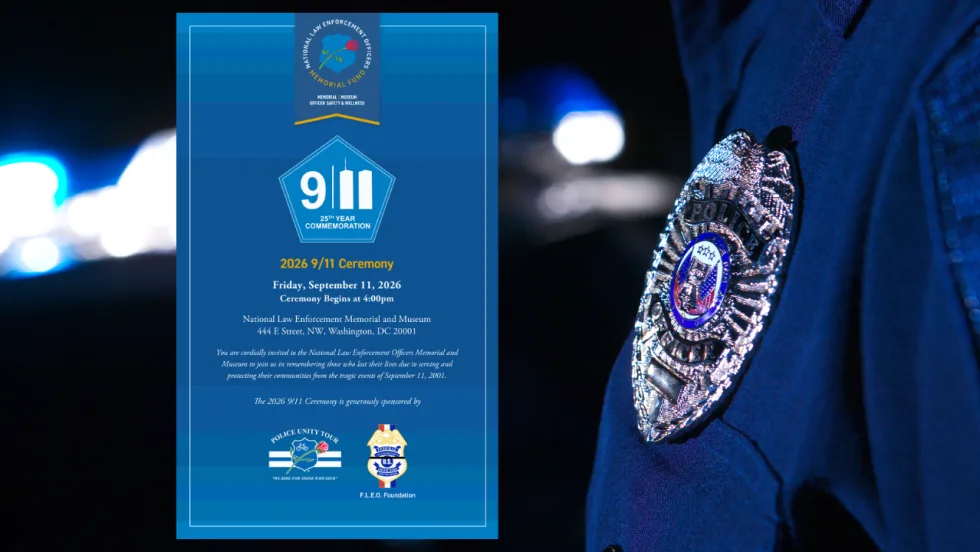
National Law Enforcement Memorial and Museum Hosting 9/11 25th-Year Commemoration Ceremony
The National Law Enforcement Memorial and Museum is hosting a 9/11 25th Year Commemoration Ceremony on Sept. 11 at 4 p.m.
Read More →
National Law Enforcement Officers Memorial Fund Announces June 2026 Officers of the Month
The National Law Enforcement Officers Memorial Fund (NLEOMF) named 15 officers of the Chico Police Department (California) as the Officers of the Month for June 2026 for their roles in responding to an active-shooter incident at a public library.
Read More →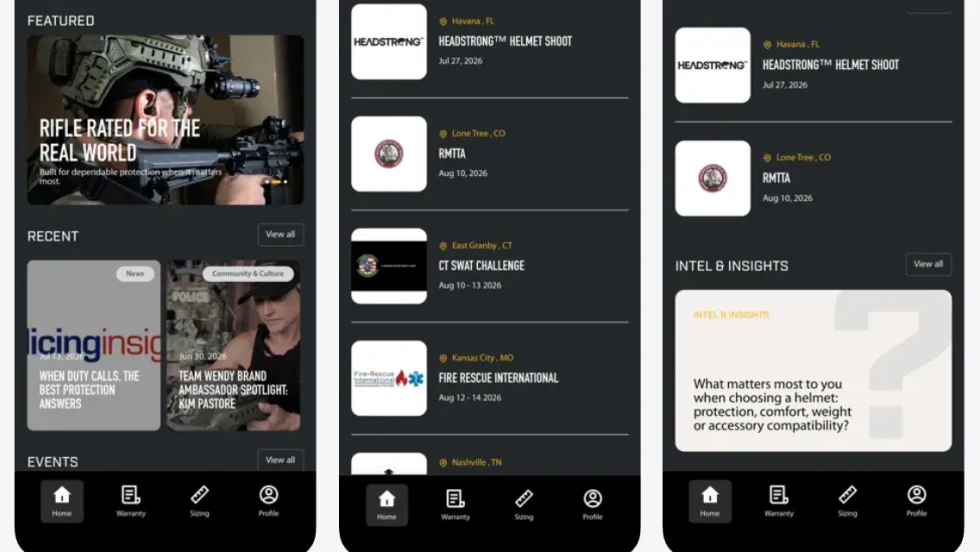
Team Wendy App Creates New Digital Hub for Helmet Owners
The Team Wendy Community App provides one location for warranty registration, size-fit tools, product updates, and community connection. For helmet owners, the new app creates a simpler path to the information and tools that matter most.
Read More →