



NIJ Certification: What Does It Mean?
There is a lot of confusion these days surrounding body armor – mostly about what it can and cannot do. What rounds will certain levels stop? Should you get soft armor? Hard armor? Steel plate? Ceramic? Concealed? Outer tactical carrier? Part of the confusion stems from three initials: NIJ. How important are those initials when it comes to ballistic protection? The lives of your officers may depend on them.


There is a lot of confusion these days surrounding body armor – mostly about what it can and cannot do. What rounds will certain levels stop? Should you get soft armor? Hard armor? Steel plate? Ceramic? Concealed? Outer tactical carrier? Part of the confusion stems from three initials: NIJ. How important are those initials when it comes to ballistic protection? The lives of your officers may depend on them.
NIJ stands for National Institute of Justice, the governing body that oversees performance standards and testing for ballistic armor. NIJ is the standard by which all commercially available body armor is judged for safety and ballistic stopping power.
Not all ballistic armor is created equal. And those inequalities can be the difference between life and death.
NIJ Certification Mark
Most ballistic armor is labeled one of two ways: with or without an NIJ Certification Mark. There is a big difference. The NIJ not only sets ballistic armor standards, it also runs an extensive testing program and encourages manufacturers to submit their armor panels, both soft and hard, for testing at NIJ-approved facilities. The testing includes ballistics tests to determine threat level and endurance tests, such as submerging the armor in water for 30 minutes and a high-humidity/high-heat test to see how well the fibers hold together under adverse conditions.
Because it is so thorough, NIJ testing is a long and expensive process. Armor that passes official NIJ laboratory testing is labeled with the NIJ Certification Mark, the highest NIJ rating.
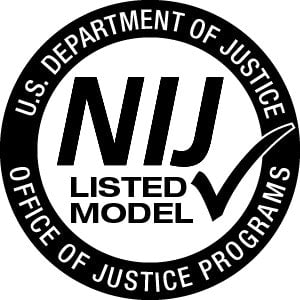
NIJ-certified armor carries the NIJ Certification Mark on the outside of the ballistic package. If this mark does not appear, the armor does not meet NIJ standard 0101.06 and is not NIJ-certified.
To save money, some manufacturers choose to make armor that satisfies parts of the NIJ written standard but has not actually been tested – and therefore not certified – by the NIJ. In many cases, manufacturers settle for the lesser standard to cut corners and allow them to sell armor at a lower price. Departments looking to save money will often be attracted to this lower priced option because budgets can be tight. However, this cost-cutting comes at great risk to the officers who wear it. Inferior ballistic protection may fail to stop even small arms fire, such as 9mm and other common rounds that NIJ-certified armor would stop.
This armor is often labeled “NIJ-rated” or “Complies with NIJ standard” but it is not NIJ-certified. The NIJ has not tested it.
On paper, non-NIJ-certified armor appears to have the same stopping power and protection level as its NIJ-certified brethren. However, because the NIJ has not tested the armor, there is no guarantee that the lower priced armor will hold up as well in real-world conditions, possibly putting officers’ lives at risk from inferior protection levels.
In fact, in some cases, non-NIJ-certified armor offers very little protection because it is constructed in such a way that it would not pass the rigorous NIJ certification process.
How well will the body armor work under adverse conditions? What about in high humidity, in the heat of the summer? How about in the rain? How long will the body armor last until it begins to break down and lose some of its ballistic protection? NIJ-certified armor has been thoroughly tested and rated to answer these questions. Non-NIJ-certified armor has not.
The Justice Technology Information Center (JTIC) arm of the NIJ keeps an up-to-date, searchable list of all NIJ-certified armor products by each manufacturer, including threat levels and warranty information.
Liability Insurance
A large part of any high-risk product is liability, and armor is no different. Armor manufacturers carry liability insurance against incidents involving their armor, but one consideration departments often overlook in selecting armor is their own liability coverage to protect against lawsuits if an officer is injured or killed while wearing a department-issued vest. The minimum coverage is typically $500,000.
Most insurance companies will not cover departments that issue armor without the NIJ Certification Mark, putting the unprotected department at great risk for a lawsuit with a potentially large settlement.
Is that a risk worth taking? Are you willing to put the lives of your officers on the line to save a few dollars? Or are your officers’ lives and department’s financial future worth the extra investment to purchase NIJ-certified armor?
Cheap is Expensive

As with many other purchases, when it comes to body armor you truly get what you pay for. Cheaper armor is exactly that: cheaper, not just in price but in quality and stopping power. Be safer and stick with NIJ-certified armor. Your officers and their families will thank you.
More Patrol

Adept Armor Introduces Two New Rifle Plates
Adept Armor has launched two new Level IV ballistic plates, the Emperor and the Archon Mark 2, which brings Adept Armor’s new Quatroid ceramic to the high-threat, performance-value center of the range at 5.2 pounds.
Read More →
POLICE Product Test: Benchmade Bailout
The Benchmade Bailout is a slim, lightweight carry knife with a deep-ride pocket clip and comes in a variety of blade steels and scales. Here is a detailed review of the Taiga Green Bailout, released earlier this year.
Read More →
NLEOMF Announces July 2026 Officer of the Month
NLEOMF honored a Michigan deputy sheriff as the July 2026 Officer of the Month for rescuing a trapped driver from a burning vehicle following a Fourth of July crash.
Read More →
Streamlight to Showcase Newest Lighting Products at National Safety Council’s Safety Congress & Expo 2026
Streamlight will showcase its latest lights, including the Portable Scene Light III and the LiteBox 1Million, at the 2026 National Safety Council (NSC) Safety Congress & Expo.
Read More →
The 2027 World Police & Fire Games Set for Perth, Australia
The 2027 World Police & Fire Games (WPFG) will take place in Perth, Western Australia, from Friday, March 12 through Sunday, March 21, 2027.
Read More →
5.11 Partners with National Fallen Firefighters Foundation to Support #ForThe343
5.11 has joined the nationwide movement honoring the 343 New York City Fire Department firefighters lost on Sept. 11, 2001.
Read More →
Team Wendy Announces Title Sponsorship of the Jorge Pastore Foundation
Team Wendy’s 3-year partnership with the Jorge Pastore Foundation expands access to programs that strengthen those who serve.
Read More →
National Law Enforcement Memorial and Museum Hosting 9/11 25th-Year Commemoration Ceremony
The National Law Enforcement Memorial and Museum is hosting a 9/11 25th Year Commemoration Ceremony on Sept. 11 at 4 p.m.
Read More →
National Law Enforcement Officers Memorial Fund Announces June 2026 Officers of the Month
The National Law Enforcement Officers Memorial Fund (NLEOMF) named 15 officers of the Chico Police Department (California) as the Officers of the Month for June 2026 for their roles in responding to an active-shooter incident at a public library.
Read More →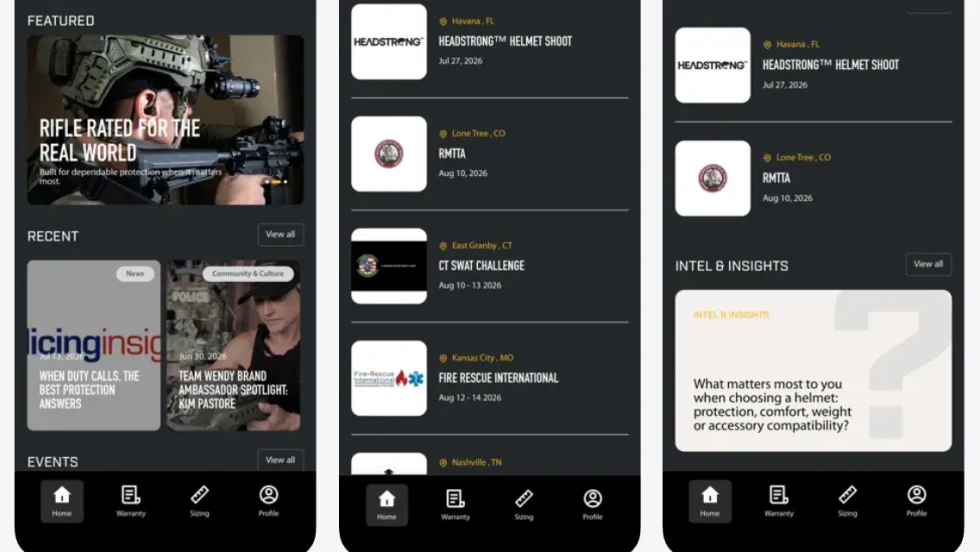
Team Wendy App Creates New Digital Hub for Helmet Owners
The Team Wendy Community App provides one location for warranty registration, size-fit tools, product updates, and community connection. For helmet owners, the new app creates a simpler path to the information and tools that matter most.
Read More →