



Graphene Research Could Lead to Foil-Thin Body Armor
Researchers from the City University of New York’s Advanced Science Research Center discovered that by combining no more than two layers of graphene, they would be able to create an ultra-thin material that, when it is struck by a fast-moving projectile like a bullet, it suddenly hardens and protects the wearer.

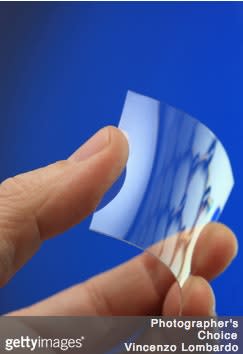
Some scientists believe the combination of two graphene layers could create a lightweight material that can stop bullets.
Researchers from the City University of New York’s Advanced Science Research Center discovered that by combining no more than two layers of graphene, they would be able to create an ultra-thin material that, when it is struck by a fast-moving projectile like a bullet, it suddenly hardens and protects the wearer, Morning Ticker reports.
Graphene is a sheet of a single layer of carbon atoms that is arranged in hexagonal fashion. Scientists have discovered that graphene has some extremely unusual properties, as it is the strongest material that has ever been tested and it very efficiently conducts heat and electricity. It was first observed by an electron microscope back in 1962, but it wasn’t until 2004 that scientists were able to isolate and characterize graphene.
Here is the full statement from the research center:
Imagine a material as flexible and lightweight as foil that becomes stiff and hard enough to stop a bullet on impact. In a newly published paper in Nature Nanotechnology, researchers across The City University of New York (CUNY) describe a process for creating diamene: flexible, layered sheets of graphene that temporarily become harder than diamond and impenetrable upon impact.
Scientists at the Advanced Science Research Center (ASRC) at the Graduate Center, CUNY, worked to theorize and test how two layers of graphene — each one-atom thick — could be made to transform into a diamond-like material upon impact at room temperature. The team also found the moment of conversion resulted in a sudden reduction of electric current, suggesting diamene could have interesting electronic and spintronic properties. The new findings will likely have applications in developing wear-resistant protective coatings and ultra-light bullet-proof films.
“This is the thinnest film with the stiffness and hardness of diamond ever created,” said Elisa Riedo, professor of physics at the ASRC and the project’s lead researcher. “Previously, when we tested graphite or a single atomic layer of graphene, we would apply pressure and feel a very soft film. But when the graphite film was exactly two-layers thick, all of a sudden we realized that the material under pressure was becoming extremely hard and as stiff, or stiffer, than bulk diamond.”
Angelo Bongiorno, associate professor of chemistry at CUNY College of Staten Island and part of the research team, developed the theory for creating diamene. He and his colleagues used atomistic computer simulations to model potential outcomes when pressurizing two honeycomb layers of graphene aligned in different configurations. Riedo and other team members then used an atomic force microscope to apply localized pressure to two-layer graphene on silicon carbide substrates and found perfect agreement with the calculations. Experiments and theory both show that this graphite-diamond transition does not occur for more than two layers or for a single graphene layer.
“Graphite and diamonds are both made entirely of carbon, but the atoms are arranged differently in each material, giving them distinct properties such as hardness, flexibility and electrical conduction,” Bongiorno said. “Our new technique allows us to manipulate graphite so that it can take on the beneficial properties of a diamond under specific conditions.”
The research team’s successful work opens up possibilities for investigating graphite-to-diamond phase transition in two-dimensional materials, according to the paper. Future research could explore methods for stabilizing the transition and allow for further applications for the resulting materials.
This work was funded by the BES Office of the Department of Energy and the complete list of authors includes Yang Gao, Tengfei Cao, Filippo Cellini, Claire Berger, Walt Heer, Erio Tosatti, Angelo Bongiorno and Elisa Riedo.
The Advanced Science Research Center (ASRC) at the Graduate Center of the City University of New York (CUNY) elevates scientific research and education at CUNY and beyond through initiatives in five distinctive, but increasingly interconnected, disciplines: environmental sciences, nanoscience, neuroscience, photonics, and structural biology. The ASRC promotes a collaborative, interdisciplinary research culture with researchers from each of the initiatives working side by side in the ASRC’s core facilities, sharing equipment that is among the most advanced available.
The paper’s abstract reads:
Atomically thin graphene exhibits fascinating mechanical properties, although its hardness and transverse stiffness are inferior to those of diamond. So far, there has been no practical demonstration of the transformation of multilayer graphene into diamond-like ultrahard structures. Here we show that at room temperature and after nano-indentation, two-layer graphene on SiC(0001) exhibits a transverse stiffness and hardness comparable to diamond, is resistant to perforation with a diamond indenter and shows a reversible drop in electrical conductivity upon indentation.
Density functional theory calculations suggest that, upon compression, the two-layer graphene film transforms into a diamond-like film, producing both elastic deformations and sp2 to sp3 chemical changes. Experiments and calculations show that this reversible phase change is not observed for a single buffer layer on SiC or graphene films thicker than three to five layers. Indeed, calculations show that whereas in two-layer graphene layer-stacking configuration controls the conformation of the diamond-like film, in a multilayer film it hinders the phase transformation.
Scientists believe it could be used to create solar cells, light-emitting diodes (LED), touch panels, or even phones. Researchers think that it would be possible to create graphene supercapacitors that would be able to replace electrolytic batteries as an energy storage device. And the auto industry is even experimenting with making cars out of this material.
The graphene market remains small, but it is emerging. The global market for graphine was $9 million in 2012, but as more breakthroughs like the most recent one see the light of day, we could see graphene completely change our everyday lives.
The full statement from the research center follows below.
Imagine a material as flexible and lightweight as foil that becomes stiff and hard enough to stop a bullet on impact. In a newly published paper in Nature Nanotechnology, researchers across The City University of New York (CUNY) describe a process for creating diamene: flexible, layered sheets of graphene that temporarily become harder than diamond and impenetrable upon impact.
Scientists at the Advanced Science Research Center (ASRC) at the Graduate Center, CUNY, worked to theorize and test how two layers of graphene — each one-atom thick — could be made to transform into a diamond-like material upon impact at room temperature. The team also found the moment of conversion resulted in a sudden reduction of electric current, suggesting diamene could have interesting electronic and spintronic properties. The new findings will likely have applications in developing wear-resistant protective coatings and ultra-light bullet-proof films.
“This is the thinnest film with the stiffness and hardness of diamond ever created,” said Elisa Riedo, professor of physics at the ASRC and the project’s lead researcher. “Previously, when we tested graphite or a single atomic layer of graphene, we would apply pressure and feel a very soft film. But when the graphite film was exactly two-layers thick, all of a sudden we realized that the material under pressure was becoming extremely hard and as stiff, or stiffer, than bulk diamond.”
Angelo Bongiorno, associate professor of chemistry at CUNY College of Staten Island and part of the research team, developed the theory for creating diamene. He and his colleagues used atomistic computer simulations to model potential outcomes when pressurizing two honeycomb layers of graphene aligned in different configurations. Riedo and other team members then used an atomic force microscope to apply localized pressure to two-layer graphene on silicon carbide substrates and found perfect agreement with the calculations. Experiments and theory both show that this graphite-diamond transition does not occur for more than two layers or for a single graphene layer.
“Graphite and diamonds are both made entirely of carbon, but the atoms are arranged differently in each material, giving them distinct properties such as hardness, flexibility and electrical conduction,” Bongiorno said. “Our new technique allows us to manipulate graphite so that it can take on the beneficial properties of a diamond under specific conditions.”
The research team’s successful work opens up possibilities for investigating graphite-to-diamond phase transition in two-dimensional materials, according to the paper. Future research could explore methods for stabilizing the transition and allow for further applications for the resulting materials.
This work was funded by the BES Office of the Department of Energy and the complete list of authors includes Yang Gao, Tengfei Cao, Filippo Cellini, Claire Berger, Walt Heer, Erio Tosatti, Angelo Bongiorno and Elisa Riedo.
The Advanced Science Research Center (ASRC) at the Graduate Center of the City University of New York (CUNY) elevates scientific research and education at CUNY and beyond through initiatives in five distinctive, but increasingly interconnected, disciplines: environmental sciences, nanoscience, neuroscience, photonics, and structural biology. The ASRC promotes a collaborative, interdisciplinary research culture with researchers from each of the initiatives working side by side in the ASRC’s core facilities, sharing equipment that is among the most advanced available.
The paper’s abstract is as follows.
Atomically thin graphene exhibits fascinating mechanical properties, although its hardness and transverse stiffness are infe-rior to those of diamond. So far, there has been no practical demonstration of the transformation of multilayer graphene into diamond-like ultrahard structures. Here we show that at room temperature and after nano-indentation, two-layer graphene on SiC(0001) exhibits a transverse stiffness and hardness comparable to diamond, is resistant to perforation with a diamond indenter and shows a reversible drop in electrical conductivity upon indentation.
Density functional theory calculations suggest that, upon compression, the two-layer graphene film transforms into a diamond-like film, producing both elastic deformations and sp2 to sp3 chemical changes. Experiments and calculations show that this reversible phase change is not observed for a single buffer layer on SiC or graphene films thicker than three to five layers. Indeed, calculations show that whereas in two-layer graphene layer-stacking configuration controls the conformation of the diamond-like film, in a multilayer film it hinders the phase transformation.
More Technology

How Motorola Solutions’ New “Insights” Platform Helps Public Safety Agencies Identify Trends to Improve Their Operations
Motorola Solutions has introduced Insights, which leverages Assist, its mission-critical artificial intelligence (AI), to address these challenges and shape what’s next for public safety analytics and reporting technology.
Read More →
What Qualifies a Laptop as Rugged or Fully Rugged?
Police officers face a wide range of working conditions that can damage or even destroy a regular consumer laptop. Learn what qualifies a computer as rugged or fully rugged and why those devices are vital for law enforcement.
Read More →
Panasonic Connect Launches the Toughbook 34 and Toughbook G3, Fully Rugged 2-in-1 Mobile Computers
Panasonic Connect has launched the Toughbook 34 and Toughbook G3 to facilitate in-vehicle dispatch, records management, and mobile command operations from any location.
Read More →

A police agency's guide to data-driven fleet management
Costs are rising and the public expects more transparency into how their tax dollars are spent. This e-book shows how police agencies can use fleet data to take control of fleet expenses while improving officer safety and demonstrating fiscal responsibility to the communities they serve.
Read More →
AI and analytics for law enforcement: Turning data into insights
Law enforcement agencies are managing more video, sensor data and digital evidence than ever before. Discover how AI and analytics can help turn that data into actionable insights that strengthen situational awareness, accelerate investigations and support more informed decisions.
Read More →
Vasco Electronics Adds Automatic Language Detection to Vasco Translator Q1
Vasco Electronics’ software update introduces hands-free language switching and expanded offline translation across 45 language pairs, empowering law enforcement, healthcare, and front-office enterprise teams
Read More →
North Miami Police Department Deploys Mark43
The North Miami Police Department has deployed Mark43 as part of its Five-Year Strategic Plan that represents its collective vision and goals for a more proactive police department, anchored by a core commitment to leveraging modern technology to enhance efficiency and public safety.
Read More →
Cellebrite Genesis for Enterprise Now Generally Available
Made available to the public sector in June, Cellebrite Genesis is serving a growing mix of national, regional, and local agencies worldwide, including some of the largest regional and metropolitan police departments. It is now available for enterprise organizations.
Read More →
2026 Vision FirstNet Users Summit to Host Emerging Leaders Training on Grassroots Advocacy for Public Safety
“Emerging Leaders Training: Understanding the Importance of Grassroots Advocacy for Public Safety," a session during the 2026 Vision FirstNet Users Summit, will offer a roadmap for unified advocacy at the federal level.
Read More →
Motorola Solutions Completes Acquisition of D-Fend Solutions
Motorola Solutions has acquired D-Fend Solutions, an industry leader in counter-drone technology. This deal provides public safety and enterprise customers with access to advanced counter-unmanned aerial systems.
Read More →