



FLIR Launches the Fido X4 Premium Handheld Explosives Trace Detector
FLIR Systems Inc. has announced the launch of the FLIR Fido X4, the newest, most advanced version of its premium handheld explosives trace detector. The Fido X4 is made to deliver extreme sensitivity for a broad range of explosives, so users can easily detect threats at levels other devices cannot.

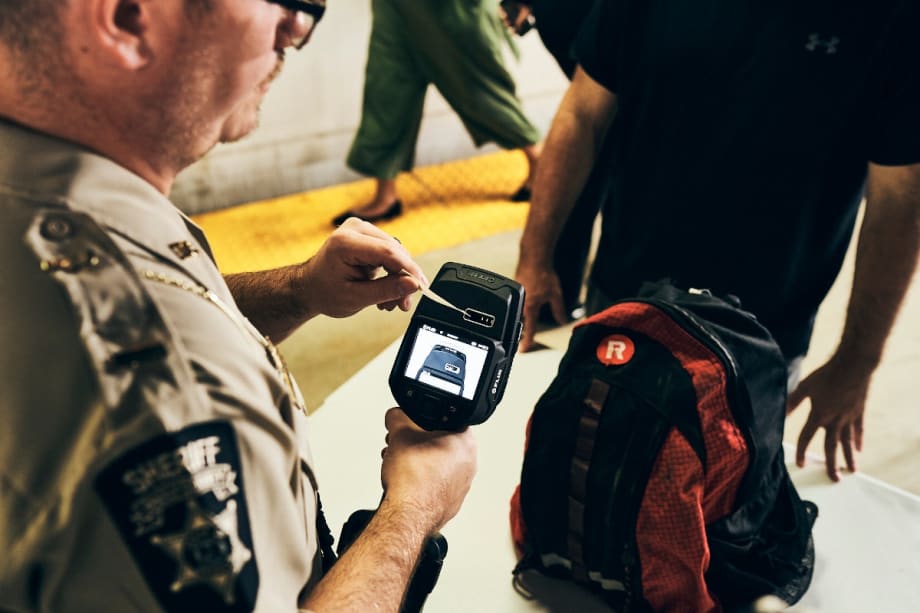
FLIR's Fido X4 is made to deliver extreme sensitivity for a broad range of explosives.
Photo: FLIR
FLIR Systems Inc. has announced the launch of the FLIR Fido X4, the newest, most advanced version of its premium handheld explosives trace detector. The Fido X4 is made to deliver extreme sensitivity for a broad range of explosives, so users can easily detect threats at levels other devices cannot.
FLIR Systems' TrueTrace detection technology features a new five-channel sensor array that delivers expanded threat coverage. According to the company, TrueTrace can accurately detect a wide range of explosives at nanogram to sub-nanogram levels—including military, commercial, improvised, and homemade explosives—allowing users to gain actionable intelligence through identification of threats in as little as ten seconds.
A FLIR PackBot Hardware Integration Kit will sync the Fido X4 with the company's unmanned ground vehicle (UGV) widely used for explosive ordnance and bomb disposal. Fido's multi-platform adaptability will allow users to switch the device from handheld operation to unmanned systems for standoff threat detection.
"Our new Fido X4 is mission-ready for all critical security applications—from high-volume checkpoint and randomized screenings to foot patrols and standoff operations—going wherever it is needed," said David Ray, president of FLIR Systems' Government and Defense Business Unit. "FLIR is committed to providing operators with intelligent sensing solutions that keep them out of harm's way. With thousands of Fido devices already deployed in more than 40 countries, the X4 builds on a legacy of success for military and public safety personnel worldwide."
Weighing three pounds and ergonomically built to minimize operator fatigue, the Fido X4 is designed for extended operations of up to 16 hours with two 8-hour, hot-swappable batteries. X4's new simplified user interface features on-board video tutorials, user prompts, and color-coded alarms with strength indicators for quick and decisive operation. Analyzing and reporting results is made easy through multiple connectivity options, so critical data can be shared fast.
FLIR and authorized FLIR channel partners are currently taking pre-orders for the Fido X4 and shipments are scheduled to begin in December 2019. The PackBot Hardware Integration Kit is being developed in 2020. For more information or to order the FLIR Fido X4, visit flir.com/x4.
More Technology

A police agency's guide to data-driven fleet management
Costs are rising and the public expects more transparency into how their tax dollars are spent. This e-book shows how police agencies can use fleet data to take control of fleet expenses while improving officer safety and demonstrating fiscal responsibility to the communities they serve.
Read More →
AI and analytics for law enforcement: Turning data into insights
Law enforcement agencies are managing more video, sensor data and digital evidence than ever before. Discover how AI and analytics can help turn that data into actionable insights that strengthen situational awareness, accelerate investigations and support more informed decisions.
Read More →
Vasco Electronics Adds Automatic Language Detection to Vasco Translator Q1
Vasco Electronics’ software update introduces hands-free language switching and expanded offline translation across 45 language pairs, empowering law enforcement, healthcare, and front-office enterprise teams
Read More →

North Miami Police Department Deploys Mark43
The North Miami Police Department has deployed Mark43 as part of its Five-Year Strategic Plan that represents its collective vision and goals for a more proactive police department, anchored by a core commitment to leveraging modern technology to enhance efficiency and public safety.
Read More →
Cellebrite Genesis for Enterprise Now Generally Available
Made available to the public sector in June, Cellebrite Genesis is serving a growing mix of national, regional, and local agencies worldwide, including some of the largest regional and metropolitan police departments. It is now available for enterprise organizations.
Read More →
2026 Vision FirstNet Users Summit to Host Emerging Leaders Training on Grassroots Advocacy for Public Safety
“Emerging Leaders Training: Understanding the Importance of Grassroots Advocacy for Public Safety," a session during the 2026 Vision FirstNet Users Summit, will offer a roadmap for unified advocacy at the federal level.
Read More →
Motorola Solutions Completes Acquisition of D-Fend Solutions
Motorola Solutions has acquired D-Fend Solutions, an industry leader in counter-drone technology. This deal provides public safety and enterprise customers with access to advanced counter-unmanned aerial systems.
Read More →
ZeroEyes, Advantech & Camden Police Partner to Bring AI Gun Detection Technology to Delaware School District
ZeroEyes has partnered with Advantech and the Camden Police Department to deploy ZeroEyes’ AI gun detection and intelligent situational awareness platform at Delaware’s Caesar Rodney School District (CRSD).
Read More →
Leonardo U.S. Cyber & Security Solutions Introduces SignalTrace, the Next Evolution in Electronic Signature Detection Technology
SignalTrace reflects years of product refinement and a clearer expression of the technology’s purpose of recognizing and correlating electronic signatures in publicly broadcast wireless signals to reveal patterns, relationships, and trends that might otherwise go undetected.
Read More →
Pimloc Launches Secure File Sharing to Streamline Release of Redacted Video
Pimloc’s Secure File Sharing lets organizations deliver redacted video, audio, and documents through expiring, passcode-protected links, accelerating delivery while reducing security, compliance, and chain-of-custody risks.
Read More →