



Use Your Foot
During a recent high-profile court case involving use of force by a deputy sheriff, a purported police expert testified that law enforcement officers are not trained to kick because it could put them off balance. While it would be comforting to think this was an isolated misguided opinion, unfortunately it is not.

During a recent high-profile court case involving use of force by a deputy sheriff, a purported police expert testified that law enforcement officers are not trained to kick because it could put them off balance. While it would be comforting to think this was an isolated misguided opinion, unfortunately it is not.
I have personally had the unpleasant experience of justifying the use of kicks to an administrator who was woefully uninformed in use of force and defensive tactics. While I was able to thoroughly justify my actions and was absolved of any wrongdoing, another less experienced officer may not have been so fortunate.
These are just two examples of the misguided opinions held by too many police administrators. Use-of-force instructors are responsible for educating administrators about all of the tools available to them, as well as educating the officers themselves in the proper application of and justification for using these tools.
Available and Viable
It makes no sense that a law enforcement agency equips and trains its officers with pistols, rifles, shotguns, batons, OC, TASERs, canines, horses, ballistic shields, battering rams, empty hand self defense, and countless other potentially dangerous law enforcement tools, but it becomes hesitant when an officer properly and justifiably uses kicks to defend himself or to subdue a suspect.
Kicks by law enforcement officers are no less proper or less ethical than any other law enforcement tactic or tool when employed under the proper circumstances. The Supreme Court held in Graham v. Connor that the reasonableness of an officer's actions must be judged by the circumstances at the time the force is used. It did not restrict or limit the tactics that an officer can employ.
A subsequent case, Plakas v. Drinski, held that there is no requirement that officers seek a less-intrusive means of subduing a suspect as long as their actions are reasonable. Nowhere are kicks singled out as some sort of taboo technique that automatically transforms an officer's otherwise legal use of force into excessive force. However, many administrators react just that way.
And use-of-force instructors have often contributed to the problem by failing to include kicks as part of their agency's basic defensive tactics training. Many administrators may reason that because kicks have not been taught by their agency over the years, they must not be necessary or appropriate.
But we need to be able to kick when necessary and know how to achieve the desired effect when doing so. Which means that we need to integrate kicks into our defensive tactics programs.
If we make kicks part of standard police training, they will become as familiar and accepted as any other technique. Additionally, as officers who are trained in the use of kicks progress through the ranks, they will understand the proper use of kicks as they evaluate the use of force by their subordinates.
If your agency does not include kicks in its defensive tactics program, it should begin to do so as soon as possible. First and foremost, kicks are a valuable tool that will allow officers to better defend themselves.
This is especially true for smaller officers. Kicks allow a smaller officer to generate a great deal of power and can help level the playing field against a stronger or larger assailant. Secondly, by incorporating kicks into training, any officer that does justifiably kick a suspect can defend his or her actions should they be called into question after the fact.
Three Basic Kicks
When deciding what kicks to include in a defensive tactics program, several things need to be considered.
First is the practicality of a particular kick. Can the average officer wearing his or her duty uniform perform a particular kick? A reverse spinning back kick may look great in the karate dojo, but it is hardly practical for law enforcement purposes.
Second, is the kick effective? Like all other law enforcement tools, it does the officer little good if the weapon or tactic has no effect when properly employed.
Third, is the kick trainable? Let's face reality and realize that the average officer is not going to spend hours each day over the course of many months or years practicing a particular kick. Therefore, the average officer will have to be able to acquire an acceptable level of proficiency with a minimal amount of training time.
Lastly, is the kick safe for the officer? Just like any other tactic, a kick should be evaluated as to whether an officer can employ the instructed kick without causing undue injury to himself or without placing himself in a worse defensive position vis-à-vis the assailant?
Let's look at three kicks that meet our criteria: the thrust kick, the leg stomp kick, and the leg shin kick.
Each of these kicks is very effective, can be employed by officers in their duty uniforms, can be easily taught and learned, and can be employed without exposing officers to additional dangers.
When training officers in how to perform these kicks, instructors need to emphasize when and how to use them in compliance with the agency's use-of-force policy.
The officer's starting position for each of the kicks will be a typical fighting or interview stance with one leg forward and the officer's weapon side away from the suspect. This non-threatening stance allows you to diffuse a potentially hostile situation, and still puts you in a position to react to any sudden attacks.
The Thrust Kick
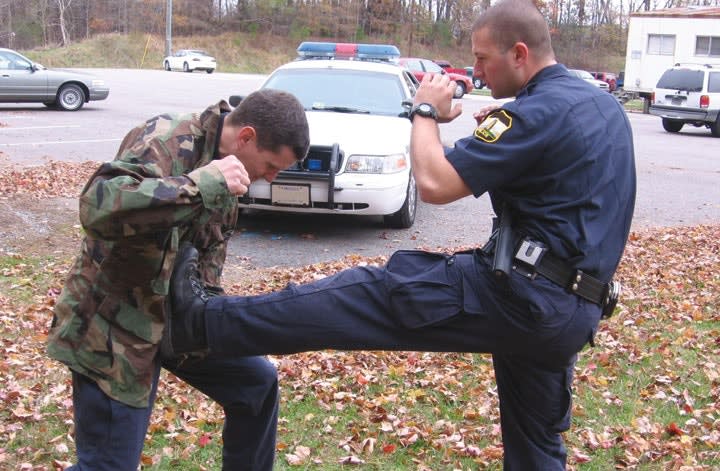
The thrust kick can be used either against a suspect who is moving forward into you or in a situation where you are moving forward such as during a search warrant entry and cannot stop to go hands on with a suspect. This kick is designed to stop the assailant's forward progress and/or to drive him backwards.
To perform this kick, you shift your weight slightly to your rear leg, lift your front leg with the knee bent to no more than waist high, then extend your leg, pushing forward with your hips and making contact with your leg fully extended.
The power from the kick is generated from the hips and the striking area is the sole of the foot. The point of contact on the assailant's body is the upper thigh or hip joint area.
This kick is very effective for stopping an assailant's forward progress or moving him backwards. This also helps keep you outside of the attacker's punch range, adding to your safety. Duty boots increase the effectiveness of the technique. Finally, there is room for error with this kick, so even if you don't land the kick exactly, it may have the desired effect.
Work to maintain the position of your upper body and not overextend your reach when you employ the kick. By maintaining your upper body position, you can employ the kick and keep your hands free. This allows you to follow the kick with additional appropriate techniques such as empty-hand strikes, baton strikes, or de-escalation control techniques. In a search warrant entry situation, you may have a firearm in your hands and can employ the kick while maintaining a stable shooting position.
The Leg Stomp Kick
The leg stomp kick can be delivered with either your front or rear leg. This kick is very effective especially during close-in encounters and even during standing grappling encounters. This is a quick stomping kick aimed at the assailant's knee area. If the assailant is a little farther away, your toes will be turned inside, striking with the outside edge of your foot. If the assailant is very close, your toes will be turned outside, striking with your heel.
The mechanics are the same with either leg. Raising your leg and lifting your knee, stomp down at 45-degrees, using your hip to drive your leg down, striking the assailant's knee.
Attacking the legs often catches an assailant by surprise and disrupts his balance. By taking away an attacker's base, you diminish his ability to generate power and continue an attack. Since officers are often reacting to an attack, the confusion created by the unexpected attack on an assailant's legs creates a pause in the attack, allowing you to regain the initiative and become the beneficiary of the action-reaction gap.
As with the thrust kick, train to deliver the leg stomp kick while maintaining your upper body posture. This allows you to be in a position to follow up with appropriate techniques, either additional strikes or control techniques. Again, this kick has room for error and is effective even if it doesn't land precisely at the knee. Believe me, if you are wearing duty boots and you make contact with your attacker when using the leg stomp technique, you will inflict pain.
The Shin Kick
The shin kick is delivered with your rear leg aiming at the assailant's legs. This is a quick roundhouse shin kick delivered at the assailant's knee or thigh. The target leg is whichever leg the assailant has forward, striking either the inside or outside of the leg depending which target is presented.
You deliver this kick with a short hip twist, striking the assailant's leg using the shin of your kicking leg. The shin kick is a very powerful kick and when it lands on the side of an assailant's leg, it is very effective for disrupting an attack. Even if it doesn't knock an attacker down, it will buy you time and distance to take the initiative. Then you can follow up with appropriate techniques.
Like the previous kicks, there is a great deal of room for error because a connection along any portion of the assailant's leg is likely to give the desired effect, and duty boots enhance the effectiveness of the technique.
Law enforcement agencies and use-of-force instructors have a responsibility to equip their officers with as many tools as possible to ensure their safety. While cost constraints may limit the equipment that is available to officers, the addition of kicking techniques to an officer's defensive tactics arsenal can be accomplished with no additional cost to an agency's training budget.
The kicks described above meet the requirements that a good defensive tactics technique should possess. They are practical, effective, trainable, and safe for the officer. Additionally, each technique if used at the proper force level is easily defendable.
These kicks are an easy and cost-effective way to enhance a law enforcement officer's ability to prevail when things go bad on the street.
A 13-year veteran of the Virginia Beach Police Department, Todd Coleman is a defensive tactics instructor and a K-9 officer.
More Patrol

Adept Armor Introduces Two New Rifle Plates
Adept Armor has launched two new Level IV ballistic plates, the Emperor and the Archon Mark 2, which brings Adept Armor’s new Quatroid ceramic to the high-threat, performance-value center of the range at 5.2 pounds.
Read More →
POLICE Product Test: Benchmade Bailout
The Benchmade Bailout is a slim, lightweight carry knife with a deep-ride pocket clip and comes in a variety of blade steels and scales. Here is a detailed review of the Taiga Green Bailout, released earlier this year.
Read More →
NLEOMF Announces July 2026 Officer of the Month
NLEOMF honored a Michigan deputy sheriff as the July 2026 Officer of the Month for rescuing a trapped driver from a burning vehicle following a Fourth of July crash.
Read More →
Streamlight to Showcase Newest Lighting Products at National Safety Council’s Safety Congress & Expo 2026
Streamlight will showcase its latest lights, including the Portable Scene Light III and the LiteBox 1Million, at the 2026 National Safety Council (NSC) Safety Congress & Expo.
Read More →
The 2027 World Police & Fire Games Set for Perth, Australia
The 2027 World Police & Fire Games (WPFG) will take place in Perth, Western Australia, from Friday, March 12 through Sunday, March 21, 2027.
Read More →
5.11 Partners with National Fallen Firefighters Foundation to Support #ForThe343
5.11 has joined the nationwide movement honoring the 343 New York City Fire Department firefighters lost on Sept. 11, 2001.
Read More →
Team Wendy Announces Title Sponsorship of the Jorge Pastore Foundation
Team Wendy’s 3-year partnership with the Jorge Pastore Foundation expands access to programs that strengthen those who serve.
Read More →
National Law Enforcement Memorial and Museum Hosting 9/11 25th-Year Commemoration Ceremony
The National Law Enforcement Memorial and Museum is hosting a 9/11 25th Year Commemoration Ceremony on Sept. 11 at 4 p.m.
Read More →
National Law Enforcement Officers Memorial Fund Announces June 2026 Officers of the Month
The National Law Enforcement Officers Memorial Fund (NLEOMF) named 15 officers of the Chico Police Department (California) as the Officers of the Month for June 2026 for their roles in responding to an active-shooter incident at a public library.
Read More →
Team Wendy App Creates New Digital Hub for Helmet Owners
The Team Wendy Community App provides one location for warranty registration, size-fit tools, product updates, and community connection. For helmet owners, the new app creates a simpler path to the information and tools that matter most.
Read More →