



Understanding Fourth Amendment "Standing"
A defendant cannot suppress evidence if he cannot show that his own legitimate rights were violated in the way it was obtained.

Photo: Mark W. Clark
Because almost all defendants charged with crimes are in fact guilty, they have few legitimate ways to defend against the charges. Defendants' first line of defense in a great many cases is to try to suppress the evidence of their guilt. To do that, they have to find some misstep by police that would require the court to exclude incriminating evidence.
There are various exclusionary rules under the Fourth, Fifth, Sixth, and Fourteenth Amendments, but the one people generally have in mind when they use the term "exclusionary rule" is the one that applies to evidence obtained by a search or seizure that doesn't comply with the Fourth Amendment case law. This exclusionary rule has applied in federal court since 1914 (Weeks v. U.S.), and to all of the states since 1961. (Mapp v. Ohio) The basic rule is that evidence derived from an unreasonable search or seizure is generally inadmissible against a defendant whose Fourth Amendment rights were violated by that search or seizure.
One of the requirements for a defendant seeking to suppress evidence under this exclusionary rule is to show that the unreasonable search or seizure that produced the evidence violated his own personal rights of privacy, liberty, or possession. This is often referred to as establishing his "standing" to suppress. Although the U.S. Supreme Court has repeatedly sought to discourage use of the word "standing" to describe the ability of a defendant to show a violation of his own Fourth Amendment rights, the term is still widely used in both state and federal courts.
The significance of "standing" is that even if officers may have committed Fourth Amendment error in obtaining evidence of the defendant's guilt, he cannot suppress the evidence if he cannot show that his own legitimate rights were violated. There are a number of situations in which the Supreme Court has ruled that defendants lacked standing, and therefore the evidence was admissible, even if it may have resulted from an unjustifiable search or seizure. Law enforcement officers need to be aware of these principles so they do not needlessly fail to pursue criminal charges because they think that a "bad" search or seizure has occurred.
Bank Records
In many jurisdictions, statutes restrict police access to depositor records kept by financial institutions. However, the Fourth Amendment does not require a warrant for such access, because the depositor's privacy is not invaded when the bank turns information over to police. Stated another way, the depositor has no "standing" to suppress such evidence, as the court held in a 1976 ruling:
"The depositor takes the risk, in revealing his affairs to another, that the information will be conveyed by that person to the government. The Fourth Amendment does not prohibit the obtaining of information revealed to a third party [such as a bank or utility] and conveyed by him to government authorities." (U.S. v. Miller)
Vehicle Passengers
Only the driver or owner of a vehicle will generally have "standing" to challenge a search of the vehicle. Often, a search of a stopped vehicle will yield evidence implicating a non-owner passenger, and the passenger will want to suppress this evidence. However, even if the search cannot be justified on any basis, the passenger still cannot invoke the exclusionary rule.
When the passenger of a stopped car tried to suppress evidence found inside incriminating him in a robbery, the court said this: "Fourth Amendment rights are personal rights which may not be vicariously asserted. The glove compartment, area under the seat and trunk of an automobile are areas in which a passenger simply would not normally have a legitimate expectation of privacy." (Rakas v. Illinois)
Another's Property
Even if police unlawfully search a backpack, a duffel bag, a purse, or some other item and find incriminating evidence, if the incriminated person is neither the owner nor permissive user of the searched property, he'll have no "standing."
For example, when police showed up at a house with a search warrant, one of the occupants, David Rawlings, dumped his drugs into his girlfriend's purse. Police searched the purse and found the drugs, which Rawlings then admitted were his. When he claimed an illegal search and moved to suppress this evidence, the Supreme Court denied his "standing," saying this:
"Rawlings bears the burden of proving not only that the search of the purse was illegal, but also that he had a legitimate expectation of privacy in that purse. Prior to Rakas, he might have been given 'standing' in such a case to challenge the search, [but no longer]." (Rawlings v. Kentucky)
Another's Home
The Supreme Court held in Minnesota v. Olson that an overnight guest, having a legitimate expectation of privacy in his host's home, has "standing" to challenge entry and search of that home. However, in Minnesota v. Carter, the court refused to extend "standing" to temporary visitors who are not overnight guests. According to the court, "An overnight guest in a home may claim the protection of the Fourth Amendment, but one who is merely present with the consent of the householder may not."
Trash
While someone's trash container is still on his private property, police would need a warrant or some exception just to approach it. (U.S. v. Jones; Florida v. Jardines) But once the trash receptacle has been placed in the alley or at the curb for collection, the occupant loses "standing" to contest its search.
Police suspected Billy Greenwood of narcotics sales out of his home. On trash collection day, they went through plastic garbage bags he had put out for collection. Based on what they found, officers obtained a warrant to search Greenwood's home, where they located additional evidence. Greenwood and his codefendants moved to suppress, arguing that they had an expectation that police would not go through people's trash. Although California courts bought this argument and ordered suppression of the evidence, the U.S. Supreme Court reversed, saying the following: "Respondents exposed their garbage to the public sufficiently to defeat their claim to Fourth Amendment protection." (California v. Greenwood)
Co-conspirators
Just because several crooks may be involved in a joint criminal enterprise does not give each of them "standing" to challenge a search or seizure that affects only the Fourth Amendment rights of another conspirator. In U.S. v. Padilla, several drug distributors hired a "mule" to drive a large quantity of narcotics across Arizona by himself. Following a vehicle stop and search that uncovered the drugs and the conspiracy, all defendants moved to suppress on the grounds of unlawful vehicle stop and search. The Ninth Circuit tried to extend "standing" to all conspirators, but the U.S. Supreme Court unanimously reversed.
Said the court, "A defendant can urge the suppression of evidence only if he demonstrates that his Fourth Amendment rights were violated by the challenged search or seizure."
Don't Overlook "Standing"
Police, prosecutors, and judges sometimes get so focused on the issue of whether or not a particular search or seizure is unreasonable that they don't notice that the evidence will be admissible anyway, because the defendant lacks "standing." Don't forget to consider whether a challenged search or seizure implicated this defendant's rights.
Devallis Rutledge is a former police officer and veteran prosecutor who currently serves as special counsel to the Los Angeles County district attorney.
More Patrol

Adept Armor Introduces Two New Rifle Plates
Adept Armor has launched two new Level IV ballistic plates, the Emperor and the Archon Mark 2, which brings Adept Armor’s new Quatroid ceramic to the high-threat, performance-value center of the range at 5.2 pounds.
Read More →
POLICE Product Test: Benchmade Bailout
The Benchmade Bailout is a slim, lightweight carry knife with a deep-ride pocket clip and comes in a variety of blade steels and scales. Here is a detailed review of the Taiga Green Bailout, released earlier this year.
Read More →
NLEOMF Announces July 2026 Officer of the Month
NLEOMF honored a Michigan deputy sheriff as the July 2026 Officer of the Month for rescuing a trapped driver from a burning vehicle following a Fourth of July crash.
Read More →
Streamlight to Showcase Newest Lighting Products at National Safety Council’s Safety Congress & Expo 2026
Streamlight will showcase its latest lights, including the Portable Scene Light III and the LiteBox 1Million, at the 2026 National Safety Council (NSC) Safety Congress & Expo.
Read More →
The 2027 World Police & Fire Games Set for Perth, Australia
The 2027 World Police & Fire Games (WPFG) will take place in Perth, Western Australia, from Friday, March 12 through Sunday, March 21, 2027.
Read More →
5.11 Partners with National Fallen Firefighters Foundation to Support #ForThe343
5.11 has joined the nationwide movement honoring the 343 New York City Fire Department firefighters lost on Sept. 11, 2001.
Read More →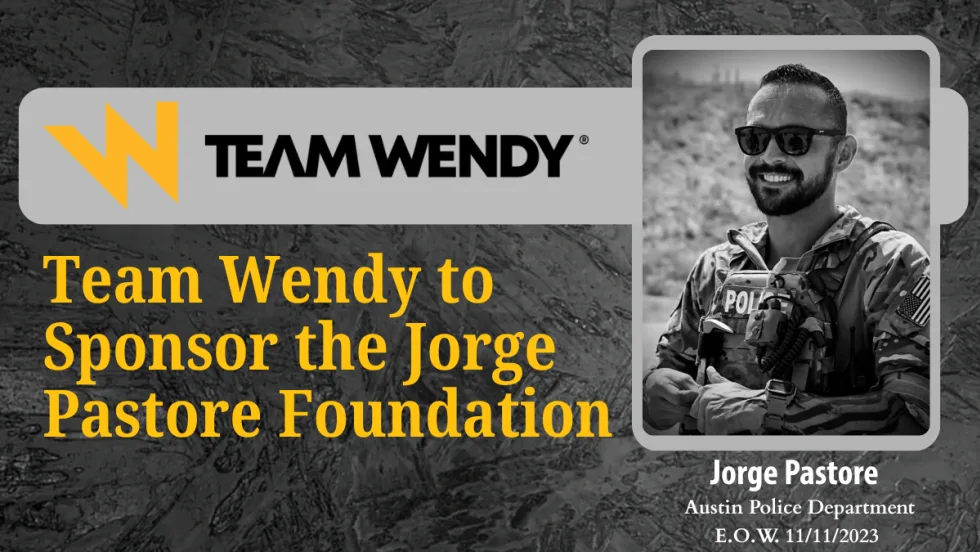
Team Wendy Announces Title Sponsorship of the Jorge Pastore Foundation
Team Wendy’s 3-year partnership with the Jorge Pastore Foundation expands access to programs that strengthen those who serve.
Read More →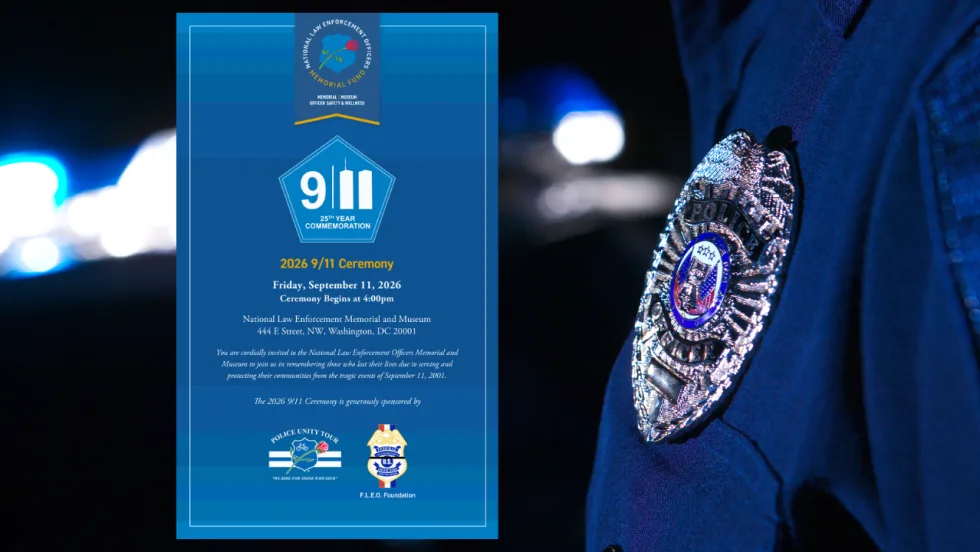
National Law Enforcement Memorial and Museum Hosting 9/11 25th-Year Commemoration Ceremony
The National Law Enforcement Memorial and Museum is hosting a 9/11 25th Year Commemoration Ceremony on Sept. 11 at 4 p.m.
Read More →
National Law Enforcement Officers Memorial Fund Announces June 2026 Officers of the Month
The National Law Enforcement Officers Memorial Fund (NLEOMF) named 15 officers of the Chico Police Department (California) as the Officers of the Month for June 2026 for their roles in responding to an active-shooter incident at a public library.
Read More →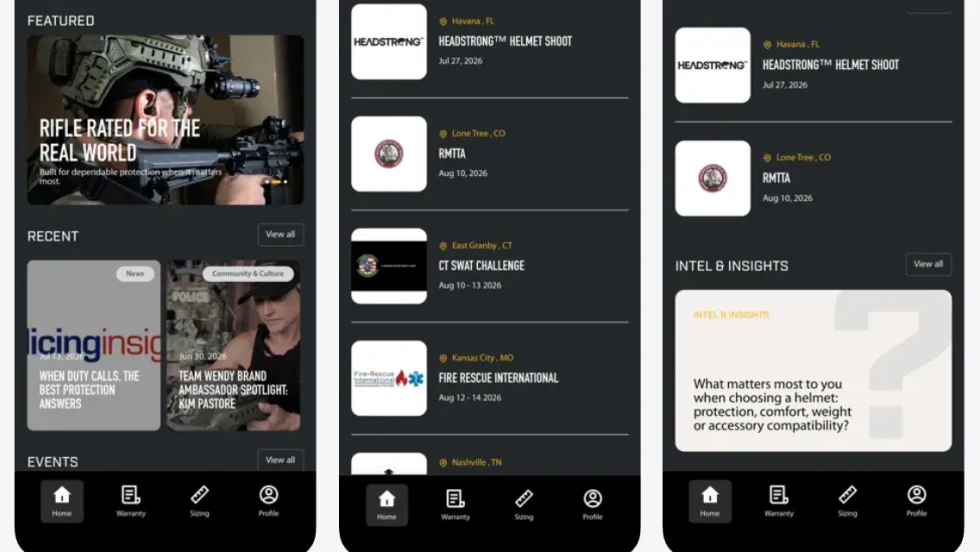
Team Wendy App Creates New Digital Hub for Helmet Owners
The Team Wendy Community App provides one location for warranty registration, size-fit tools, product updates, and community connection. For helmet owners, the new app creates a simpler path to the information and tools that matter most.
Read More →