



The State of American Law Enforcement - A Love-Hate Relationship
"My brother told me, 'If you want everyone to love you, join the fire department. If you want half the people to love you but half the people to hate you, go ahead and be on the police department.'" — Officer Michael Pecha, Omaha (Neb.) Police Department.


Meeting the high expectations to which people hold police officers is a tall order. To do so an officer must fix any problem immediately, including longstanding relationship and substance abuse issues. The officer must also utilize high-tech tools to find and examine evidence even for minor crimes, not speak in any way harshly, and leave even a person who hates anyone in uniform with a smile.
Given the astonishingly high standard that Americans expect of their cops, it's surprising that most people have a positive view of law enforcement. The profession even ranks among the top 10 most prestigious in a recent Harris poll, with 46 percent of respondents conferring law enforcement very great prestige and 27 percent considerable prestige.
More specific officer traits also garner praise. In a 2006 Gallup poll almost half of Americans rated the honesty and ethical standards of police officers as high. In a 2005 Harris poll, an even higher percentage of Americans rated their communities' police officers highly for quick response, not using excessive force, being helpful and friendly, and being part of the community.
Not too bad, especially considering that sometimes it seems police officers are ranked just below lawyers and ambulance chasers in profession popularity.
New York-based ABC reporter Richard Esposito agrees that the public's perception of police is good and has in fact improved in his 27 years as a journalist. "It's had to do with reforms, sensitivity training, and the diversity of police forces across the country," he says.
So what about the percentage of people who don't hold police officers in high regard?
Despite the favorable numbers, most contacts police officers make are with people they must arrest or reprimand. Such people are inherently negatively disposed to officers. "Obviously, it's usually the people committing the crimes who don't respect us," says Officer Michael Pecha of the Omaha (Neb.) Police Department.
Blue People
To be sure, not everyone has a positive view of law enforcement. And much of this feeling stems from the situations surrounding people's interactions with the police. Whether the recipient of a speeding ticket, a suspect, or a victim of a crime, seeing that blue uniform usually means something is wrong.
Even those who respect police officers might feel uneasy around them. Some are afraid that they could be treated unfairly because of stories they've heard. For others, the mystique surrounding the uniform and the badge, along with the requisite authority, is simply too foreign. No matter a person's opinion of police, an invisible barrier separates members of law enforcement from the uninitiated.
"Some of my friends just don't treat me the same," admits Officer Raymond Gallardo of the Des Moines (Iowa) Police Department. "They're still friendly; they're still my friends. However, there's a little difference and I can't really put my finger on what that difference is."
Immediately after 9/11, Americans had an exceptionally favorable opinion of police officers, seeing them as brave rescuers who risked life and limb to bring citizens to safety. Yet police were still second to firefighters in the outpouring of support. Now the 9/11 effect has long since faded from public memory, and most police officers have no illusions about their place in society.
"My brother told me, 'If you want everyone to love you, join the fire department. If you want half the people to love you but half the people are going to hate you, go ahead and be on the police department.' So I knew what I was headed for," says Pecha of Omaha PD.
Law enforcement requires cracking down on those who break the law. This inherently creates opposition, if not outright enemies. People who have never worn the badge can never truly understand what it is to be a police officer. Sometimes this lack of understanding leads to unrealistic expectations. Other times it leads to outright hatred for anyone in uniform.
"We're members of a blue minority group and we're never going to be completely understood except by other blue people," says Joseph Wambaugh, former LAPD officer and author of fiction and non-fiction about law enforcement. "It just isn't something that we sit around stewing about. It's the price you pay when you enter this club."
Police officers do talk about their interactions on the job, but such talk is usually limited to telling more universally appealing humorous stories at parties. Not everyone appreciates cops' requisite gallows humor, and more poignant anecdotes often involve realities of the job that the average person cannot and does not want to fully understand. Officers themselves can't dwell on the negative aspects of their job too often or they couldn't keep on doing it.
The CSI Effect
The general population doesn't understand what it takes to do police work, although they might mistakenly believe they do. A proliferation of movies and television shows that play fast and loose with the truth to make the job seem more enticing to viewers has played its part in this confusion.
Popular crime show "C.S.I." and its spinoffs set in New York and Miami would have people believe that every police force has at its disposal high-tech gadgetry to solve every crime, as well as a team of experts to follow each case through to its quick and satisfying conclusion. Loyal TV viewers often expect the same from their local cops.
Some even go out of their way to "help" solve the crime a la Gil Grissom. "I've been on calls before where evidence was left behind, and the person who called the police had everything laid out like they would on TV, marked with little pieces of paper nearby," says Officer Raymond Gallardo of the Des Moines (Iowa) Police Department. "It wasn't that big of a crime. I wanted to laugh but I didn't. Maybe it was huge to them. You've got to respect that."
In other cases, victims of a crime are more demanding because of their misconceptions. When reality doesn't meet fantastical expectations, citizens take their frustrations out on officers. "It's a nightmare," says Patrol Officer Jeffrey Petkac of the Cleveland (Ohio) Police Department. "We call it the C.S.I. effect in Cleveland. Literally, people think that every policeman has a spectral analysis flashlight on his belt that can determine whether the killer wore soft-soled shoes or a tweed jacket. It's ridiculous."
Of course, not every agency has the resources of television crime fighters. But citizens don't always understand the realities of budget constraints and the fact that a more minor crime such as petty theft is not as high on the priority list as say a rape or murder. Officers have to just grin and bear it. Even when their skills as professionals are called into question.
What really irks Petkac is when people spend hours analyzing a decision he had to make in a split-second. He likens such talk to Monday morning quarterbacking. "My job, my profession, and one other—professional coach of a sports team—are the only professions in the world that everyone knows how to do better than us."
Complaints
When citizens are truly ticked off they file formal complaints, the bane of many a cop's existence. These can go nowhere or lead to suspension, firing, or criminal charges.
As an example of the changing times, one police officer was recently indicted for killing bystanders while chasing a speeder, something that would have been seen as an unfortunate but unavoidable result of the job in years past.
"I think there are a lot more formal complaints that require investigation, and that puts fear into cops," says Wambaugh. "They're afraid they could be seriously disciplined for infractions that probably wouldn't have been considered infractions in my day."
Rich Rivera, training director of the Police Complaint Center, was a police officer himself for six years. He now spends his time taking citizen complaints, investigating complaints, and training law enforcement agencies how to facilitate the complaint intake process. He also compiles detailed statistics of the complaints people report.
Demeanor complaints are the most common in New Jersey, where the Center is based. "People just want to be treated like a human being. They don't want to be berated, degraded, humiliated, demoralized," says Rivera.
The same holds true for police officers. They want to be respected. Sometimes a mutual sensitivity to disrespect finds officers and citizens at cross purposes. Sometimes it ends up in the courtroom and involves larger issues of civil liberties.
The American Civil Liberties Union (ACLU)—public enemy number one for many cops—says that it takes on these issues of public complaint to promote transparency in law enforcement and champion citizens' privacy.
The ACLU says it seeks to improve law enforcement policies for citizens and thus claims to support police departments. However, its focus is on what citizens believe is wrong with law enforcement, which puts the organization at odds with officers who see it as more concerned with the rights of predators and less with the rights of their victims.
"What law enforcement does inherently implicates civil liberties, so any time that's the case you're going to have pushback," says Ray Gronberg, a reporter for the Herald-Sun newspaper in Durham, N.C., and adjunct faculty at the University of North Carolina Journalism School.
[PAGEBREAK]
High Expectations
Police officers are held to a higher standard than the average person. They can be not just criticized but sued for losing their cool, whether it be cursing or using excessive force. And considering the situations in which cops find themselves on a daily basis, maintaining a calm demeanor while simultaneously defending oneself from possible bodily harm can take its toll physically and emotionally. Cops see people at their best and their worst, but they must always show their best face, regardless of the circumstances.
Such high expectations have both positive and negative consequences.
"I think the public's criticism keeps us honest," says Gallardo of Des Moines PD. But in almost the same breath he admits that pressure to perform can take its toll. "There's a lot of stress involved in this job," he says, "and sometimes people can't handle that stress and because of that they do something wrong."
Bad cops do exist, and they should be disciplined. But Officer Marcus Benner of the Minneapolis Police Department worries that coming down too harshly on some officers could discourage them from doing their best. He's seen it happen. "It's sad to see a rookie, coming out of the academy all ready to go, one year later have all the air taken out of his sails," says Benner. "That's the saddest thing in the world when all they wanted to do was be a police officer and help the community."
The Police Complaint Center's Rivera concedes that when it comes to complaints, police officers are no longer given de facto benefit of the doubt, and that in fact the pendulum may have swung too far in the opposite direction.
"Years ago cops were gospel," says Rivera. "From my generation, under 40, if you were brought home by the police, [the question] was, 'What did you do?' or 'What did you say to the cop?' and now it's, 'What did the cop do to you?' I think there needs to be a balance."
For his part, Petkac is tired of people foisting responsibility for their troubles on the police. He recently had to respond to a domestic case. Because all domestic cases are given high priority, he and his partner arrived posthaste with lights and sirens. The urgent call turned out to be an 11-year-old boy tearing up his house because he was fighting with his mother. "That's not a police matter, it's a parenting issue," says Petkac.
More commonly, spouses call on the police when a domestic dispute arises. Long histories of physical abuse, alcoholism, and drug use often contribute to these altercations. Patrol officers can't possibly resolve such problems in one or even several calls. Yet they're often expected to do exactly that. They're set up to be the fall guy.
"If you've ever been to a restaurant where there are a lot of police, a parent will walk by and say, 'You better eat your vegetables or the police are going to take you away.' That hurts," says Petkac. "We are perceived as the bad guys."
There are ways to change the opinion of children and adults. It requires time and money, but in the end it's all about building credibility and gaining trust.
Turning the Tide
As pervasive as television has become in society, shows about police officers often have the power to affect people's views on law enforcement, sometimes for the better. Among the most popular and enduring police shows is Fox Television's "COPS." Its appeal doesn't end with the opening theme song "Bad Boys."
With its documentary style that follows officers on their patrol shift, "COPS" has shown viewers what a call is like from the law enforcement perspective. Not only has this view enlightened casual watchers as to the everyday goings on of police work, it has also helped bring new recruits into the ranks.
"Many police officers have told me they got into law enforcement because of the television show 'COPS,'" says show creator and executive producer John Langley. "Not a few, many."
Yet it isn't so easy to convince many detractors that law enforcement officers are out to help their communities.
Officer Benner of the Minneapolis PD prides himself on positively influencing citizens at an early age. As part of his agency's Police Athletic League staff, he coaches children as young as eight in basketball, baseball, and football. What began as a favor to a friend became a passion. He says he was hooked his first day as a volunteer.
"The best was that by the time one week of practice went by every kid on the team told me they wanted to be police officers," says Benner of his initiation into the Police Athletic League.
It wasn't easy convincing kids' African-American parents and neighbors to trust him, especially because he himself is African American. Some accused him of betraying their trust by essentially joining the enemy. But once they saw he seriously wanted to help children and others in their neighborhood, community members took his suggestion to help create change from within.
Now, they walk up to Benner and give him the names of recent high school graduates they would like to see join the police department.
Just seeing police officers in situations outside of patrol can help community members understand that they're flesh and bone, too. It's easier to hate a uniform than it is to hate someone you know personally.
"We're not out there trying to save the world," says Cleveland PD's Petkac. "If you are, you're kidding yourself. You're not going to save the world, but you might be able to save one person. You might be able to help one kid."
Keeping Pace with Media Technology
When it comes to winning people's hearts and minds, managing a police agency's image in the media is a whole different ballgame these days thanks to video cameras in cell phones, blogs, and YouTube. Today's cop and today's police agency is not only under the scrutiny of organized and professional news media but anyone who happens to have an axe to grind and pictures to back up his or her complaint.
Last summer one teenager videotaped an interaction with a veteran Baltimore police officer who got physical when the teen and his friends were caught skateboarding in a marked no-skateboarding zone and refused to leave. Almost a year later the video appeared on the Internet site YouTube. One of the teens and his mother were then asked to appear on "Good Morning America," where they decried the officer for his actions. The officer, who had no complaints on his record, was suspended without pay.
"That's the power of the Internet right now," says Rivera of the Police Complaint Center. "No longer are small towns and communities isolated from the rest of the world. Now they're making it to national news."
With the rapid pace of media reporting and individuals' ability to post their own videos and blogs online comes a tendency to show the public things out of context. But police departments are not new to the public relations game. They've just had to adjust with the times. "The important thing is we have even more media outlets nowadays than ever before," says newspaper reporter Gronberg. "Nobody has a monopoly on it."
What that means is that police agencies have to be quicker on the draw when trying to win the battle for public opinion.
Issuing statements as quickly as possible can help to alleviate tension about ongoing cases or cases of alleged police misconduct. Updated agency Websites that provide detailed contact information and showcase department involvement in the community also go a long way toward garnering public support and improving the way the public perceives its police.
In January 2008, POLICE Magazine launched a year-long article series focusing on the “state of American law enforcement.” If you’d like to read the other chapters, click on the links below.
Chapter 1: The Thinning Blue Line. Law enforcement agencies nationwide are competing for a dwindling population of recruits.
Chapter 2: The Blue Mosaic. Policies meant to diversify law enforcement agencies have changed police demographics and will continue to do so in the future.
Chapter 3: Teaching to the Test. Does law enforcement training focus too much on qualifying and not enough on skills that can help you win fights?
Chapter 5: Can the Average Cop Thrive in the Age of Specialization? The generalist cop is part of a dying breed, which means many of today's officers will need to excel at a specialty.
Chapter 6: Women Warriors. Female police officers must walk a fine line between fitting in and making their own way in law enforcement.
Chapter 7: Working on the Front Lines. The patrol officer is the backbone of American policing, but a lot of agencies don’t want to admit it.
Chapter 8: SWAT: Breaking the Mold. Agencies nationwide model their tactical teams on LAPD SWAT. So what does it mean if that unit changes its policies to be more politically correct?
Chapter 9: Stopping the Next 9/11. Improvements in intelligence gathering, training, and equipment give you a good chance of preventing the next attack and saving lives if it happens.
Chapter 10: Rules of Engagement. Today’s law enforcement officer is the best trained and best equipped cop in history, so why do policy makers think you have the judgment and intellect of children?
Chapter 11: Gangster Nation. Big city street gangs have taken root in small town America, bringing mayhem to Main Street.
Chapter 12: Damned If You Do, Damned If You Don't. When a cop uses - or doesn't use - a less-lethal weapon in contemporary America, there can be hell to pay.
More Patrol

Streamlight Portable Scene Light III Wins 2026 OH&S New Product of the Year Award
Streamlight’s Portable Scene Light III has won the 2026 Occupational Health & Safety (OH&S) New Product of the Year Award in the Lighting category.
Read More →
Adept Armor Introduces Two New Rifle Plates
Adept Armor has launched two new Level IV ballistic plates, the Emperor and the Archon Mark 2, which brings Adept Armor’s new Quatroid ceramic to the high-threat, performance-value center of the range at 5.2 pounds.
Read More →
POLICE Product Test: Benchmade Bailout
The Benchmade Bailout is a slim, lightweight carry knife with a deep-ride pocket clip and comes in a variety of blade steels and scales. Here is a detailed review of the Taiga Green Bailout, released earlier this year.
Read More →
NLEOMF Announces July 2026 Officer of the Month
NLEOMF honored a Michigan deputy sheriff as the July 2026 Officer of the Month for rescuing a trapped driver from a burning vehicle following a Fourth of July crash.
Read More →
Streamlight to Showcase Newest Lighting Products at National Safety Council’s Safety Congress & Expo 2026
Streamlight will showcase its latest lights, including the Portable Scene Light III and the LiteBox 1Million, at the 2026 National Safety Council (NSC) Safety Congress & Expo.
Read More →
The 2027 World Police & Fire Games Set for Perth, Australia
The 2027 World Police & Fire Games (WPFG) will take place in Perth, Western Australia, from Friday, March 12 through Sunday, March 21, 2027.
Read More →
5.11 Partners with National Fallen Firefighters Foundation to Support #ForThe343
5.11 has joined the nationwide movement honoring the 343 New York City Fire Department firefighters lost on Sept. 11, 2001.
Read More →
Team Wendy Announces Title Sponsorship of the Jorge Pastore Foundation
Team Wendy’s 3-year partnership with the Jorge Pastore Foundation expands access to programs that strengthen those who serve.
Read More →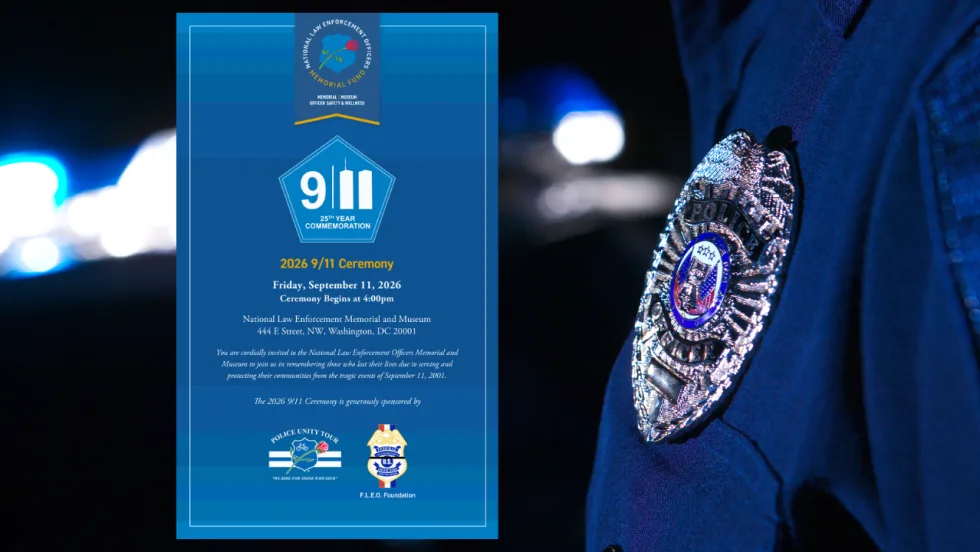
National Law Enforcement Memorial and Museum Hosting 9/11 25th-Year Commemoration Ceremony
The National Law Enforcement Memorial and Museum is hosting a 9/11 25th Year Commemoration Ceremony on Sept. 11 at 4 p.m.
Read More →
National Law Enforcement Officers Memorial Fund Announces June 2026 Officers of the Month
The National Law Enforcement Officers Memorial Fund (NLEOMF) named 15 officers of the Chico Police Department (California) as the Officers of the Month for June 2026 for their roles in responding to an active-shooter incident at a public library.
Read More →