



The Next Dimension
Since the earliest days of trial by jury, detectives have been searching for new ways to help jurors visualize crime scenes. Using new computer and photographic technologies, investigators can create diagrams with complex 3-D surfaces and immersive 360-degree images.

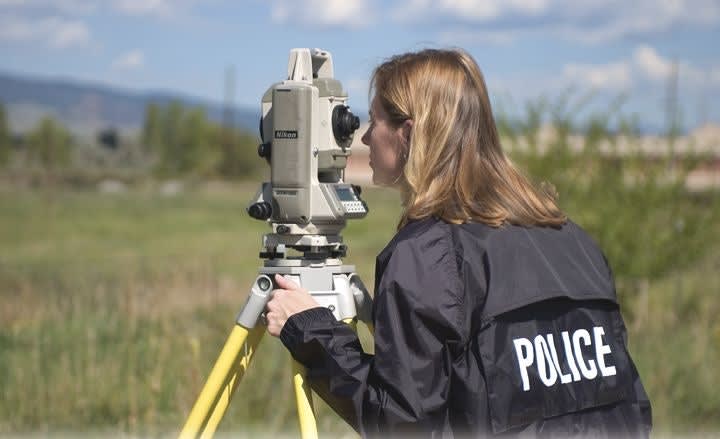
More and more agencies are employing surveying equipment such as total stations to record data for 3D crime scene imagery.
Since the earliest days of trial by jury, detectives have been searching for new ways to help jurors visualize crime scenes. In this pursuit, law enforcement quickly adopted photography and hand-drawn diagrams to create two-dimensional representations of crime scenes.
These basic courtroom graphics have always been, well, as the term two-dimensional indicates...flat, lacking vertical depth. But not anymore.
Using new computer and photographic technologies, investigators can create diagrams with complex 3-D surfaces and immersive 360-degree images. Such high-tech representations of crime scenes allow for much more accurate presentation of bullet holes, blood spatter, and other evidence that's hard to document with 2-D methods.
Since visual documentation is considered one of the most important types of evidence presented to a jury, the details of a diagram-or lack of them-can dramatically impact a jury's perception of the chronology and probable events surrounding the crime, which can ultimately impact the verdict.
Going 3-D
So how do you recreate a crime scene in 3-D? Well, unless you want to make a diorama, you'll need a computer and some special software. Solutions range from about $500 to more than $60,000. How much you spend will depend on the complexity of the equipment and software that you want to acquire and the desired level of detail in the final product. The most cost-effective solution is to purchase diagramming software that accepts "Z" axis or vertical measurements.
To use these tools, CSIs or detectives at the scene use a tape measure or inexpensive laser measuring device to manually measure length, width, and height of the location and the evidence. These data points are entered into the software by hand then used to create the 3-D diagram.
If you want to spend a little more money for greater precision, you might want to integrate a sophisticated measuring device such as a total station (a surveyor's tool) to electronically capture distance information.
Using a total station, you can accurately measure distances and angles, recording 3-D data. The total station is connected to a small device called a "data collector," usually a PDA. The measurements are stored electronically on the data collector and can be automatically transferred into a 3-D software program. The advantages of working with a total station and a data collector include increased automation, faster measurement, and many more measurement points, yielding a more detailed diagram.
Another option for obtaining 3-D measurement is through the use of photogrammetry, the science of extrapolating 3-D measurements from 2-D photographs. Software advances have made this process easier, considerably less expensive, and more accurate than ever. And photogrammetry has also been merged with immersive imaging to provide a unique view of the crime scene along with precise 3-D measurements.
Immersive imaging has been used in real estate sales for years, yet only recently have police departments begun to use this technology. An immersive image provides a 360-degree view of the scene that the viewer can scroll around; it's almost like being in the crime scene. This is especially powerful when combined with 3-D measurement.
The following is a collection of some of the most widely used tools for 3-D diagramming:
Crime Zone
Crime Zone from Beaverton, Ore.-based CAD Zone is one of the most popular forensic diagramming software packages on the market. CAD Zone has been developing forensic software products for more than a decade and it shows in the quality of Crime Zone.
Any cop who is moderately computer literate can easily create professional 2-D and 3-D crime scene or crash scene diagrams and models with Crime Zone. The program is surprisingly easy to learn, and not just the basics either. It takes far less time than you'd think to master this software. The interface is intuitive and the symbols library is complete, containing just about every type of weapon and piece of evidence you can imagine.
A unique feature of Crime Zone is its ability to create a 3-D model from a 2-D diagram with the click of a button. The 3-D model includes all the 2-D measurement information and can be viewed from any perspective. Additionally, measurements can be entered in baseline or triangulation form, making it far easier to place evidence in the diagram. Small details count, like articulated joints on the figures that allow the user to ensure the body is accurately portrayed in the diagram.
Departments using a total station can purchase Crime Zone with Pocket Zone for $995. Pocket Zone is data collection software that can be loaded on the handheld computer of your choice and connected to a laser measuring device. The 3-D measurement data is easily imported into Crime Zone, greatly speeding up the workflow. Also, Pocket Zone is the only data collection software specifically designed for law enforcement, not surveyors, so it's easier to use than many of its competitors.
DeltaSphere 3000
The DeltaSphere 3000 3-D scanner and SceneVision 3-D from Chapel Hill, N.C.-based 3rdTech are two of the most amazing law enforcement products that I've ever seen. The DeltaSphere 3000 3-D scanner is a high-speed scanning laser rangefinder that's kind of like a total station on steroids. By that I mean it's capable of taking more than 25,000 measurements per second.
Users set up the DeltaSphere 3000, and it automatically scans the scene, taking millions of precise measurements along with digital photographs. 3rdTech's SceneVision 3-D software then combines these data points and digital photographs to create a high-resolution digital recreation of the scene. This diagram can be rotated around any axis and viewed from any desired perspective. You can zoom in or out and add closeup photos of specific evidence. In addition, extremely accurate 3-D measurements are possible of any items in the scene and tools are included for bullet and blood spatter trajectory.
The effective range of this unit is about 40 feet. You really need to see the resulting diagram on a computer to fully appreciate the capabilities of the DeltaSphere 3000. The DeltaSphere 3000 creates the most accurate and detailed 3-D diagram I've ever seen. Price is around $40,000, depending on the exact configuration.
iWitness
DeChant Consulting Services of Bellevue, Wash., offers a unique photogrammetry software package called iWitness that's designed specifically for crime scene and crash scene measurement. It's simple to use but very powerful.
Here's how iWitness works: Take three digital photographs of the same scene from three different angles. At the scene, measure one distance visible in all three photos. Next, import the images into iWitness and mark six corresponding points that are visible in the images. The software automatically orients the camera in 3-D space and processes the data to provide accurate 3-D coordinates of any points marked in the scene.
The data from iWitness can be directly imported into a variety of computer-aided drawing (CAD) systems, including Crime Zone. The bottom line: from one measurement and three photos iWitness, which retails for $895, can accurately determine 3-D distances of the crime or accident scene.
Linear Systems
The SpheroCam HDR distributed by Linear Systems of San Bernardino, Calif., is truly on the cutting edge of technology. This system combines a high-resolution (up to 50 million pixels), high-dynamic-range camera with precise 3-D photogrammetry.
To use the SpheroCam HDR, you place the specially calibrated digital camera system (with a 16mm fisheye lens) atop a tripod in the center of a crime scene. The camera then rotates 360 degrees, capturing everything from the floor to the ceiling.
The resulting immersive image allows the user to pan up and down and left and right. A zoom tool allows the user to look closely at evidence in the scene. The unique feature of this system is that any item can be accurately measured in 3-D space by simply dragging a slider between two points.
Multiple scenes or rooms can also be linked together by hotspots to create a "virtual reality" tour of the crime scene. The included software is intuitive and features image encryption and user verification to ensure the veracity of the images.
This advanced system is not cheap. It's priced from $45,000 to $70,000, but you may find it worth the price, especially when you consider its flexibility.
MapScenes
MapScenes from Canada's MicroSurvey is marketed as a "Complete 3-D scene diagramming tool." The software is designed for both crime scenes and crash reconstructions, and is sold in two versions, Pro and Lite.
The Pro version of MapScenes sells for $1,395 and is designed for agencies using total stations or other electronic measuring devices. MapScenes Pro is designed to be used in conjunction with MicroSurvey's Evidence Recorder Pro ($995) to collect electronic measurement data and transfer it into your computer.
MapScenes is a powerful diagramming tool that allows for animated viewing of the diagram in 2-D or 3-D. The included symbol library contains more than 7,000 items, the most of any diagramming software. And digital photographs can be linked to the diagram to show specific details.
All of its features could lead you to believe that MapScenes presents users with a steep learning curve, but the included tips, manual, and training movies really help get you up to speed.[PAGEBREAK]
PanoScan
Another immersive photography system that's being used for law enforcement applications comes from Van Nuys, Calif.-based PanoScan. The PanoScan system features a high-resolution, high-dynamic-range camera on a tripod mount that rotates 360 degrees. As the camera rotates, it captures a seamless image of an entire scene. The image can be output as a panoramic print or shown on screen.
PanoScan's new Mark 3 camera captures images much faster than its predecessors, has increased data storage capacity, and downloads faster with USB 2.0 connectivity. PanoScan equipment is currently on duty with a number of agencies, including the San Bernardino County (Calif.) Sheriff's Department, the Kern County (Calif.) Sheriff's Department, and the Los Angeles County Sheriff's Department.
Take a Test Drive
Agencies considering the purchase of 3-D diagramming and imaging tools need to consider many factors, including system cost, simplicity, training issues, and support.
That's why the old adage, "Try before you buy," is true here. Most vendors provide a demo version of their software so you can use the product and really determine if it fits your needs.
Immersive and 3-D technology will continue to evolve but it's mature enough that most agencies can benefit. Maybe now is the time to consider adding this tool to your agency's toolbox.
How Investigators are Using 3D Graphics
A recent police shooting in Creswell, Ore., illustrates how effective a 3D diagram can be for showing bullet trajectory.
Det. Doug Jordan of the Eugene Police Department used the CAD Zone's Crime Zone product to create 2D and 3D diagrams of the shooting.
In the incident, a male suspect kidnapped his girlfriend in a trailer park. Shortly after the kidnapping, the girlfriend escaped. When Lane County deputies arrived at the scene, the suspect fired several shots through his trailer's walls. The Eugene-Lane County Metro SWAT team was activated, arriving about midnight that day. The suspect continued shooting outside through the walls of his trailer.
Negotiators tried to talk the suspect out, but when the suspect emerged from the trailer the next morning, he began shooting at the SWAT team with a handgun. The SWAT team returned fire, hitting the suspect several times. During this shooting, some of the SWAT team's rounds, fired from across the street from the suspect's trailer, penetrated a modular home on the north side of the fence that ran between the RV portion of the trailer park and the modular home section.
The Use of Force Review Board wanted to know from what location the rounds that struck the modular home were fired. Therefore, it was critical to determine the trajectory (from which angle/height the shots occurred) of those rounds.
Pragmatically, the trajectory could be determined only by using a scale diagram in which the location of the SWAT personnel was carefully plotted. The 3D diagram clearly showed that a SWAT Team member lying prone across the street from the suspect's trailer had fired the errant rounds and that those rounds had been fired at the suspect.
Another example of how 3D diagrams are helping investigators involves a drug-related shooting in Mendocino, Calif.
One of the suspects had given the victim money early one day to purchase marijuana. The victim failed to make the purchase, after which time the suspect and an accomplice visited the victim's house to retrieve their money.
When the suspects arrived at the victim's home, gunfire erupted from both parties. Two people were struck by bullets. One person was shot twice in the head, while a second person was struck in the left shoulder and mouth.
Witnesses, police officers, victims, and even suspects used diagrams of the incident to show where they were during the shooting. The jury could see the exact location of the furniture and evidence as well as the structure of the house. Each witness' view was important. And having the witnesses pinpoint where in the crime scene they were when the bullets began flying made their individual testimony more credible.
Another example of 3D imaging as a police application involves a police shooting in Houston. In that case, officers were dispatched to an assault in progress. What they didn't know was that a home invasion robbery was actually taking place.
Four officers responded to the scene and knocked on the apartment door. A man answered, telling the officers that everything was all right inside. The man was acting suspicious and making furtive movements with his body. The officer demanded to see the man's hands, at which point the suspect raised a large handgun and fired, striking the officer in the forearm.
A gunfight ensued, and the officers retreated to cover under the onslaught. The suspects managed to enter their stolen pickup truck, which was partially blocked by two police cruisers. The suspect vehicle rammed the police cars and fled the scene.
Officers continued to return fire. One round struck the suspect's rear tire, causing it to go flat. The suspects abandoned the truck a short distance away and fled on foot, eventually carjacking a man for his vehicle. Both suspects were quickly identified by evidence left behind in the ditched truck.
They were caught a few hours later in a nearby city. Both were eventually convicted of attempted murder on a police officer.
Homicide Division Crime Scene Investigator Jeff Cruser was tasked with the job of recreating this crime scene in the form of a diagram. Cruser knew that traditional hand-drawn methods would be difficult in this case because of the complexity of the scenes.
So Cruser chose to work in Crime Zone. He was able to measure the crime scenes and import the data into the software to quickly generate accurate diagrams of all the vehicles and evidence. Being able to create a 3D model with the click of a button was particularly useful in giving the jury another way to visualize the scene.
For More Information
3rdTech
www.3rdTech.com
CAD Zone
www.cadzone.com
iWitness
www.iwitnessphoto.com
Linear Systems
www.linear-systems.com
MapScenes
www.mapscenes.com
PanoScan
www.panoscan.com
Spheron (SpheroCam HDR)
www.spheron.com
David Spraggs is an investigator and firearms instructor with the Boulder (Colo.) Police Department. He also teaches forensic photography and crime scene investigation.
More Technology
A police agency's guide to data-driven fleet management
Costs are rising and the public expects more transparency into how their tax dollars are spent. This e-book shows how police agencies can use fleet data to take control of fleet expenses while improving officer safety and demonstrating fiscal responsibility to the communities they serve.
Read More →
AI and analytics for law enforcement: Turning data into insights
Law enforcement agencies are managing more video, sensor data and digital evidence than ever before. Discover how AI and analytics can help turn that data into actionable insights that strengthen situational awareness, accelerate investigations and support more informed decisions.
Read More →
Vasco Electronics Adds Automatic Language Detection to Vasco Translator Q1
Vasco Electronics’ software update introduces hands-free language switching and expanded offline translation across 45 language pairs, empowering law enforcement, healthcare, and front-office enterprise teams
Read More →

North Miami Police Department Deploys Mark43
The North Miami Police Department has deployed Mark43 as part of its Five-Year Strategic Plan that represents its collective vision and goals for a more proactive police department, anchored by a core commitment to leveraging modern technology to enhance efficiency and public safety.
Read More →
Cellebrite Genesis for Enterprise Now Generally Available
Made available to the public sector in June, Cellebrite Genesis is serving a growing mix of national, regional, and local agencies worldwide, including some of the largest regional and metropolitan police departments. It is now available for enterprise organizations.
Read More →
2026 Vision FirstNet Users Summit to Host Emerging Leaders Training on Grassroots Advocacy for Public Safety
“Emerging Leaders Training: Understanding the Importance of Grassroots Advocacy for Public Safety," a session during the 2026 Vision FirstNet Users Summit, will offer a roadmap for unified advocacy at the federal level.
Read More →
Motorola Solutions Completes Acquisition of D-Fend Solutions
Motorola Solutions has acquired D-Fend Solutions, an industry leader in counter-drone technology. This deal provides public safety and enterprise customers with access to advanced counter-unmanned aerial systems.
Read More →
ZeroEyes, Advantech & Camden Police Partner to Bring AI Gun Detection Technology to Delaware School District
ZeroEyes has partnered with Advantech and the Camden Police Department to deploy ZeroEyes’ AI gun detection and intelligent situational awareness platform at Delaware’s Caesar Rodney School District (CRSD).
Read More →
Leonardo U.S. Cyber & Security Solutions Introduces SignalTrace, the Next Evolution in Electronic Signature Detection Technology
SignalTrace reflects years of product refinement and a clearer expression of the technology’s purpose of recognizing and correlating electronic signatures in publicly broadcast wireless signals to reveal patterns, relationships, and trends that might otherwise go undetected.
Read More →
Pimloc Launches Secure File Sharing to Streamline Release of Redacted Video
Pimloc’s Secure File Sharing lets organizations deliver redacted video, audio, and documents through expiring, passcode-protected links, accelerating delivery while reducing security, compliance, and chain-of-custody risks.
Read More →