



The 'Independent Source' Doctrine
If you can identify two or more ways to justify a detention, arrest, search, or entry, you increase the odds that at least one of them will be upheld in court.


Most cops understand the importance of carrying a backup weapon. The primary could get lost, malfunction, or run out of ammo. It's wise not to put all of your survival eggs in one basket.
Given the complexity and uncertainty of the ever-changing Fourth Amendment rules, it's also wise not to put all of your search-and-seizure eggs in one basket. If you can identify two or more ways to justify a detention, arrest, search, or entry, you increase the odds that at least one of them will be upheld in court, and the contraband or evidence you found will be ruled admissible. This is where the "independent source" doctrine can help.
No Harm, No Foul
The rationale of the court-created exclusionary rule is that by suppressing evidence, courts will deter police from making unreasonable searches and seizures. But if a criminal defendant's rights have not been violated, there is no police misconduct to deter, so no suppression. And the defendant's rights are not violated if the search or seizure can be justified under at least one standard theory, even though another theory advanced by police or prosecutors does not support the action taken.
The U.S. Supreme Court has emphasized repeatedly that although one source of contested evidence might be "tainted," a different source may save the evidence from suppression.
"If knowledge of the facts is gained from an independent source, they may be proved like any others." (Silverthorne Lumber v. U.S.)
"The 'fruit of the poisonous tree' doctrine excludes evidence obtained from or as a consequence of lawless acts, not evidence obtained from an independent source." (Costello v. U.S.)
"It is clear from our prior holdings that the exclusionary rule has no application where the Government learned of the evidence from an independent source." (Segura v. U.S.)
"The independent source doctrine allows admission of evidence that has been discovered by means wholly independent of any constitutional violation." (Nix v. Williams)
"The 'independent source' doctrine permits the introduction of evidence initially discovered during, or as a consequence of, an unlawful search, but later obtained independently from lawful activities untainted by the initial illegality." (Murray v. U.S.)
For example, suppose you have a search warrant to search a house. Before telling the resident about the warrant, you ask for consent to come in and search, and the resident agrees. You then tell him that you also have a warrant. You now have two independent sources for evidence that you find inside.
If a court later finds that the warrant was so defective that it was unreasonable to rely on it, you can invoke consent to justify the search. Or, if the court had found that the consent was not voluntary or was not given by someone who reasonably appeared to have authority to consent, the warrant would be an independent source of the evidence. To defeat the "independent source" doctrine, a defendant would have to attack the validity of each and every justification you claim.
Cell Phone Searches Today
Here's the perfect opportunity to apply the "independent source" doctrine when you search. Can you search a suspect's cell phone incident to his lawful arrest? It all depends on where you work.[PAGEBREAK]
The general rule is that the scope of a search incident to arrest extends to anything the suspect is wearing and carrying when he is arrested. (Florida v. Gustafson) This could include his pockets, wallet, and backpack, and smaller containers found inside these places-such as a pack of cigarettes. (U.S. v. Robinson) A cell phone is a digital container carried on the person, so it should be subject to search incident to arrest. However, not all courts agree.
In U.S. v. Finley, the Fifth Circuit of the United States Court of Appeals said that the contemporaneous search of the cell phone the suspect was carrying at the time of his arrest is a permissible search incident to arrest, per Robinson. This ruling has been followed by federal courts in Maine and Texas, but not in California and Florida.
The Ohio Supreme Court rejected the Finley holding, on the grounds that digital containers are somehow more protected than other containers. (State v. Smith) The California Supreme Court is still considering whether to uphold or reverse a 2008 appellate decision applying Finley. (People v. Diaz)
Eventually, the U.S. Supreme Court will have to weigh in and settle the question of whether the Fourth Amendment applies differently to digital containers than to others. In the meantime, the prudent move for law enforcement officers is to keep the "independent source" doctrine in mind and to try to establish other ways to justify cell phone searches, in addition to searching incident to arrest.
Multiple Independent Sources
"Search incident to arrest" is just one of several exceptions to the warrant requirement. Officers may be able to identify other exceptions that could apply to any particular search (not just cell phone searches), such as one or more of the
following:
Consent. Good standard practice is to seek consent before every non-emergency search. Consent is an ideal independent source, even when there seem to be other valid justifications. It doesn't require any suspicion, it's easy to request ("OK if I search your cell phone?"), and you don't get any worse off by asking, even if consent is refused. (U.S. v. Drayton)
Probation or parole search. If the suspect is on probation or parole on condition that he submit his personal property to warrantless search, this could be an independent source. (Samson v. California)
Fleeting targets. With probable cause to believe contraband or evidence may be somewhere in a vehicle, you may search any part of the vehicle and its contents that could conceal the object of your search. (California v. Acevedo)
Officer safety. Where there is reasonable suspicion to believe a suspect is armed and dangerous, you may make a limited search of the outer clothing (pat down) for weapons. (Terry v. Ohio)
Public safety. Threats to public safety justify immediate searches to remove the risk. (Cady v. Dombrowski)
Booking search. The property of a booked prisoner may be examined and logged for safekeeping. (Illinois v.Lafayette)
Inventory. Vehicles and their contents may be searched under a standardized inventory policy. (Colorado v. Bertine)
Are Backups Worth The Bother?
Just about every law enforcement officer has heard of at least one shooting where an officer saved himself or herself with a backup weapon-or could have. And just about every prosecutor has handled suppression hearings where the officer could have saved the evidence by simply considering alternative ways to justify search-or-seizure activity.
Even if you think you're on solid ground searching for officer safety or incident to arrest, why not take a minute to request consent, and to ask whether the suspect is on probation or parole search terms? You believe there's probable cause to search the trunk of a fleeting target; why not also seek consent, check probation status, and conduct a standardized inventory?
To maximize your chances of preventing the suppression of valuable evidence, maximize the number of grounds for searching. Don't put all your search-and-seizure eggs in one basket.
Devallis Rutledge is a former police officer and veteran prosecutor who currently serves as Special Counsel to the Los Angeles County District Attorney. He is the author of 12 books, including "Investigative Constitutional Law."
More Patrol

Adept Armor Introduces Two New Rifle Plates
Adept Armor has launched two new Level IV ballistic plates, the Emperor and the Archon Mark 2, which brings Adept Armor’s new Quatroid ceramic to the high-threat, performance-value center of the range at 5.2 pounds.
Read More →
POLICE Product Test: Benchmade Bailout
The Benchmade Bailout is a slim, lightweight carry knife with a deep-ride pocket clip and comes in a variety of blade steels and scales. Here is a detailed review of the Taiga Green Bailout, released earlier this year.
Read More →
NLEOMF Announces July 2026 Officer of the Month
NLEOMF honored a Michigan deputy sheriff as the July 2026 Officer of the Month for rescuing a trapped driver from a burning vehicle following a Fourth of July crash.
Read More →
Streamlight to Showcase Newest Lighting Products at National Safety Council’s Safety Congress & Expo 2026
Streamlight will showcase its latest lights, including the Portable Scene Light III and the LiteBox 1Million, at the 2026 National Safety Council (NSC) Safety Congress & Expo.
Read More →
The 2027 World Police & Fire Games Set for Perth, Australia
The 2027 World Police & Fire Games (WPFG) will take place in Perth, Western Australia, from Friday, March 12 through Sunday, March 21, 2027.
Read More →
5.11 Partners with National Fallen Firefighters Foundation to Support #ForThe343
5.11 has joined the nationwide movement honoring the 343 New York City Fire Department firefighters lost on Sept. 11, 2001.
Read More →
Team Wendy Announces Title Sponsorship of the Jorge Pastore Foundation
Team Wendy’s 3-year partnership with the Jorge Pastore Foundation expands access to programs that strengthen those who serve.
Read More →
National Law Enforcement Memorial and Museum Hosting 9/11 25th-Year Commemoration Ceremony
The National Law Enforcement Memorial and Museum is hosting a 9/11 25th Year Commemoration Ceremony on Sept. 11 at 4 p.m.
Read More →
National Law Enforcement Officers Memorial Fund Announces June 2026 Officers of the Month
The National Law Enforcement Officers Memorial Fund (NLEOMF) named 15 officers of the Chico Police Department (California) as the Officers of the Month for June 2026 for their roles in responding to an active-shooter incident at a public library.
Read More →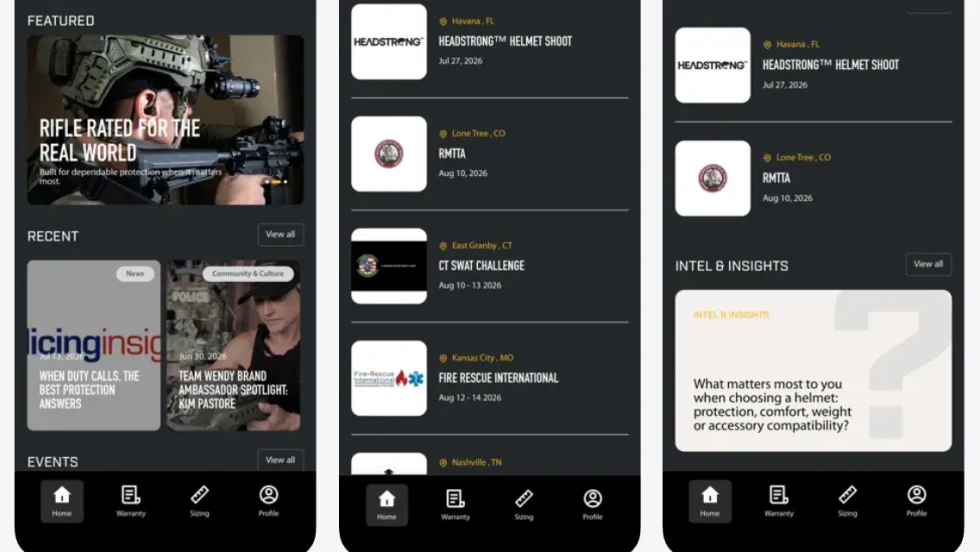
Team Wendy App Creates New Digital Hub for Helmet Owners
The Team Wendy Community App provides one location for warranty registration, size-fit tools, product updates, and community connection. For helmet owners, the new app creates a simpler path to the information and tools that matter most.
Read More →