



Surviving Your Off-Duty Hours
Anyone who has spent any amount of time in law enforcement has heard threats. That is one of the reasons we carry firearms while off duty, have unlisted telephone numbers, and maybe have the registration information of our personally owned vehicles restricted.

"I'm gonna get you when I get out!"
Anyone who has spent any amount of time in law enforcement has heard threats. That is one of the reasons we carry firearms while off duty, have unlisted telephone numbers, and maybe have the registration information of our personally owned vehicles restricted.
As cops, we deal with numerous people on a professional basis. There is a probability that some of our "clients" will not be happy with our actions. A few might actually make an attempt to do us harm.
Besides inflicting physical harm, the offender may choose from several lower risk methods of revenge. These can be very effective in damaging a person's credit, life, family and career.
Where There's a Will There's a Way
Anyone who wants to track somebody down, and who knows how "the system" works, isn't going to let minor hurdles like an unlisted telephone number deter him or her. Let's face it. Officers have been followed from their police stations to their homes.
Each and every one of us has information about us stored away in various information databases. Some of that information is privileged information. This includes credit information, criminal histories and motor vehicle registration information. This information is supposedly restricted to a "need-to-know" and. for the most part, is fairly secure. Sometimes some of this information can become "quasi-public information."
There is also public information, available to anyone who knows how to obtain it. This type of information includes property records; birth, death, marriage and divorce certificates; civil actions; and other documents.
Let's face it. If you own a home, have been married or divorced, have been involved in any type of litigation, personally or professionally, that information is readily available to the public.
Enter the Internet Age
Information that once had to be dug out of musty court archives is now available to anyone who has Internet access. Looking for your long lost love? How about the cop who unjustly gave you the ticket for doing 92 in a school zone?
There are numerous people-finding services that abound on the Internet. They guarantee results in finding one's "long lost love." These films use numerous information sources to locate individuals. Some of these sources are legitimate, and some are considered "quasi public information." There are something like 10,000 people-finding sites on the Internet, and all of them are unregulated.
Have you filled out a warranty card for a newly purchased item? Recently subscribed to a magazine? Registered for an upcoming sweepstake? Applied for a check-cashing card? Filed for a change-of-address at the post office? All of this information is sold and will eventually end up in people finders' data banks.
More than one undercover operation has been compromised when a check of the undercover operative revealed a temporary address change to Quantico, Va., when the operative attended in-service training with the FBI.
Many police departments are aware of the available information and will only list the officer's last name on documents released to the public, such as press releases.
Stolen Identities
Identity theft, the theft of another's personal information, is another crime that is rapidly gaining in popularity. The identity thief will assume the identity of another, and go on a spending spree, utilizing the purloined credit of the unsuspecting "donor." In many cases, victims will not know that their credit is compromised until months, or years later. Identity theft accumulates about 500,000 new victims per year, and that number increases rapidly every year. Currently, identity theft is a Clime in only a handful of states. Only about 10 percent of the suspects are caught, and most only get probation as punishment. Identity theft is a low-risk, high-profit venture.
Many take the position that the financial institutions are the victims. Explain that to someone who has maintained good credit only to be labeled a "deadbeat." Try to imagine the nightmare of repairing your integrity, let alone credit, after someone has used your identifying information to refinance your house, "purchased" cars, boats, trips to Maui and so on. Then deal with collection agencies, financial institutions and possibly, legal action, to defend yourself for the goods and services "you" purchased and refused to pay for.
To an extent, the financial institutions are victims, however, these organizations exist to make a profit, and the losses are passed on to the consumer - you and me - in the form of higher fees.
What better way in seeking revenge against the cop who arrested you for drunken driving - when you were only two blocks from home?
Keep Your Profession To Yourself
Another wrinkle in identity theft is called the "cloned car." This is where vehicle-identifying information is stolen and the information is transferred to a stolen car. Cop's cars are specifically targeted, as some states will allow certain persons to "confidentialize" their vehicle registration, so that when the plate is "run" it will indicate that the car is owned by a member of the law enforcement community.
Certain steps can be taken to minimize the chances of becoming a victim. In this business it does not pay to advertise that we are members of law enforcement while we are off duty.
Deputy Shane York of the Los Angeles County Sheriff's Department paid the ultimate price while off duty at a hair salon with his fiancee. Armed robbers conducted a takeover robbery and placed everyone on the floor. Upon taking the deputy's wallet, they discovered his badge, and the unarmed deputy was executed - just because he was a cop!
It is strongly suggested that the badge and police ID not be carried in one's wallet. A separate wallet or badge case, which contains your police ID and other professional certificates (though as little personal information as possible), should be carried. The main wallet, which I call the "check-cashing wallet," should contain nothing that would identify you as a police officer.
Your Social Security card should be stored in a safe place. It does not belong in your wallet. The identity thief requires a Social Security number, and stolen wallets and purses are one way of obtaining personal information. If your wallet is stolen, why make it easy for the crook?
There are other identifiers that street people are aware of that can indicate one's profession, such as a handcuff key dangling from your key chain, basket weave wallets and belts, and not-so-subtle items, such as police license plate frames, police association stickers, baseball caps, jackets and T-shil1s with police logos.
Several years ago a co-worker went to pick up his wife from work on his day off. He arrived a few minutes early, so he went to the coffee shop next door to kill a few minutes. While sipping his coffee, a lone male entered the coffee shop, brandished a shotgun and announced that he was holding the place up. The robbery almost escalated into a homicide as the robber spotted the T-shirt my friend was wearing, which identified the name of the police department he worked for in large, bold letters. Perhaps the robber was wise enough to calculate the differences in terms of punishment between robbery and homicide, because after scooping-up the cash, he ended, up pointing the shotgun at my friend's midsection and muttered; "I hate pigs!"
You can bet my friend no longer wears any off-duty clothing with the word "POLICE" on it.
The person behind you I n line at the store may not immediately know what you do for a living, however, if your personal checks or credit card display your department's badge or logo, your professional will quickly become a matter of public information. If a robbery occurs, what are your chances of safety if the person behind you, the clerk, your companion, or a friend cries out, "You're a police officer-do something.
Speaking of clerks, how many times have you heard about a dishonest clerk misusing credit card information? Advertising your profession may give someone ideas to "charge" a couple of extra purchases to your account, a little "payback" from the clerk whose friend was wrongly ticketed for making a U-turn on the freeway the previous month.
Officers making purchases while in uniform should pay cash. Why give out your bank and credit card information?
Other Ways to Protect Yourself
Other methods of protection would be to place ownership of property into your spouse's name or place the title into a trust. Owners of income property might consider forming a corporation. One should obtain competent legal and tax advice prior to making any drastic changes in property ownership.
Considering having your professional publications and (if permissible) vehicle registration sent to a post office box.
Credit card and ATM receipts should be shredded, not simply discarded into a convenient trash bin. "Trash surfing" is one of the ways an identity thief obtains his or her information.
You should run your credit twice a year and review the credit report carefully. Any questionable entries should be disputed immediately. Many times victims of identity theft won't know that they are victims until they attempt to purchase homes, cars, or other major purchases only to find out that their credit has been severely compromised.
If you drive a vehicle that is popular with thieves, the plate should be run periodically (department policies permitting) to see if your car has been "cloned". Any new license plates issued to your vehicle, which you did not order, would be an indicator that your vehicle information has been compromised.
Police officers should be concerned with officer survival both on and off duty. Adhering to these rules should lessen the chances of being victimized.
John Bellah is a corporal with the California State University, Long Beach P.D. In his 23-year law enforcement career, he has investigated numerous fraud and identity theft cases.
More Patrol

Adept Armor Introduces Two New Rifle Plates
Adept Armor has launched two new Level IV ballistic plates, the Emperor and the Archon Mark 2, which brings Adept Armor’s new Quatroid ceramic to the high-threat, performance-value center of the range at 5.2 pounds.
Read More →
POLICE Product Test: Benchmade Bailout
The Benchmade Bailout is a slim, lightweight carry knife with a deep-ride pocket clip and comes in a variety of blade steels and scales. Here is a detailed review of the Taiga Green Bailout, released earlier this year.
Read More →
NLEOMF Announces July 2026 Officer of the Month
NLEOMF honored a Michigan deputy sheriff as the July 2026 Officer of the Month for rescuing a trapped driver from a burning vehicle following a Fourth of July crash.
Read More →
Streamlight to Showcase Newest Lighting Products at National Safety Council’s Safety Congress & Expo 2026
Streamlight will showcase its latest lights, including the Portable Scene Light III and the LiteBox 1Million, at the 2026 National Safety Council (NSC) Safety Congress & Expo.
Read More →
The 2027 World Police & Fire Games Set for Perth, Australia
The 2027 World Police & Fire Games (WPFG) will take place in Perth, Western Australia, from Friday, March 12 through Sunday, March 21, 2027.
Read More →
5.11 Partners with National Fallen Firefighters Foundation to Support #ForThe343
5.11 has joined the nationwide movement honoring the 343 New York City Fire Department firefighters lost on Sept. 11, 2001.
Read More →
Team Wendy Announces Title Sponsorship of the Jorge Pastore Foundation
Team Wendy’s 3-year partnership with the Jorge Pastore Foundation expands access to programs that strengthen those who serve.
Read More →
National Law Enforcement Memorial and Museum Hosting 9/11 25th-Year Commemoration Ceremony
The National Law Enforcement Memorial and Museum is hosting a 9/11 25th Year Commemoration Ceremony on Sept. 11 at 4 p.m.
Read More →
National Law Enforcement Officers Memorial Fund Announces June 2026 Officers of the Month
The National Law Enforcement Officers Memorial Fund (NLEOMF) named 15 officers of the Chico Police Department (California) as the Officers of the Month for June 2026 for their roles in responding to an active-shooter incident at a public library.
Read More →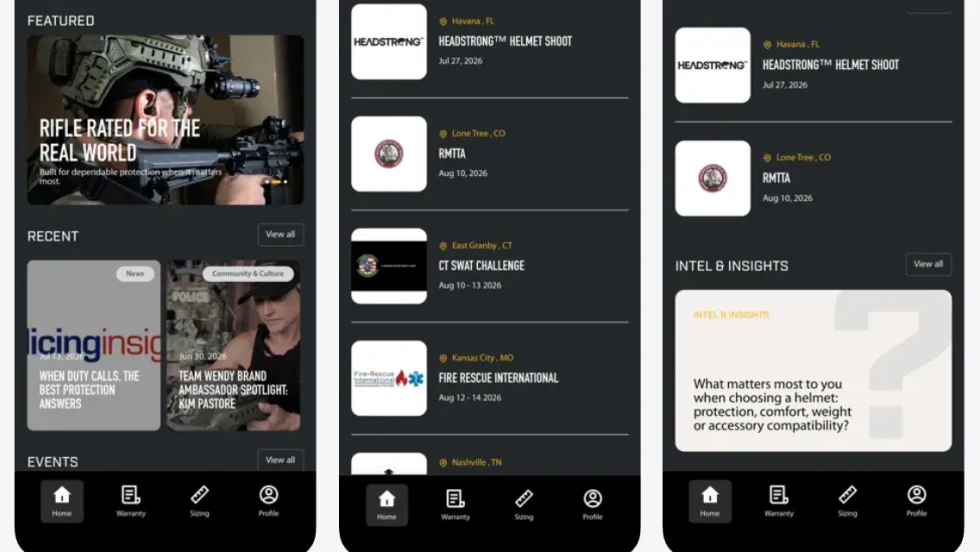
Team Wendy App Creates New Digital Hub for Helmet Owners
The Team Wendy Community App provides one location for warranty registration, size-fit tools, product updates, and community connection. For helmet owners, the new app creates a simpler path to the information and tools that matter most.
Read More →