



Should You Use the Punch?
The amount of resistance from a 100-pound heavy bag when you punch it at full power could cause injury if the proper punching mechanics are not employed.


Should law enforcement officers use the straight punch in a violent confrontation? Yes, if that level of force is justifiable under the standard of objective reasonableness established by the Supreme Court.
But when we examine the issue more closely, there are identifiable caveats-issues that should make us wary-to such a simplistic perspective. What about risk of injury to officers? What about public perception? What about training?
Every law enforcement agency has a use-of-force policy, and most permit the use of personal body weapon strikes (PBW). Typically, these PBWs consist of hand strikes, elbow strikes, knee strikes, and kicks taught by the agencies' defensive tactics instructors.
The extent to which policies enumerate the type of striking techniques and where they fall in the use-of-force continuum varies from agency to agency. I know of several agency policies that address personal body weapon strikes as a force option, but the instructors from those agencies told me they do not formally train in specific striking techniques, including punching. Conventional risk management wisdom says if a force option is in your policy, there should be specific training to address it.
To Punch or Not To Punch?
I have taught a wide variety of striking techniques to my martial arts students over the past 30 years. I have also taught personal body weapon strikes to my law enforcement students over the past 20 years, but the straight punch was never part of the repertoire.
Instead, I substituted a palm heel strike for a straight punch. I also teach a hammer fist and an uppercut punch, both of which have different mechanics than a straight punch.
The largest deterrent to teaching straight punches has been the risk of injury to the officer. As I mentioned, the mechanics of a straight punch differ from other hand strikes, and those differences result in a technique that requires a higher level of skill, which in turn requires more training. And the last thing that most agencies want to do is pay for more training.
Perception and Injury
Still, even though most agencies don't teach their officers how to punch, their officers still use this strike on the street. An officer from a large metropolitan law enforcement agency told me that his officers were punching their aggressors with increasing frequency, yet they do not teach punching techniques as part of their defensive tactics training program. This led to a discussion on the validity of punching as a viable force option.
His perspective was that if you punch a suspect on the job, you'll break the small, fragile bones in your hand.
An injured hand (particularly your dominant or shooting hand) is a valid concern, but if you punch properly-meaning you have the right mechanics and hit the right target-the risk of injury is minimal.
I've also encountered the admonition, "It looks bad from a public perspective." That's arguable. But frankly, very few use-of-force incidents "look good."
We use force to protect ourselves and the public. Our concern should be focused on whether the force is objectively reasonable, necessary, and effective. With the ubiquitous cell phone video cameras, we have grown overly concerned about what will look bad to the public. There is value in knowing we are accountable for our actions, but our safety and the safety of the public trump the whole public perception issue.
People Like to Punch
So should your agency teach punching as a force option for its officers? Let me share what I've learned over the course of the last four years of teaching an in-service defensive tactics program.
Four years ago, my agency formalized its personal body weapon curriculum to address a training deficiency. We chose not to teach a straight punch due to time constraints. We felt we could address the need for a hand strike with a straight palm heel strike, in less time, with less risk of injury in both training and practical application.
We continued to train in this manner, incorporating the PBWs into each of our subsequent annual in-service training blocks, until we made a startling discovery.
This year, we ran every participant (roughly 600 sworn law enforcement officers) through a defensive tactics evaluation. We asked each officer to perform 12 tasks, one of which was to demonstrate a PBW hand strike on a striking shield. We did not specify which technique they were to use.
Nearly 60 percent of the participants threw a straight punch at their target. This was somewhat surprising for us on two levels.
First, we had never trained our personnel to throw a straight punch. Second, one of the pieces of data we collected for each participant was the type of training they have had, and only 25 percent claimed to have any combat sport, martial art, or advanced weaponless defense training.
Yet under pressure, nearly 60 percent of the participants threw straight punches. This suggested an innate reflexive response rather than a trained reflexive response, a result we felt was significant, and one that we needed to address in our training.
The reality was this: For three years we tried training our personnel not to throw a straight punch. In spite of this, under the mild stress of a performance evaluation, the dominant hand strike that the majority of our officers chose to use was a straight punch. We concluded that it has now come time to train officers how to throw a proper straight punch.
Punching Mechanics
A straight overhand punch is complex by nature because it involves three joints: the shoulder, elbow, and wrist. All three joints have to coordinate and align properly at the point of impact to effectively deliver power. The proper striking surface of the fist is also critical for power delivery and protection of the puncher.
Let's look at the proper mechanics of a straight punch, from a "reverse engineering" perspective.
At the point of impact, the proper striking surface is the first two knuckles of your fist. This portion of your fist is the most structurally sound skeletally and it allows you to concentrate your energy on a smaller surface area, thus increasing the power and effectiveness of your strike on your opponent.
To achieve this, your fist must be properly formed. Common mistakes include letting the thumb protrude, which can cause it to snag or otherwise engage a target and that can result in debilitating injury. Another common mistake is to let the last two fingers protrude, which causes the fist to be loose and does not promote the protrusion of the stronger first two knuckles.
At the point of impact, the first two knuckles are in contact with the target, and your wrist is straight both laterally and vertically. Your palm should be facing downward at full extension. Your elbow should be level with your fist and your shoulder should support your elbow by moving in the same direction.
Delivering the Punch
The proper alignment to the target is critical to developing power and efficiency. At the point of impact, your fist should be striking a target aligned with your center mass. This supports the energy going into the punch as it travels back in the opposite direction.
To get to the point of impact, the straight punch should travel in as straight a path to the target as possible.
Punches may originate from a variety of positions, depending on the circumstances the officer is in.
Rather than teach a specific starting position (like a boxer's stance or the "chamber" for martial artists), we only require the punch to pass through the area defined by the top of the shoulders to the lower chest, or the "power zone," because it maximizes the force of the punch.
As your fist passes through the power zone, it moves straight to the target, at center mass. As your arm moves forward, your fist is rotated (pronated) so that the palm faces downward at the point of impact with your target.
Proper extension requires the punch to stop before you lock your elbow joint, without overcommitting your hips and shoulders. Once extended, your fist should snap back through the power zone and to a neutral position in preparation for additional force options such as throwing additional punches.
Looking at a straight punch from start to finish, you can see that all three joints (shoulder, elbow, and wrist) come into play. Your shoulder drives your fist forward; your elbow guides the fist toward the target; and your wrist remains straight and stable to ensure proper transfer of energy and stability on impact with your target.
The straight punch can be thrown from a bladed stance with either hand. Power is generated through the rotation of the hips and shoulders, and the speed of the fist.
Punch Training
To properly train to throw a straight punch, review and practice a balanced, bladed stance. Start by extending your fist out to a soft target (like a punching mitt), making sure your fist is lined up with your center mass and you have the proper striking surface of the fist in contact with the target.
Do not use any type of striking glove for this drill, so you can develop your sensitivity to the feel of hitting with the proper striking surface of the fist. Retract your hand back through your power zone.
Practice this several times, incorporating varying amounts of hip and shoulder rotation. Develop your focus, accuracy, speed, and timing, alternating lead and dominant hands.
Once you are comfortable with your mechanics, increase the resistance by hitting a striking shield (with a partner). You can use a lightly padded striking glove to protect your hands.
When you feel comfortable with your punching mechanics with both hands, run the same drills (punching mitt, striking shield) with moving targets. This requires you to make split-second adjustments in your body positioning, which lends itself to a more realistic and practical application of this skill.
Lastly, heavy bag work is important but should only be incorporated into your punch training after the fundamental mechanics are mastered. The amount of resistance from a 100-pound heavy bag when you punch it at full power can cause injury if the proper punching mechanics are not employed.
You have a variety of force option tools available today. Technology has enhanced your ability to safely control subjects.
Yet you will always have a need to protect yourself with your most basic tools, your personal body weapons. Empirical evidence suggests one of the most frequently used striking techniques is the straight punch.
Rather than ignore this reality, you should recognize the straight punch as a legitimate self-defense tool and train accordingly. By following a proper training procedure, you can develop a valuable skill that can help you protect the public safely and effectively.
Sgt. Jim Harbison is the Basic Academy Coordinator at the Contra Costa County (Calif.) Office of the Sheriff Law Enforcement Training Center, where he teaches defensive tactics and physical fitness.
More Patrol

Streamlight Portable Scene Light III Wins 2026 OH&S New Product of the Year Award
Streamlight’s Portable Scene Light III has won the 2026 Occupational Health & Safety (OH&S) New Product of the Year Award in the Lighting category.
Read More →
Adept Armor Introduces Two New Rifle Plates
Adept Armor has launched two new Level IV ballistic plates, the Emperor and the Archon Mark 2, which brings Adept Armor’s new Quatroid ceramic to the high-threat, performance-value center of the range at 5.2 pounds.
Read More →
POLICE Product Test: Benchmade Bailout
The Benchmade Bailout is a slim, lightweight carry knife with a deep-ride pocket clip and comes in a variety of blade steels and scales. Here is a detailed review of the Taiga Green Bailout, released earlier this year.
Read More →
NLEOMF Announces July 2026 Officer of the Month
NLEOMF honored a Michigan deputy sheriff as the July 2026 Officer of the Month for rescuing a trapped driver from a burning vehicle following a Fourth of July crash.
Read More →
Streamlight to Showcase Newest Lighting Products at National Safety Council’s Safety Congress & Expo 2026
Streamlight will showcase its latest lights, including the Portable Scene Light III and the LiteBox 1Million, at the 2026 National Safety Council (NSC) Safety Congress & Expo.
Read More →
The 2027 World Police & Fire Games Set for Perth, Australia
The 2027 World Police & Fire Games (WPFG) will take place in Perth, Western Australia, from Friday, March 12 through Sunday, March 21, 2027.
Read More →
5.11 Partners with National Fallen Firefighters Foundation to Support #ForThe343
5.11 has joined the nationwide movement honoring the 343 New York City Fire Department firefighters lost on Sept. 11, 2001.
Read More →
Team Wendy Announces Title Sponsorship of the Jorge Pastore Foundation
Team Wendy’s 3-year partnership with the Jorge Pastore Foundation expands access to programs that strengthen those who serve.
Read More →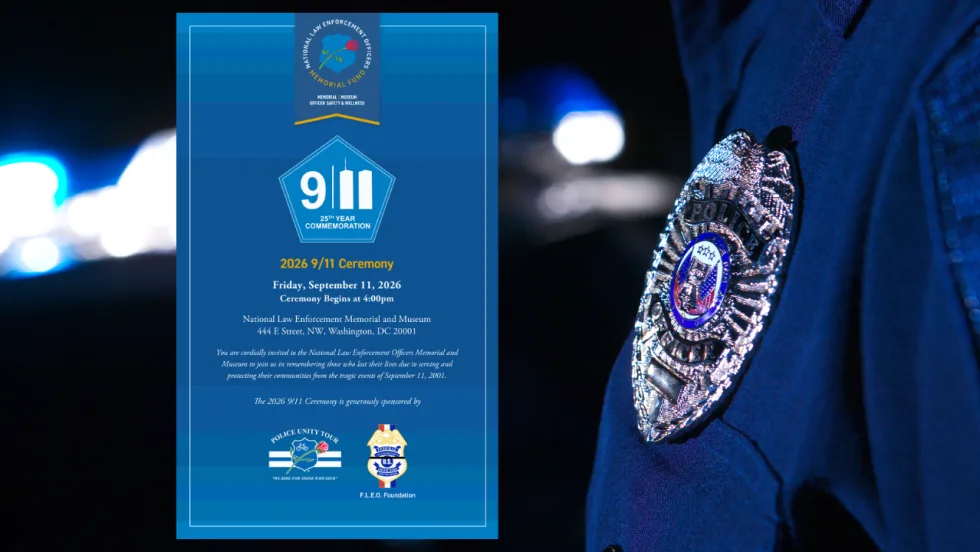
National Law Enforcement Memorial and Museum Hosting 9/11 25th-Year Commemoration Ceremony
The National Law Enforcement Memorial and Museum is hosting a 9/11 25th Year Commemoration Ceremony on Sept. 11 at 4 p.m.
Read More →
National Law Enforcement Officers Memorial Fund Announces June 2026 Officers of the Month
The National Law Enforcement Officers Memorial Fund (NLEOMF) named 15 officers of the Chico Police Department (California) as the Officers of the Month for June 2026 for their roles in responding to an active-shooter incident at a public library.
Read More →