



Should You Chase or Contain?
So should you chase or contain? It depends on the situation and what agency you work for. Just as there are a variety of threats to consider about suspects in flight, so too are there differences of opinion as to how to address the problem.

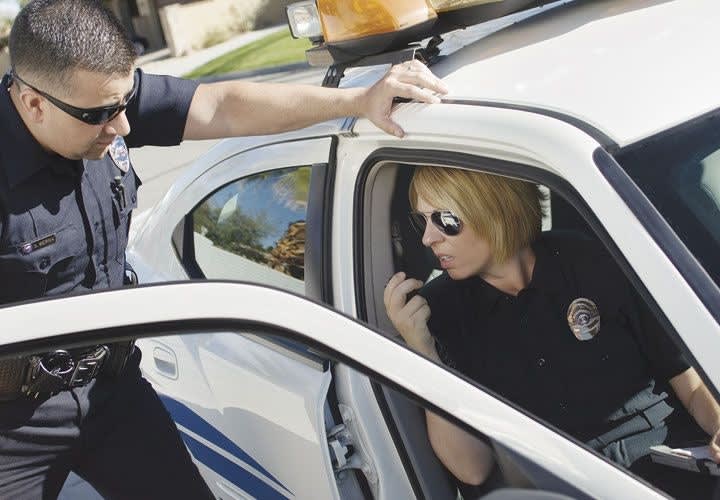
While many officers keep themselves in top-flight physical condition, few enjoy the prospect of performing impromptu wind sprints down dark alleys. For chasing a suspect carries with it all manner of varying threats.
Not only do you risk going it alone from the start or separating from your partner mid-chase, you also face having to go one-on-one with someone determined not to go back to the pen. And with that determination comes the possibility of deadly force being used-by you, the suspect, or both.
The alternative is to establish a containment of the suspect. Of course, this might afford your target additional time to insinuate himself elsewhere or call a homie to come and pick him up. The suspect's escape or capture may well come down to who has the best communications and the most rapid response.
So should you chase or contain? It depends on the situation and what agency you work for. Just as there are a variety of threats to consider about suspects in flight, so too are there differences of opinion as to how to address the problem.
By and large, administrators of larger police agencies, who are supposedly concerned about the welfare of their officers, have come down decidedly on the side of containing suspects. On the other side are the beat cops, the ones who ironically have the most to lose by chasing but feel duty bound to do so.
The Call of Duty
Former Fontana, Calif., police officer Frank Tolerico was shot three times by a suspect at the terminus of a foot pursuit. Two rounds were stopped by his trauma plate, but a third passed through his neck, barely missing his carotid artery and spine. He ended up shooting and killing the suspect, but not before nearly being killed himself.
Has such a traumatic experience changed his paradigm on foot pursuits?
Not at all.
"That's what our job is," Tolerico says, a hint of disgust in his voice. "We're there to protect the innocents-the taxpayers who these people prey upon. My posture is we prey on the predators."
Like many cops, Tolerico is not pleased with where he sees policy-driven law enforcement heading.
Who is Being Protected?
While the articulated justifications for such stringent policies are concerns for officers' welfare, a look at the histories of officers killed in foot pursuits would seemingly belie the assertion. If anything, officers tend to come out on top when going one on one with suspects. Certainly, the timing of such epiphanies invites second glances.
When the Los Angeles County Sheriff's Department announced further curtailments to deputies' foot pursuit options, it did so after a year that saw a precipitous rise in deputy-involved shootings, many of which were incident to foot pursuits. As the shootings were apparently deemed to be within policy, and the deputies were obviously a leg up on the suspects, one might reasonably ask just whose welfare the department was concerned about: the deputy's, or the suspect's?
It's been more than 20 years since the last LASD deputy was killed incident to a foot pursuit, according to retired LASD deputy and former ALADS (the Association of L.A. Deputy Sheriffs) president Roy Burns. If the department is really that concerned over a deputy getting killed, then one might reasonably ask why it doesn't place greater emphasis on partnering its deputies in more two-man cars.
Whatever the impetus, LASD's foot pursuit policy reflects a direction in which many agencies are gravitating. A cynical take is that it is all risk management-dictated: If officers do not confront suspects, there is a diminished likelihood of officers using force on those suspects; so there will be fewer lawsuits and cries from outraged communities.
Many believe that was the reason Wellford, S.C., Mayor Sallie Peake decided to prohibit that town's officers from engaging in any foot pursuit, despite proclamations that it was intended to prevent officer injuries. But the subsequent brouhaha by both cops and citizens found the policy rescinded and cops back in the game.
Still, the question remains: Should cops chase suspects on foot? Or should they coordinate resources in hopes of containing the suspect and effecting an arrest?[PAGEBREAK]
The Virtues of Containment
A six-year veteran of the LASD's K-9 detail, Sgt. Eric Lindblom is no stranger to chasing bad guys. As a patrol supervisor, he had at one time been in more vehicle pursuits than any other sergeant on the department and more than a few foot pursuits. Personally, he's still fine with the prospect of chasing bad guys. Professionally, he believes the containment argument has merit.
"Look, if you're chasing a suspect that you know is armed and he runs into a backyard, you don't want to go back there after him," Lindblom points out. "Let us (K-9) roll out and help you. It just doesn't make sense putting yourself in a position where you're probably going to get shot."
Lindblom cites one particular incident wherein a suspect had taken the high ground and was lying in wait with two guns on his person to ambush a deputy. But the sight of an approaching K-9 and additional personnel gave the suspect pause. For Lindblom, it was the potential for a very different outcome that continues to give him pause.
"I don't like to think what would have happened if some deputy ran in that backyard and had to deal with a sudden ambush one-on-one," he says.
Ideally, K-9 should be deployable both by policy and availability, particularly when dealing with suspects known to be armed. But what of those incidents where it isn't known if the suspect is armed or not-will LASD deploy then?
"No," Sgt. Lindblom admits. "It has to be something that falls on our radar such as a felony suspect or an obvious threat to officers."
In such circumstances, one-man units are pretty much obligated to let the suspect run, lest something bad happen and they find themselves left out to hang.
Lindblom acknowledges that a no foot pursuit policy is never going to be an ideal situation for any cop, regardless of the agency he works for. Still, he observes that there have been many positive dividends to LASD's perimeter mindset as evidenced by a corresponding increase in the number of suspects captured incident to containments these past few years.
"Deputies are quicker to establish containments," Lindblom notes. "It's like anything else. The more you do it, the better you get. And I'll tell you this: Unless the guy gets in a house, we're going to get him. Might he go to a rooftop or a tree when we don't have an aero unit up and we miss him? Maybe. But most of the time, we get him."
To be fair, the department still acknowledges that two-man cars can chase and capture so long as they remain together, and in the last couple of years has re-expanded the role of canines in searching for grand theft auto suspects-a lawsuit-driven "no-no" in preceding years.
Inherently Dangerous
Even if LASD's justification for its policy is suspect-and it is-it doesn't discount the fact that foot pursuits are inherently dangerous. Even absent an altercation with a suspect, the threats that confront officers are numerous. Low-hanging branches, undulant terrain, and other unseen factors can cause everything from barked shins and twisted ankles to battered foreheads and bruised egos. For many police agencies, foot pursuits are the number one source of police injuries, and prove a precipitating factor in a second major cause of injury: Uses of force.
When you factor in the recon undertaken by some suspects in anticipation of such pursuits, you have to consider the possibility of booby traps. In Collingswood, N.J., investigators found that drug dealers had cut holes in the floors and placed wires or ropes in various locations throughout the buildings they used to cause officers to trip and fall onto broken glass, nails, or other injury-producing items.
Another factor is the officer's paradigm at the time of the chase. An FBI study found that a significant number of officers who were assaulted incident to foot pursuits were focused on the prospect of effecting arrests: Little consideration was given to the possibility of the suspect becoming a threat. None of the officers in the study had received any prior training or guidance from their departments regarding whether or not to give chase and what action to take thereafter.[PAGEBREAK]
This raises another concern: If some departments are overly vigilant in prohibiting foot pursuits, are others too lax in not addressing them at all?
If you work for such a department, then it becomes your responsibility to discipline yourself in determining whether or not to pursue.
Weigh the potential complications of engaging the suspect against the complications posed by the suspect's potential escape. Among the questions you have to ask yourself is whether or not you have both the cardiovascular conditioning to catch up with the suspect and the strength with which to overcome any subsequent resistance the suspect may then offer. Of those officers who have died incident to foot pursuits, many died not because of an ensuing force incident, but from heart attacks.
Another pursuit danger faced by undercover and plainclothes officers is mistaken identity. Before you take off on a pursuit, make sure that you can be readily identified as an officer by both citizens and fellow officers. This is a particularly important concern for minority officers: A recent study determined that more black officers were killed in so-called "friendly fire" incidents than white officers.
Finally, even if the individual officer comes out on top incident to a foot pursuit, you might find yourself behind the eight ball elsewhere. After shooting and killing a Jamaican immigrant, Scott Smith became the first Connecticut police officer to be charged with murder for an action committed in the line of duty. Smith was convicted and sentenced to six years in prison. The repercussions reverberate throughout the community.
Flexible Pursuit Policies
There is no shortage of cops who feel that they are physically capable of chasing down suspects and, like Frank Tolerico, feel obligated to do so.
Many law enforcement agencies want their officers to chase, but with some established considerations or guidelines in place. Crafting a policy that is both practical and supportable is problematic. Absent a policy, you can and probably will chase on foot to your heart's content. Moreover, since there's no policy to violate, you are less apt to find yourself in trouble administratively or in civil court than the cop who does the same thing but finds it in violation of something that his department has promulgated.
In response to the threats posed by local drug dealers, the Collingswood (N.J.) Police Department adopted a policy that included five key points that should give an officer consideration toward canceling his or her foot pursuit. They include instances where personnel find themselves:
1. Possibly entering vacant or occupied buildings, structures, confined spaces, or wooded/isolated locations without using the team concept or without supervisory authorization, except in the event of extreme urgency, such as the immediate threat to the safety of the general public or other officers.
2. Believing that the danger to pursuing officers or the public outweighed the necessity for immediate apprehension.
3. Disarmed or in having lost possession of their service weapons.
4. Losing contact with their fellow officers or the department's communication center.
5. Losing visual contact with the violator and become unsure of the suspect's whereabouts or continued direction of travel.
While these might well result in an officer's termination of a foot pursuit, the policy does not preclude the possibility of an officer initiating a foot pursuit in the first place. The Collingswood PD clearly understood that a police officer has the authority, at all times, to attempt to stop any individual suspected of committing any criminal offense, violation, or traffic infraction. However, the department also realized that while the officer initiates the stop, the violator provokes the pursuit by fleeing. Therefore, the department wanted its officers to base their decisions on whether to pursue a fleeing suspect on the degree of risk to themselves or others.
Plainly, the policy encourages common sense policing while offering well articulated and clearly understood parameters.
Conversely—and perhaps incredibly to some police administrators—many law enforcement agencies don't have any foot pursuit policy.
Case in point: In the aftermath of the Philadelphia Police Department's recent shooting of Vincent Parsons, it's a point of contention that the department still does not have a foot pursuit policy.
In 2005, Common Pleas Judge Ellen H. Ceisler, then chief of the department's Integrity and Accountability Office, noted that 48 percent of the department's police shootings between 1998 and 2003 took place during foot chases and recommended that the department issue a policy. Bemused that there should be any controversy over foot pursuits, one Philadelphia sergeant told me, "Hey, it's simple. You run, we chase. Debate over."
Sam Murphy, a corporal with the Durango (Colo.) Police Department, notes that his agency likewise lacks a foot pursuit policy. But that's not to say that either the department or its officers are apathetic on the matter: Theirs is more of a common sense-driven practice.
Officers are simply encouraged not to get in over their heads. With many of the department's officers taking advantage of local terrain to bike or run, they tend to keep themselves in shape, at least more so than the people they pursue. Not surprisingly, they enjoy a better than 90 percent success rate in capturing suspects incident to foot pursuits and containments.
More Patrol

Team Wendy Introduces the EXFIL Endurance Ballistic Helmet, Engineered to Reduce the Burden of Extended Wear
Team Wendy has launched its EXFIL Endurance, a new lightweight ballistic helmet engineered to deliver protection, comfort, and fit during demanding, extended operations.
Read More →
The First Responders Children’s Foundation National First Responders Day Roll Call of Heroes Ceremony Returns to Times Square, NYC
First Responders Children’s Foundation (FRCF), in collaboration with T-Mobile, will host the Roll Call of Heroes ceremony in Times Square to commemorate National First Responders Day on Wednesday, Oct. 28. During the event, FRCF will present 18 Hero Awards.
Read More →
Streamlight to Showcase Newest Lighting Products for Law Enforcement Professionals at IACP 2026
Streamlight will showcase its newest lights for law enforcement at the International Association of Chiefs of Police Annual Conference & Expo. Featured lights will include the TLR-3 X, the PolyTac 1X, and more.
Read More →
Streamlight Portable Scene Light III Wins 2026 OH&S New Product of the Year Award
Streamlight’s Portable Scene Light III has won the 2026 Occupational Health & Safety (OH&S) New Product of the Year Award in the Lighting category.
Read More →
Adept Armor Introduces Two New Rifle Plates
Adept Armor has launched two new Level IV ballistic plates, the Emperor and the Archon Mark 2, which brings Adept Armor’s new Quatroid ceramic to the high-threat, performance-value center of the range at 5.2 pounds.
Read More →
POLICE Product Test: Benchmade Bailout
The Benchmade Bailout is a slim, lightweight carry knife with a deep-ride pocket clip and comes in a variety of blade steels and scales. Here is a detailed review of the Taiga Green Bailout, released earlier this year.
Read More →
NLEOMF Announces July 2026 Officer of the Month
NLEOMF honored a Michigan deputy sheriff as the July 2026 Officer of the Month for rescuing a trapped driver from a burning vehicle following a Fourth of July crash.
Read More →
Streamlight to Showcase Newest Lighting Products at National Safety Council’s Safety Congress & Expo 2026
Streamlight will showcase its latest lights, including the Portable Scene Light III and the LiteBox 1Million, at the 2026 National Safety Council (NSC) Safety Congress & Expo.
Read More →
The 2027 World Police & Fire Games Set for Perth, Australia
The 2027 World Police & Fire Games (WPFG) will take place in Perth, Western Australia, from Friday, March 12 through Sunday, March 21, 2027.
Read More →
5.11 Partners with National Fallen Firefighters Foundation to Support #ForThe343
5.11 has joined the nationwide movement honoring the 343 New York City Fire Department firefighters lost on Sept. 11, 2001.
Read More →