



Seizing and Searching Passengers
In the 2007 decision in Brendlin v. California, the U.S. Supreme Court added yet another to a series of Fourth Amendment opinions on the subject of vehicle searches and seizures involving passengers, rather than drivers.

In the 2007 decision in Brendlin v. California, the U.S. Supreme Court added yet another to a series of Fourth Amendment opinions on the subject of vehicle searches and seizures involving passengers, rather than drivers. Several issues that might arise from police interactions with passengers of vehicles have been addressed by the court.
When Are Passengers "Detained?"
The driver of a vehicle has been detained when he or she submits to a police stop. (U.S. v. Cortez) Such detention requires reasonable suspicion of criminal activity, or a traffic violation or equipment defect. (U.S. v. Sharpe) The question of whether a passenger has been detained sometimes depends on the kind of vehicle the passenger is riding in.
In two cases arising from Florida drug interdiction inspections, the U.S. Supreme Court said that when officers boarded buses during scheduled stops and asked passengers for consent to search, the passengers had not necessarily been detained, because the officers had done nothing that would have communicated to a reasonable innocent person that he or she was not at liberty to ignore the police and terminate the encounter. (Florida v. Bostick; U.S. v. Drayton) The court has said that this same rule applies to passengers of trains, planes, and taxicabs. (Bostick; Brendlin)
"Two officers walked up to Bostick on the bus, asked him a few questions, and asked if they could search his bags [where they found cocaine]. No seizure occurs when police ask questions of an individual, ask to examine the individual's identification, and request consent to search his or her luggage—as long as the officers do not convey a message that compliance with their requests is required." (Florida v. Bostick)
By contrast, the court recently ruled that everyone riding in a private passenger vehicle is necessarily detained whenever that vehicle is stopped by police. Bruce Edward Brendlin was a front-seat passenger in a car that was stopped by police for an investigation that prosecutors later conceded was not supported by reasonable suspicion. As a result of the stop, Brendlin was found to be in possession of drugs and manufacturing paraphernalia. His motion to suppress this evidence as the "fruit" of an unlawful stop was denied in state court, on the ground that passengers have no "standing" to contest the stop of a vehicle, since they have not personally been detained.
The U.S. Supreme Court unanimously reversed this holding and ruled that neither drivers nor passengers would feel free to leave and so are all detained, and all have a right to challenge the legality of the stop in a suppression motion. (This means they would also be able to sue for violation of their Fourth Amendment rights based on an unjustifiable stop.)
Coincidentally, the court essentially found it reasonable for police to keep passengers from walking away during the normal course of a justified vehicle stop:
"Any reasonable passenger would have understood the police officers to be exercising control to the point that no one in the car was free to depart without police permission. It is also reasonable for passengers to expect that a police officer will not let people move around in ways that could jeopardize his safety. What we have said reflects a societal expectation of 'unquestioned command' at odds with any notion that a passenger would feel free to leave, or to terminate the encounter in any other way, without advance permission." (Brendlin v. California)
Ordering Passengers Out
In Pennsylvania v. Mimms, the court ruled that police making a valid traffic stop have the right, for officer safety reasons, to order the driver out of the vehicle. No reasons need be given for this routine action. Twenty years later, the court extended this rule to all passengers:
"Danger to an officer from a traffic stop is likely to be greater when there are passengers in addition to the driver in the stopped car. Outside the car, the passengers will be denied access to any possible weapon that might be concealed in the passenger compartment. We therefore hold that an officer making a traffic stop may order passengers to get out of the car pending completion of the stop." (Maryland v. Wilson)
[PAGEBREAK]
Arresting Passengers for Unclaimed Contraband
Often, several people are in a stopped vehicle where drugs, illegal weapons, or other incriminating evidence is found under the seats, in the glove compartment, or in other common-access areas. If no one admits to possession of the items, can the driver and passengers be arrested based on their shared dominion and control? The court answered this question in the affirmative in Maryland v. Pringle.
Joseph Jermaine Pringle was the front passenger in a car stopped for speeding. During a consent search, the officer found cocaine under the backseat armrest and a roll of cash in the glove compartment. The driver, the rear seat passenger, and Pringle all denied knowledge or possession, so the officer arrested all three. After waiving Miranda and admitting possession, Pringle moved to suppress his statement on grounds of unlawful arrest. Maryland state courts granted his motion, but the U.S. Supreme Court unanimously reversed:
"We think it an entirely reasonable inference from these facts that any or all three of the occupants had knowledge of, and exercised dominion and control over, the cocaine. It was reasonable for the officer to infer a common enterprise among the three men. We hold that the officer had probable cause to believe that Pringle had committed the crime of possession of a controlled substance." (Maryland v. Pringle)
Search Incident to Passenger's Arrest
Upon lawful arrest of the driver, the passenger compartment of the vehicle is subject to "contemporaneous" search (meaning "here and now"). The scope of search includes all places, compartments, and containers within the passenger compartment, but not the trunk. (Thornton v. U.S.)
In New York v. Belton, the Supreme Court held that even if it is a passenger, rather than the driver of the vehicle who is arrested, a prompt search of the contents of the passenger compartment may also be made. Of course, the clothing and any containers carried by the arrestee may also be searched incident to his or her lawful arrest. (U.S. v. Robinson)
Search Based on Probable Cause
When an officer makes a lawful vehicle stop and has PC to suspect something seizable somewhere in the vehicle, the Fourth Amendment allows an immediate or postponed search of any part of the vehicle and its contents that might conceal the object of the search. (U.S. v. Ross) The court has ruled that this is true, even if the item searched appears to be the property of an unsuspicious passenger. (Wyoming v. Houghton, upholding the search of a female passenger's purse to find the male driver's drugs. And note that in Rakas v. Illinois, the court held that passengers will not normally have "standing" to challenge the search of another's car.)
Passengers' Rights Cheat Sheet
All passengers in private vehicles are detained at a stop.
Passengers may be ordered out and kept from leaving.
Passengers may be arrestable for joint possession of contraband.
Passengers' property and the vehicle may be searched incident to their arrest (passenger compartment), or with PC (any hiding place).
Devallis Rutledge, a former police officer and veteran prosecutor, currently serves as Special Counsel to the Los Angeles County District Attorney. His latest book is "Criminal Investigations and Evidence."
More Patrol

Adept Armor Introduces Two New Rifle Plates
Adept Armor has launched two new Level IV ballistic plates, the Emperor and the Archon Mark 2, which brings Adept Armor’s new Quatroid ceramic to the high-threat, performance-value center of the range at 5.2 pounds.
Read More →
POLICE Product Test: Benchmade Bailout
The Benchmade Bailout is a slim, lightweight carry knife with a deep-ride pocket clip and comes in a variety of blade steels and scales. Here is a detailed review of the Taiga Green Bailout, released earlier this year.
Read More →
NLEOMF Announces July 2026 Officer of the Month
NLEOMF honored a Michigan deputy sheriff as the July 2026 Officer of the Month for rescuing a trapped driver from a burning vehicle following a Fourth of July crash.
Read More →
Streamlight to Showcase Newest Lighting Products at National Safety Council’s Safety Congress & Expo 2026
Streamlight will showcase its latest lights, including the Portable Scene Light III and the LiteBox 1Million, at the 2026 National Safety Council (NSC) Safety Congress & Expo.
Read More →
The 2027 World Police & Fire Games Set for Perth, Australia
The 2027 World Police & Fire Games (WPFG) will take place in Perth, Western Australia, from Friday, March 12 through Sunday, March 21, 2027.
Read More →
5.11 Partners with National Fallen Firefighters Foundation to Support #ForThe343
5.11 has joined the nationwide movement honoring the 343 New York City Fire Department firefighters lost on Sept. 11, 2001.
Read More →
Team Wendy Announces Title Sponsorship of the Jorge Pastore Foundation
Team Wendy’s 3-year partnership with the Jorge Pastore Foundation expands access to programs that strengthen those who serve.
Read More →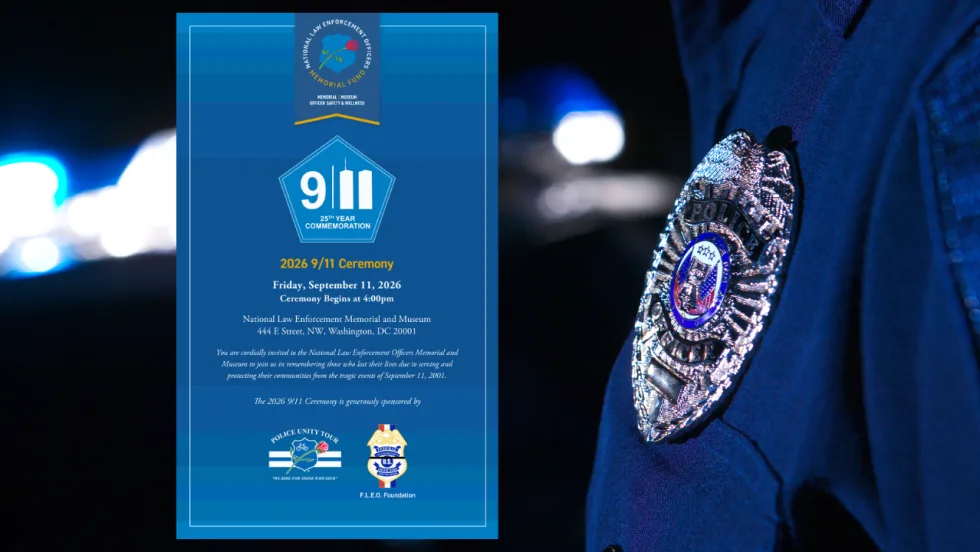
National Law Enforcement Memorial and Museum Hosting 9/11 25th-Year Commemoration Ceremony
The National Law Enforcement Memorial and Museum is hosting a 9/11 25th Year Commemoration Ceremony on Sept. 11 at 4 p.m.
Read More →
National Law Enforcement Officers Memorial Fund Announces June 2026 Officers of the Month
The National Law Enforcement Officers Memorial Fund (NLEOMF) named 15 officers of the Chico Police Department (California) as the Officers of the Month for June 2026 for their roles in responding to an active-shooter incident at a public library.
Read More →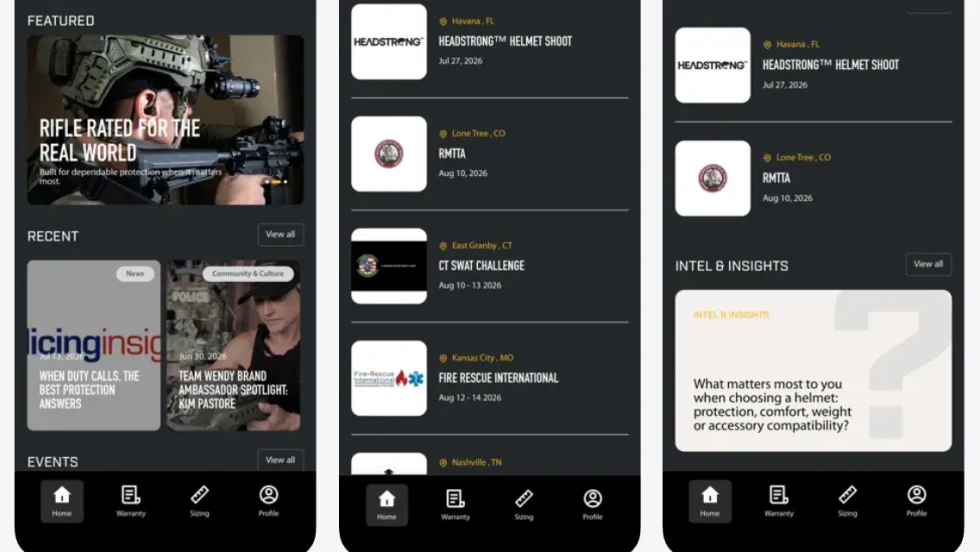
Team Wendy App Creates New Digital Hub for Helmet Owners
The Team Wendy Community App provides one location for warranty registration, size-fit tools, product updates, and community connection. For helmet owners, the new app creates a simpler path to the information and tools that matter most.
Read More →