



Rugged and Ready
Just know this: The ruggedized computer market is booming. Everyone from soldiers and Marines operating in the Sandbox to construction supervisors building your local strip mall are using these things. That means that a ton of companies are getting into this market and offering a variety of different models, and it will pay to shop around.

I'm writing this a week before the International Association of Chiefs of Police (IACP) conference and tradeshow in New Orleans.
Why that's relevant to this article is easy to explain. In recent years, IACP has resembled a computer show as much as a police gear show. You walk the aisles at IACP and the biggest booths tend to belong to high-tech companies hawking the latest computer-aided dispatch systems and newest lines of mobile data systems, including laptops and on-board computer terminals.
All of that high-tech stuff and the jargon spouted by the reps from these firms can make your head spin; at least it does mine. But the one thing that I can clearly make out of the marketing din is the fact that these computers keep getting tougher, faster, and more functional.
There's a famous computer dictum invented by Intel co-founder Gordon Moore in a 1965 paper. Moore wrote that "the number of transistors that can be placed on an integrated circuit is increasing exponentially, doubling approximately every two years."
Moore's Law means that since the 1960s, computer power has been doubling every two years. Moore's law is why it's now hard to find a patrol car in this country that isn't equipped with an onboard or laptop computer system. Computers are cheaper, faster, and lighter than they have ever been. In the next few years, they will get even cheaper, lighter, and faster as manufacturers switch from hard drive memories to flash memory.
Unfortunately, the innovation quantified in Moore's Law is a double-edged sword for the computer buyer. You can buy really cool stuff now, or you can wait and buy even cooler stuff in three months. This is the reason why used computers depreciate in value even faster than used cars. You can't really buy a state-of-the-art computer.
What you can do, however, is find a computer that fits your needs. It doesn't have to have the fastest, newest CPU on the market. All it really has to do is run your software at an efficient speed, communicate with your peripherals such as fingerprint scanners and citation printers, offer you a display that can be viewed in bright daylight, and survive your operating conditions.
That last point is critical for law enforcement mobile data systems. They will get shaken around, maybe even dropped, and they are prone to catching spilled drinks and other fluids on their keyboards. Even worse, they have to cope with the constant vibration of being driven around in a car, sometimes at high speed.
This is why you can't take a normal, everyday laptop and mount it in a cop car as a mobile data system. You can get the best mount made, and the vibration will still shake that system to death.
The solution is to buy laptops and onboard computer systems that have been ruggedized to certain military specifications (Mil-Spec). These computers have been shaken, dropped, sprayed with water, dusted with sand, and they came through the torture testing still functioning. Even a high-quality standard laptop would be toast if you dropped it from three feet to a hard floor, but ruggedized computers will keep on computing. (See "How Rugged is Rugged?" below.)
Most of you probably already have ruggedized laptop or onboard computer systems in your patrol vehicles. So the question that you probably need answered is, "When should we upgrade?" You need to upgrade when your computers are starting to reach the point of obsolescence where they can no longer do what you need them to do. And no one can make that decision for you.
When you do make that decision, it's time to contact the manufacturer or one of your local systems integrators and see what they have for you.
Just know this: The ruggedized computer market is booming. Everyone from soldiers and Marines operating in the Sandbox to construction supervisors building your local strip mall are using these things. That means that a ton of companies are getting into this market and offering a variety of different models, and it will pay to shop around.
The chart that accompanies this article will give you a good idea of what computer companies and systems integrators will have to show you in the coming year.
How Rugged is Rugged?
The gold standard for ruggedized computers is Mil-Spec 810F. But unless you work in a computer testing lab, you probably don't know what is required of a computer before it can boast this rating.
Mil-Spec 810F (also known as MIL-STD 810F) status is bestowed after a machine survives a series of tests that if you were a computer you would think of as torture. The machines are dropped, shaken, heated, frozen, elevated, and drowned.
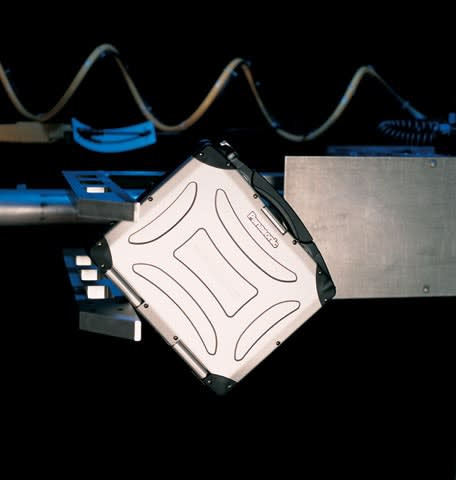
Here's a quick look at what Panasonic does to its Toughbooks to make sure that they can survive hard time in Iraq or thousands of hours on duty with you.
The Drop Test
The Toughbook is sequentially dropped in non-operating mode (meaning screen closed and computer down) onto each face, edge, and corner for a total of 26 drops. The impact surface is two-inch-thick plywood over a steel plate over concrete.
The Vibration Test
The Toughbook is clamped to an aluminum plate. Switched off and closed, it's subjected to a good shaking. Yeah that's simplistic, but the science reads like this: 0.04 g2/Hz at 20-1,000 H, -6 db octave at 1,000 to 2,000 Hz, one hour duration axis. Trust me, they vibrate the heck out of the sucker. Another vibration intended to simulate 1,000 miles of ground travel is conducted with the computer and the hard drive activated.
Water Resistance
An operating Toughbook is sprayed with water for 12 hours to simulate rain. If it can take that, it can handle your coffee spills.
Humidity
Pray that you never have to work in these conditions: 86 degrees to 140 degrees Fahrenheit at 95-percent relative humidity. The Toughbook has to endure 10 days of this heat and moisture.
Dust Resistance
At 140 degrees, silica flour (simulated sand) is dusted over the machine. The computer fails if anything binds up or any of the contacts or relays malfunction.
High Temperature
With the computer switched on and open, it is heated to 140 degrees Fahrenheit. Tack on another 20 degrees for the non-operational mode testing.
Low Temperature
The computer is frozen to minus-20 degrees Fahrenheit while operating. Switched off, it experiences a balmy minus-60 degrees Fahrenheit.
Thermal Shock
Panasonic sets the high non-operating temperature at 205 degrees Fahrenheit and low non-operating temperature at minus-60 degrees Fahrenheit. The computer gets three cycles of this temperature variance.
Altitude
Odds are your patrol car won't be flying at 15,000 feet without pressurization. But if it does, your Toughbook can take it.
More Technology
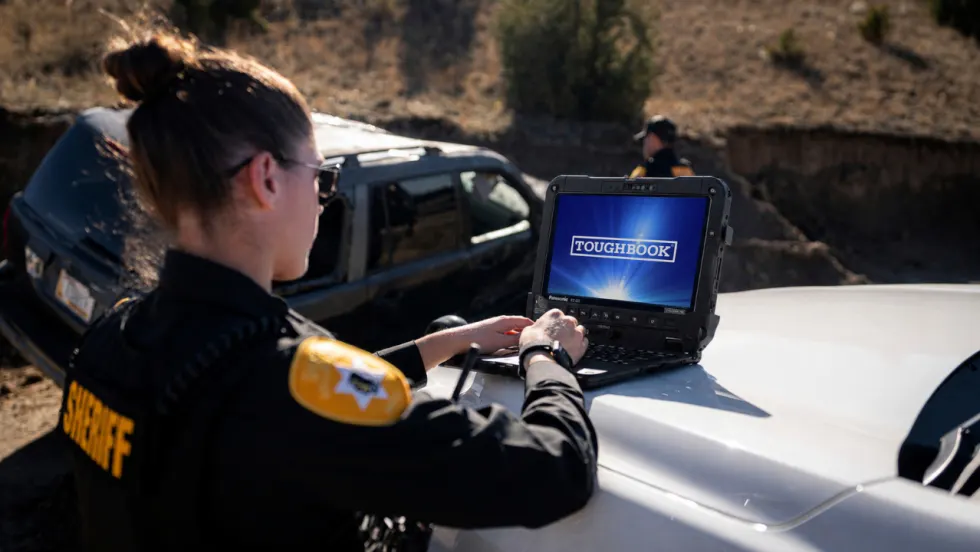
Panasonic Connect Launches the Toughbook 34 and Toughbook G3, Fully Rugged 2-in-1 Mobile Computers
Panasonic Connect has launched the Toughbook 34 and Toughbook G3 to facilitate in-vehicle dispatch, records management, and mobile command operations from any location.
Read More →
A police agency's guide to data-driven fleet management
Costs are rising and the public expects more transparency into how their tax dollars are spent. This e-book shows how police agencies can use fleet data to take control of fleet expenses while improving officer safety and demonstrating fiscal responsibility to the communities they serve.
Read More →
AI and analytics for law enforcement: Turning data into insights
Law enforcement agencies are managing more video, sensor data and digital evidence than ever before. Discover how AI and analytics can help turn that data into actionable insights that strengthen situational awareness, accelerate investigations and support more informed decisions.
Read More →

Vasco Electronics Adds Automatic Language Detection to Vasco Translator Q1
Vasco Electronics’ software update introduces hands-free language switching and expanded offline translation across 45 language pairs, empowering law enforcement, healthcare, and front-office enterprise teams
Read More →
North Miami Police Department Deploys Mark43
The North Miami Police Department has deployed Mark43 as part of its Five-Year Strategic Plan that represents its collective vision and goals for a more proactive police department, anchored by a core commitment to leveraging modern technology to enhance efficiency and public safety.
Read More →
Cellebrite Genesis for Enterprise Now Generally Available
Made available to the public sector in June, Cellebrite Genesis is serving a growing mix of national, regional, and local agencies worldwide, including some of the largest regional and metropolitan police departments. It is now available for enterprise organizations.
Read More →
2026 Vision FirstNet Users Summit to Host Emerging Leaders Training on Grassroots Advocacy for Public Safety
“Emerging Leaders Training: Understanding the Importance of Grassroots Advocacy for Public Safety," a session during the 2026 Vision FirstNet Users Summit, will offer a roadmap for unified advocacy at the federal level.
Read More →
Motorola Solutions Completes Acquisition of D-Fend Solutions
Motorola Solutions has acquired D-Fend Solutions, an industry leader in counter-drone technology. This deal provides public safety and enterprise customers with access to advanced counter-unmanned aerial systems.
Read More →
ZeroEyes, Advantech & Camden Police Partner to Bring AI Gun Detection Technology to Delaware School District
ZeroEyes has partnered with Advantech and the Camden Police Department to deploy ZeroEyes’ AI gun detection and intelligent situational awareness platform at Delaware’s Caesar Rodney School District (CRSD).
Read More →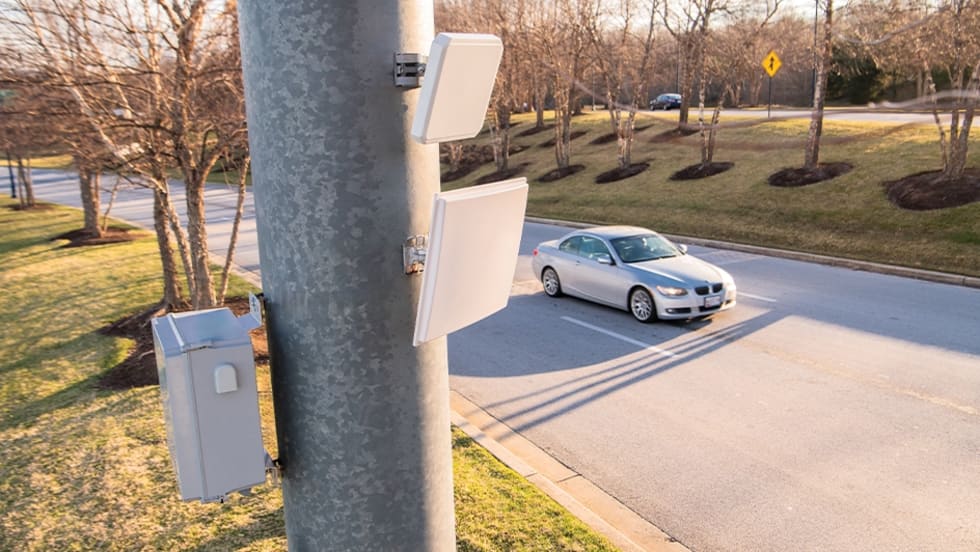
Leonardo U.S. Cyber & Security Solutions Introduces SignalTrace, the Next Evolution in Electronic Signature Detection Technology
SignalTrace reflects years of product refinement and a clearer expression of the technology’s purpose of recognizing and correlating electronic signatures in publicly broadcast wireless signals to reveal patterns, relationships, and trends that might otherwise go undetected.
Read More →