



Police Productivity: A State of Mind, An Approach to the Job
How many times in your career have you uttered the words, "It's dead out," or "There's nothin' goin' on," or any of a million similar phrases that basically say, "I'm bored?"

How many times in your career have you uttered the words, "It's dead out," or "There's nothin' goin' on," or any of a million similar phrases that basically say, "I'm bored?"
There are very few, if any, police officers who can honestly say these words have never passed their lips.
In fact, the vast majority of us can readily identify with the old law enforcement cliché that police work is 99 percent sheer boredom and one percent sheer terror.
The simple truth is there are very few departments where officers do not often spend large percentages of their on-duty time engaged in non-committed patrols.
The unfortunate thing is that while most of us are bored a great deal of our shifts, we're apparently not having that great an effect on crime. In many areas people don't feel safe walking the streets. Violent crime, while statistically on the decline, is still very feared and prevalent in many areas. Street gangs effectively run entire neighborhoods, keeping honest citizens in a state of constant fear.
For these reasons, the question must be asked, "How can we have a greater effect on crime and criminals in our jurisdiction?" Perhaps part of the answer lies in how we utilize our non-committed patrol time. The following are some ideas on how to better utilize down time:
1. Concentrate on Problem Areas
Most of us have areas in jurisdiction that are easily identified as having more calls for service than other, similar areas. Often, a little focused attention on these problem areas is all that is needed to decrease calls for service and increase the quality of life for law-abiding residents.
Talk to the neighbors. Glean information on the possible causes for the problems in the area, then try to develop strategies for dealing with those problems. Sometimes a more strict police presence is all that is needed.
A few well-placed summonses can do wonders, but don't get tunnel vision; sometimes other entities are better suited for resolving localized issues. Use the fire department, social services, and other agencies to find ways to fix what ails the neighborhood.
Be creative and persistent. One problem solved today might prevent ten calls for service in the next month.
2. Consider "Knock and Talks:"
This is an essential tool for dealing with problems. Many times, for example, officers receive information from concerned citizens about possible drug houses in their areas. The typical reply from officers is a courteous expression of appreciation, a promise to "keep an eye" on the problem and, a few days later, file 13.
Ultimately this leaves the officers feeling ineffective, the citizens feeling like the officers don't care, and the problem still chugging along smoothly.
However, if these officers would simply exercise a little initiative by knocking on a door, engaging occupants of the problem location in conversation while looking around for any plain-view evidence, and then possible asking for consent to search, great things might happen.
The officers would feel empowered to deal with these types of problems. The citizens would feel the officers responded to their cries for help, and the problem would either be solved by a trip to the fray bar hotel or, at least, offenders would know the suspicious activity is recognized as a problem and feel some pressure. Either way, all the good guys win.
3. Hide and Watch: Using this technique, an officer parks or stands a discreet distance from a high crime area and, with the aid of binoculars, watches the activities in the area. Often, it will only take a few minutes of observing a person's behavior to develop reasonable suspicion.
A contact can then be made and additional evidence gathered. Remember, as you are watching you will need to be able to articulate what made you suspicious about that person's behavior, but also remember that reasonable suspicion is not as high a standard as probable cause.
4. Working Traffic: Another possible activity for idle times is to keep an eye on vehicles moving on the roadways. Even if you aren't into writing a lot of tickets, traffic is a great way to find out what people are up to.
It is important to remember that big criminals often commit little crimes. A great many murder and drug convictions started as simple traffic stops. These offenders would have never been caught had someone not taken the initiative to pull them over. So be willing to make traffic contacts.
During your contact, engage the detainees in conversation. Be a little nosy. Be discreet and use common sense, but try to elicit some useful information. Look closely at the vehicle. Can you see evidence in the ashtray or on the dash?
If you feel something is amiss, ask for consent. The worst that can happen is the suspect says no, you have to let him go, the shift's a few minutes closer to ending and you're a few minutes closer to retirement. On the other hand, your initiative could take a real "bad guy" off the street.
5. Engaging in Building and Bar Checks: This is another way to maximize your use of free time. Get out of your patrol car and shake some doors. You could surprise a burglar or someone making a drug deal in the shadows.
You might find an open door before a criminal has a chance to, thus preventing another officer from having to take a burglary report in the morning.
Building owners might be a little inconvenienced by being called to respond and secure their business late at night, but they'll appreciate your diligence in doing your job, and merchants and business owners can be valuable allies when your department is asking its governing body for more "tools and toys." Besides, a little walk in the fresh air can be really refreshing on a long and lonely midnight shift.
6. Directed Walking Patrol: If you see someone walking in one of your neighborhoods late at night, park around the corner and quietly watch him for a few minutes. Shadow him a block away. Find out what he's up to.
If you have to stay available for calls, stay within a block or so of your vehicle. Your response time won't be that greatly affected, and you might be surprised at all you can see by watching the late-night pedestrian public.The list of things an officer can do to more effectively utilize his or her time is only limited by the officer's imagination. The bottom line, however, is don't allow yourself to be "bored" during your shift. Chances are, somewhere in your jurisdiction, there is someone committing a crime almost every hour of every day. Most of these criminals are never caught; in fact, majority of these crimes are probably never even reported.
But, if you are willing to step out of your car and use some initiative and ingenuity, you can maximize your use of downtime, and consistently have a greater effect on these crimes and criminals than your colleagues who are busy being bored.
Off. Bauman has been a police officer for eight years serving in a variety of assignments including patrol, bicycle detail and as an emergency services team member. He was most recently assigned to his department's Office of Community Resources where DARE and GREAT programs are administered. This is his first contribution to POLICE.
More Patrol

Adept Armor Introduces Two New Rifle Plates
Adept Armor has launched two new Level IV ballistic plates, the Emperor and the Archon Mark 2, which brings Adept Armor’s new Quatroid ceramic to the high-threat, performance-value center of the range at 5.2 pounds.
Read More →
POLICE Product Test: Benchmade Bailout
The Benchmade Bailout is a slim, lightweight carry knife with a deep-ride pocket clip and comes in a variety of blade steels and scales. Here is a detailed review of the Taiga Green Bailout, released earlier this year.
Read More →
NLEOMF Announces July 2026 Officer of the Month
NLEOMF honored a Michigan deputy sheriff as the July 2026 Officer of the Month for rescuing a trapped driver from a burning vehicle following a Fourth of July crash.
Read More →
Streamlight to Showcase Newest Lighting Products at National Safety Council’s Safety Congress & Expo 2026
Streamlight will showcase its latest lights, including the Portable Scene Light III and the LiteBox 1Million, at the 2026 National Safety Council (NSC) Safety Congress & Expo.
Read More →
The 2027 World Police & Fire Games Set for Perth, Australia
The 2027 World Police & Fire Games (WPFG) will take place in Perth, Western Australia, from Friday, March 12 through Sunday, March 21, 2027.
Read More →
5.11 Partners with National Fallen Firefighters Foundation to Support #ForThe343
5.11 has joined the nationwide movement honoring the 343 New York City Fire Department firefighters lost on Sept. 11, 2001.
Read More →
Team Wendy Announces Title Sponsorship of the Jorge Pastore Foundation
Team Wendy’s 3-year partnership with the Jorge Pastore Foundation expands access to programs that strengthen those who serve.
Read More →
National Law Enforcement Memorial and Museum Hosting 9/11 25th-Year Commemoration Ceremony
The National Law Enforcement Memorial and Museum is hosting a 9/11 25th Year Commemoration Ceremony on Sept. 11 at 4 p.m.
Read More →
National Law Enforcement Officers Memorial Fund Announces June 2026 Officers of the Month
The National Law Enforcement Officers Memorial Fund (NLEOMF) named 15 officers of the Chico Police Department (California) as the Officers of the Month for June 2026 for their roles in responding to an active-shooter incident at a public library.
Read More →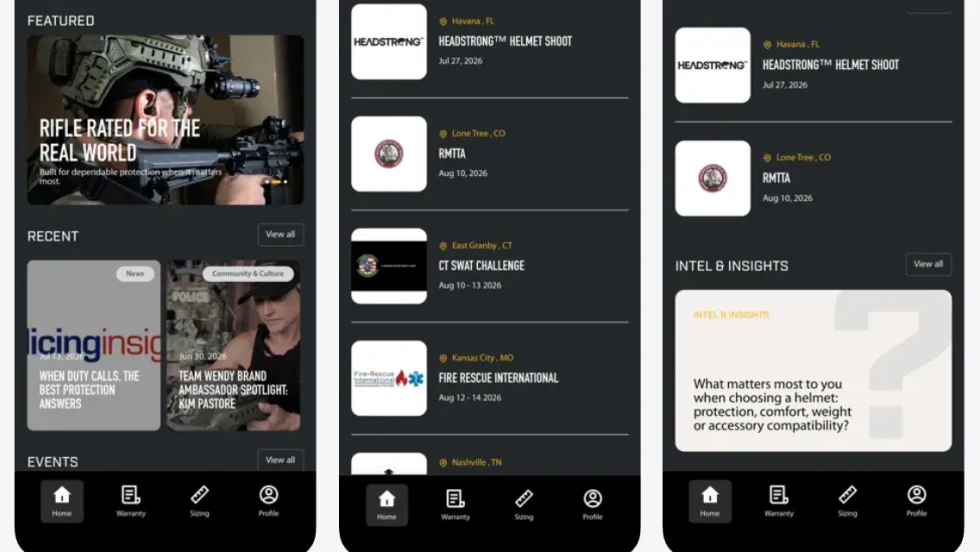
Team Wendy App Creates New Digital Hub for Helmet Owners
The Team Wendy Community App provides one location for warranty registration, size-fit tools, product updates, and community connection. For helmet owners, the new app creates a simpler path to the information and tools that matter most.
Read More →