



Playing the Grant Game
What could your department do with $250,000? Would you buy squad cars, add staff, purchase new equipment? What sounds like a pipe dream is actually a dream come true for those departments that have successfully pursued grant monies to fill budgetary shortfalls.


Photo: iStockPhoto.com.
What could your department do with $250,000? Would you buy squad cars, add staff, purchase new equipment?
What sounds like a pipe dream is actually a dream come true for those departments that have successfully pursued grant monies to fill budgetary shortfalls.
The Division of Criminal Justice recently awarded $5.75 million in federal grants to 17 New Jersey cities facing high levels of violent crime. These funds will enable departments to purchase "force multiplying" crime-fighting technologies they might otherwise have been unable to afford.
The money, which will be distributed as $500,000 grants to larger cities and $250,000 to smaller cities, may be used to purchase technologies such as closed-circuit TV cameras with gun shot detection capabilities, automated license plate readers, mobile data terminals, and communications equipment.
However, while the state has allocated specific amounts to each city, police departments must apply to the Division of Criminal Justice to receive the funds. Letters with grant applications and information were mailed to departments in April.
And for agencies such as the Jersey City Police Department, no one had to ask them twice to get those applications in.
"In this era of declining levels of funding and decreased staffing levels, police agencies must explore other means to augment the efficiency of our officers," Jersey City Police Chief Thomas Comey stated in a release put out by New Jersey's Office of the Attorney General. "This funding will afford the Jersey City Police Department the opportunity to upgrade and expand our technology to better protect our community."
As the Jersey City example illustrates, the money exists, but it's only available to those who apply for it-and that's where many police agencies fall short, says Denise Schlegel, president of DS Schlegal and Associates, whose firm provides grant writing training and facilitation services.
"The biggest challenge to law enforcement is the time to get it done and get it done right," she says. "It takes time and it has to be done correctly or you won't get the funds."
Recession Proof?
In a climate where tight budgets and scarce resources seem to rule the day, it's logical to think law enforcement grants may be drying up. But that's not accurate, says Thomas Caves, special assistant to the secretary at the North Carolina Department of Crime Control and Public Safety and instructor for Grant Writing USA.
Grants change every time a new administration enters office, Caves says. Just as the Bush Administration chopped COPS grants in favor of Homeland Security funding, the Obama Administration, too, has altered the funding structure. But, he stresses, the funds generally remain stable; they are simply awarded via a new funding mechanism.
He does warn, however, there are efforts afoot to reduce overall spending within the government, which may impact public safety allocations.
Margaret Stark, senior certified grant consultant with Avon Protection Systems, notes the status of several federal grants, which have been the mainstay of law enforcement, are still unknown. And while rumors are afloat that these grants will see substantial cuts, she says "nothing has been officially posted as to what changes will occur."
Even so, Caves predicts funding will remain stable. "In my experience," he says, "public safety dollars tend to remain level [even during tough economic times]."
What is certain, says Stark, is that agencies across the country have seen their budgets slashed to cope with local budgetary crises, and this will increase law enforcement's reliance on grant funding. "In years past, when funding was plentiful, there were some questionable grants funded. I don't think we're going to see that anymore," she says. "Competition will be fierce-everyone is broke. Agencies will need to take advantage of everything at their disposal to ensure they get funding because there will be more agencies than ever applying for it."
Know Thy Grants
When the competition heats up, the best teams train harder; that's what agencies will need to do to win the funding game.
First, Caves says departments should know what types of grants are available; they include the following:
Discretionary Grants. Here, the federal government reviews grant applications and weighs them against set legislative and regulatory requirements and published selection criteria, then awards funding to the applications that best address program requirements.
Block Grants. This is a large sum of money granted by the federal government to state governments with general provisions as to how it is to be spent. The federal government might set 27 uses for the money, but the state might only allow six. Unlike discretionary grants, the federal government offers broad guidelines but the states have the final say on how the money can be used. Therefore, applications for block grant money should be directed to state governments.
Earmarks. This is a legislative provision that directs approved funds to be spent on specific projects. "An earmark is essentially the effort of a congressman to send money home to his or her district," Caves says.
Agencies can also look to the corporate community and private foundations for funding, adds Schlegal.
Show Me the Money
Grant funding changes every year, so the next most important step is to know what grants are available. Departments can follow the money by attending grant-writing courses and training a close eye on Congressional dialogue. "What they are talking about on the Hill is probably going to become a grant at some point in time," Caves says.
There are a number of excellent resources that can help departments track available funds, adds Stark.
Grants.gov, for instance, provides a unified site for interaction between grant applicants and the federal agencies managing grant funds. A police chief looking to secure funding for Personal Protective Equipment (PPE) can simply type in PPE on the site to retrieve a list of available funding sources. "This site posts all available grants, so they also may find funding for things they are not looking for," Stark says, which is where a site such as
Firstrespondergrants.com can help.
Firstrespondergrants.com sifts through the info on Grants.gov to locate grants benefiting public safety, then lists those grants on its site with links to the federal grant information and application at Grants.gov.
Other grant sources include:[PAGEBREAK]
Responders Knowledge Base, which lists FEMA grants
But Caves emphasizes conferences and seminars such as those offered by grantwritingusa.com might be the best place to pinpoint available funds. "They organize the info and present it without a lot of fluff," he says. "But if you go once and never go again, then you're not going to be effective, because grants change. What was a solid grant program 20 years ago probably doesn't exist today because of policy changes. You need to get this training every year."
Dot the I's and Cross the T's
Successfully completing a grant application is a lot like taking a test. If test-takers follow the directions and do things as instructed they pass but if they don't, they fail, says Stark.
"Grant writers need to read the directions carefully," she says. "Every grant will be slightly different and require different things in the application."
Failing to follow directions is a good way to get a grant application thrown out, agrees Caves. "You have to read the instructions-even if they're 80 pages long-to find out the types of projects the grant promotes and what's required in the application."
Carefully reading directions also helps grant writers pick up buzzwords to use in their grant proposals. According to Caves, doing so shows they did their homework.
Instructions typically provide a long list of approved and blacklisted purchases. A department asking to use the money to purchase unapproved items will quickly be denied funding. "When I was a reviewer for the Department of Justice, we often found that people asked for things we specifically said we would not fund," Caves says.
Caves cautions agencies not to apply for money just for the sake of doing so. The department's needs and mission must match those of the funding source. "Unless your mission matches theirs, you're going to be spinning your wheels," he says. "When you have a match, send out a proposal and hope for the best."
Be Prepared
The Boy Scouts of America motto "Be Prepared" is one to follow in grant writing. Agencies that look for money but lack data to complete their applications will be unable to file them in time.
"Deadlines are swift and that's one reason you need to prepare ahead of time," says Stark. "You need to know what you're planning to apply for, collect the information that shows a need, and have it ready so when the grant opens you're ready to move."
Advance preparations should include registering for e-grants filing with Grants.gov to obtain a DUNS number and applying for a Central Contractor Registry Number, then registering both numbers with state government. "This needs to be done in advance because the process can take weeks," says Stark.
Grants also ask for community statistics and demographics. It's not enough to say: "We have a lot of violent crime in our jurisdiction." Most grants require agencies to submit Uniform Crime Reporting (UCR) reports and other data to demonstrate need.
"We're finding many police departments haven't recorded this information," says Schlegal, author of "Grant Writing-Show Me the Money." "If you don't participate in the UCR, then you don't get the funding. It takes you out of the ballgame altogether."
Being prepared also includes knowing what tools and technologies your department needs, adds Caves. As a grant writer for the North Carolina State Highway Patrol, Caves began collecting a wish list in January. He encouraged every employee and every unit to submit ideas for items their budgets could not pay for, whether these were new bullet-resistant vests, better digital cameras, or in-car computers. He organized this list in November and provided it to management for approval by January 1.
"When grants opened, I already had my ducks in a row," he says. "I knew what I was going to pursue for grants for the year at the same time I began collecting information for the next year."
Even if the application window has closed and funds have been awarded, Caves encourages checking in with funding agencies toward the end of their fiscal year. "If a funding source cannot get their money spent by year's end, their money for the following year gets cut," he explains. "If you talk to them two months before the end of their fiscal year, they might have funds available for your program or project."
North Carolina once had a judge throwing out DUI charges because citations had been issued at a checkpoint that lacked signage to warn motorists of the checkpoint. Caves asked the Governor's Highway Safety Program for grant money to pay for signage, and they quickly provided it. This funding wouldn't have been available if the department hadn't asked for it, Caves says.
Spend Wisely
Everyone's heard the scuttlebutt over economic stimulus funding, and concerns over whether it was appropriately awarded and spent. Once agencies receive grant monies, it's essential to spend it as their applications said they would.
"A grant is not a blank check that you can spend as you please," says Caves. "It's for you to do exactly what you said you were going to do when you requested the grant."
The funding source must approve any deviations in spending, even for changes that might seem intuitive. Let's say a grant was for 18 computers and, because the price of these computers dropped, the department can now buy 20 instead of 18 for the same amount of cash. "You can't do that without permission," says Caves. "The Feds get really bent out of shape if you change any terms. If you said you were going to buy 18 computers, you better buy 18 computers, unless you receive written authorization from the funding source."
Most grants also require reporting on a scheduled basis, adds Stark. If agencies fail to report on time or do not include the information required, they can be asked to return the money.
While securing grant funding is not a quick process, Caves points out it "can be a very effective tool" that helps police departments drum up the money they need.
"It is a very stressful time," he says. "But stressful times are times of opportunity." And grants are just one opportunity cash-strapped agencies may not want to pass up.
Ronnie Garrett is a freelance writer based in Fort Atkinson, Wisc.
More Patrol

Adept Armor Introduces Two New Rifle Plates
Adept Armor has launched two new Level IV ballistic plates, the Emperor and the Archon Mark 2, which brings Adept Armor’s new Quatroid ceramic to the high-threat, performance-value center of the range at 5.2 pounds.
Read More →
POLICE Product Test: Benchmade Bailout
The Benchmade Bailout is a slim, lightweight carry knife with a deep-ride pocket clip and comes in a variety of blade steels and scales. Here is a detailed review of the Taiga Green Bailout, released earlier this year.
Read More →
NLEOMF Announces July 2026 Officer of the Month
NLEOMF honored a Michigan deputy sheriff as the July 2026 Officer of the Month for rescuing a trapped driver from a burning vehicle following a Fourth of July crash.
Read More →
Streamlight to Showcase Newest Lighting Products at National Safety Council’s Safety Congress & Expo 2026
Streamlight will showcase its latest lights, including the Portable Scene Light III and the LiteBox 1Million, at the 2026 National Safety Council (NSC) Safety Congress & Expo.
Read More →
The 2027 World Police & Fire Games Set for Perth, Australia
The 2027 World Police & Fire Games (WPFG) will take place in Perth, Western Australia, from Friday, March 12 through Sunday, March 21, 2027.
Read More →
5.11 Partners with National Fallen Firefighters Foundation to Support #ForThe343
5.11 has joined the nationwide movement honoring the 343 New York City Fire Department firefighters lost on Sept. 11, 2001.
Read More →
Team Wendy Announces Title Sponsorship of the Jorge Pastore Foundation
Team Wendy’s 3-year partnership with the Jorge Pastore Foundation expands access to programs that strengthen those who serve.
Read More →
National Law Enforcement Memorial and Museum Hosting 9/11 25th-Year Commemoration Ceremony
The National Law Enforcement Memorial and Museum is hosting a 9/11 25th Year Commemoration Ceremony on Sept. 11 at 4 p.m.
Read More →
National Law Enforcement Officers Memorial Fund Announces June 2026 Officers of the Month
The National Law Enforcement Officers Memorial Fund (NLEOMF) named 15 officers of the Chico Police Department (California) as the Officers of the Month for June 2026 for their roles in responding to an active-shooter incident at a public library.
Read More →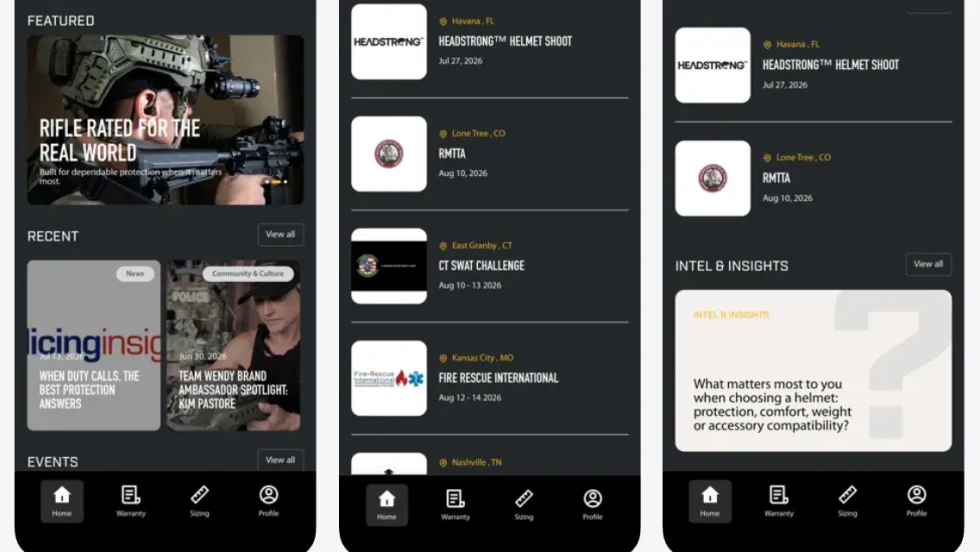
Team Wendy App Creates New Digital Hub for Helmet Owners
The Team Wendy Community App provides one location for warranty registration, size-fit tools, product updates, and community connection. For helmet owners, the new app creates a simpler path to the information and tools that matter most.
Read More →