



Patrol Shields Vs. Active Shooters
Newer shields developed with patrol officers in mind are lighter weight and designed to allow officers to shoot while carrying them. They can also easily fit in a patrol car.

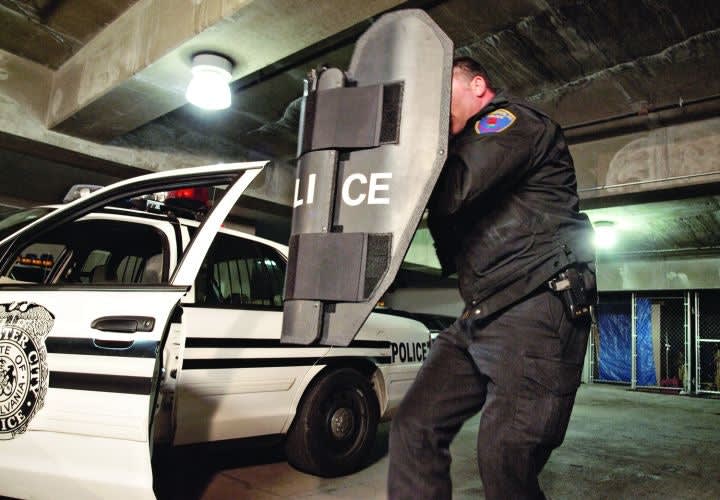
Ballistic shields such as the Baker PatrolBat are designed to fit in a patrol officer's car and can be carried while shooting solo. Photo: Mark W. Clark.
Conventional wisdom about response to active shooter situations has changed drastically since the Columbine High School shooting in 1999. It's changed even more so in the last two years. Not only is it widely considered fool hardy to wait for a SWAT team to resolve such a situation, it's now the new standard for one patrol officer to enter and act alone unless someone else shows up pretty quickly to help out. Should that officer go in with a shield?
Until recently the answer to that question would have been an unequivocal "No."
Experts in the field are currently debating the wisdom of a patrol officer using a shield in such situations. Traditional tactical shields can take a lot of fire, but they're also heavy and cumbersome. Waiting for SWAT to arrive with these shields doesn't make sense.
Newer shields developed with patrol officers in mind are lighter weight and designed to allow officers to shoot while carrying them. They can also easily fit in a patrol car. Examples include the Go Shield and the Baker PatrolBat. But they're still an additional piece of equipment. And they're expensive, as is the additional training that would be needed to use them.
Don Alwes, an instructor for the National Tactical Officers Association and a patrol officer with the Wilmore (Ky.) Police Department, isn't sold on the idea of first responders using shields when they arrive at an active shooter incident. He's concerned that officers will be encumbered by the shield and that it will interfere with their ability to shoot accurately, slowing them down and diminishing their
effectiveness.
"One of the things we've learned in the tactical world, well before law enforcement tac teams, are the three tactical principles: speed, surprise, and violence of action," says Alwes. "Those are what we want when trying to assault a place where people are dying. The shield doesn't help you with any of those."
Alwes recommends using shields only if the incident becomes a barricade situation, or after the shooter has been neutralized and officers are clearing the building, "once things slow down."
Rick Armellino, director of Baker Ballistics, which manufactures the Baker BatShield line, disagrees. He says that heavier tactical shields are designed for slow movement, but those for patrol response don't cause the same issues.
"The use of the patrol shield helps the officer move swiftly in unprotected open areas and past doorways," says Armellino. "Without the shield they have to slow down for their own safety and use a lot of natural cover, which may or may not be available to protect them against ambush as they make entry to go toward the killing."
Easing Access Problems
There are agencies that provide shields to all of their officers. But those are few and far between. Most don't have the funding to purchase that many shields, even if they see a need.
"Mostly, we've found it's the rural sheriff's departments that put shields out on patrol and keep them in the vehicle," says Armellino. "They're on their own. Sometimes their nearest backup is in the next county and a minimum of 30 minutes away. They need all the protection they can get when they're out on patrol."
However, if the agency brass doesn't see such a dire need for its officers, most likely they won't purchase shields for all of them anytime soon. Some departments purchase a few and control who can use them on patrol.
One way to do that is put them in sergeants' cars. But that means a patrol officer would have to wait for the sergeant to get a shield to the scene before being able to use it to engage a shooter. Some agencies even mandate that patrol officers wait for a sergeant or other supervisor to arrive on scene before acting as a means of controlling liability. Armellino says agencies that follow this strategy usually plan to purchase more shields to be distributed to individual officers when they can afford them. But until then, it can be a logistical nightmare.
"If you need it, you need it," says Police Sgt. Tim O'Neill of the Avon and Somerset Constabulary in England. "That might sound obvious, but you can't wait for someone to bring the requisite equipment."[PAGEBREAK]
O'Neill is a firearms instructor at his agency, a tactical team member, and is part of a national team that looks at active shooter response. Because guns are more difficult to come by in the United Kingdom, shootings in the workplace and at schools are much rarer there, but when they happen it's important to be able to act, he says. This can be difficult because only some officers in the UK are armed. To handle such situations, all officers are given shields, and on each shift several armed response officers are available to respond to calls that require a firearm and additional tactical training.
Similarly, another strategy for working with fewer shields is to allow patrol officers trained in the use of a shield to check one out to use during their shift. Of course an officer can't know if he or she will need one beforehand. But this system does put shields in the hands of some officers on patrol so they can roll to a call and go in immediately with added protection. Still, it's not the same as every officer having his or her own shield.
"If the patrol officer has the permission and ability to be the first responder into a dangerous active shooting situation, then it's safer and more effective for him to do that with a shield," says Armellino. "The key is for him to have the shield on the front seat so as he exits the vehicle it's with him. There's no time for one to show up from headquarters."
It's Good Enough for SWAT
So, is it best for a patrol officer to use a shield or not?
"If you have a IIIA shield in your car, but the suspect has a rifle, the shield won't provide adequate cover," cautions Alwes.
Armellino dismisses this excuse to leave a shield behind: "I think that's a silly proposition to say, 'Don't bring a shield because it doesn't stop everything.'" He stresses that any form of additional protection could deflect a bullet, so in his opinion it can only help.
For his part, O'Neill would tend to wait until at least two officers with shields are available to enter an active shooter incident, and preferably four. He definitely sees the need for ballistic shields, but every situation is different. "If I could take one and operate effectively, I would. But it depends on the weapons I've got and how many people I've got with me," says O'Neill.
What bothers O'Neill the most is the fact that most patrol officers in the United States are not even being given the option to use a shield, partly because it's not seen as necessary.
"Why does SWAT have shields? Because they have a higher risk," O'Neill says. "So what happens when you have to go in and save someone's life? It's still someone who needs it to protect themselves. The patrol officer is going in because of the immediacy of the situation, so they need it, too."
One in Every Car
Whether patrol officers should make use of shields for specific incidents or not, it's a moot point if they don't have them to use in the first place. Cost is still an issue, as is deployment and the need for proper training. But if law enforcement agencies were able to purchase patrol shields, they'd most likely see the benefits of having them on hand.
"Active shooter situations, particularly at schools, is what gets them to buy the patrol shields and put them out on patrol," says Armellino. "Once they're on patrol, your typical patrol officer finds many ways that a shield can protect them, in doing all types of typical and dangerous duties."
Uses include high-risk car stops, serving warrants, and even domestic calls where someone inside could shoot through the door at police, Armellino says.
Alwes acknowledges shields have some great uses, too, and he'd ideally like to see one in every patrol car. "They're great for warrant services, for slow deliberate searches where you can use cover, for hostage situations, and for downed officer or downed citizen rescues." He just doesn't think they're the best equipment for an active shooter situation. But Alwes is all for listening to others' opinions and looking at new ways of approaching situations tactically.
As is O'Neill, who visits the United States at least once a year to learn from trainers here. He agrees that sharing knowledge and embracing new ideas are essential to ensuring law enforcement can best serve and protect the public. "You have to decide if you're moving forward or if you're in the 'ain't broke don't fix it' camp," he says.
Considering that Armellino has a list of agencies that would purchase shields for their patrol officers if only they had the funding, it seems like they're willing to move forward. And with overall changes in how patrol officers are expected to respond to threats, including active shooters, it's likely the monies will be set aside when the economy improves.
"Ultimately, I think you'll find in five or 10 years from now, the use of a shield on patrol will be standard," predicts Armellino. And when that happens, it will be up to agencies and individual officers to decide how to use them.
First Responder Shield Resources:
Armored Mobility
Baker Ballistics
Instant Armor
LCOA Composites
OM Tactical
Patriot3
Point Blank
Safariland
More Patrol

Adept Armor Introduces Two New Rifle Plates
Adept Armor has launched two new Level IV ballistic plates, the Emperor and the Archon Mark 2, which brings Adept Armor’s new Quatroid ceramic to the high-threat, performance-value center of the range at 5.2 pounds.
Read More →
POLICE Product Test: Benchmade Bailout
The Benchmade Bailout is a slim, lightweight carry knife with a deep-ride pocket clip and comes in a variety of blade steels and scales. Here is a detailed review of the Taiga Green Bailout, released earlier this year.
Read More →
NLEOMF Announces July 2026 Officer of the Month
NLEOMF honored a Michigan deputy sheriff as the July 2026 Officer of the Month for rescuing a trapped driver from a burning vehicle following a Fourth of July crash.
Read More →
Streamlight to Showcase Newest Lighting Products at National Safety Council’s Safety Congress & Expo 2026
Streamlight will showcase its latest lights, including the Portable Scene Light III and the LiteBox 1Million, at the 2026 National Safety Council (NSC) Safety Congress & Expo.
Read More →
The 2027 World Police & Fire Games Set for Perth, Australia
The 2027 World Police & Fire Games (WPFG) will take place in Perth, Western Australia, from Friday, March 12 through Sunday, March 21, 2027.
Read More →
5.11 Partners with National Fallen Firefighters Foundation to Support #ForThe343
5.11 has joined the nationwide movement honoring the 343 New York City Fire Department firefighters lost on Sept. 11, 2001.
Read More →
Team Wendy Announces Title Sponsorship of the Jorge Pastore Foundation
Team Wendy’s 3-year partnership with the Jorge Pastore Foundation expands access to programs that strengthen those who serve.
Read More →
National Law Enforcement Memorial and Museum Hosting 9/11 25th-Year Commemoration Ceremony
The National Law Enforcement Memorial and Museum is hosting a 9/11 25th Year Commemoration Ceremony on Sept. 11 at 4 p.m.
Read More →
National Law Enforcement Officers Memorial Fund Announces June 2026 Officers of the Month
The National Law Enforcement Officers Memorial Fund (NLEOMF) named 15 officers of the Chico Police Department (California) as the Officers of the Month for June 2026 for their roles in responding to an active-shooter incident at a public library.
Read More →
Team Wendy App Creates New Digital Hub for Helmet Owners
The Team Wendy Community App provides one location for warranty registration, size-fit tools, product updates, and community connection. For helmet owners, the new app creates a simpler path to the information and tools that matter most.
Read More →