



Parole and Probation Searches
After pussyfooting around the issue for years, the U.S. Supreme Court has finally come to a decision on what justifies a probation or parole search.

Most of the U.S. Supreme Court's many rulings on Fourth Amendment issues dealing with the justification of warrantless searches and seizures have focused on either suspicion of criminal wrongdoing, or consent or exigency. But in a handful of cases, the court has considered another category of Fourth Amendment justification: basing a search or seizure on the suspect's status as a parolee or probationer. The decision in Samson v. California from the court's most recent term is the latest pronouncement in an evolving set of rulings.
Griffin v. Wisconsin
To assist probation officers and parole officers with their supervision and to aid in the general law enforcement need to curb recidivism, many states require parolees and probationers to agree that their conditional release will be subject to curtailment of their normal Fourth Amendment protections. Typically, the released convict agrees to submit his person, property, and residence to warrantless, suspicionless search and seizure by any correctional or law enforcement officer for the duration of the probationary or parole term.
The state of Wisconsin had a similar provision when officers found felony probationer Joseph Griffin with a handgun in his home, in violation of the conditions of his probation and state law. The state courts denied his motion to suppress the gun, finding that the probation officer had "reasonable grounds" to make a warrantless entry and search.
The U.S. Supreme Court ruled that suppression was properly denied, but rejected the "reasonable grounds" test as a necessary justification for a probation search. The court said it was unnecessary to consider the "reasonable grounds" issue, because the probation regulation was a valid basis for the search: "The search of Griffin's residence was 'reasonable' within the meaning of the Fourth Amendment because it was conducted pursuant to a valid regulation governing probationers."
Pennsylvania Board of Probation and Parole v. Scott
The next probation and parole issue decided by the Supreme Court was whether to apply the exclusionary rule to evidence offered at a parole revocation hearing. Five months after being released from a minimum prison term for murder, parolee Keith Scott was found to have five firearms in his home when it was searched by parole officers. Evidence of this violation of parole was admitted at his revocation hearing, but the appellate court and Pennsylvania Supreme Court reversed this decision. Those courts held that the search of Scott's home violated the Fourth Amendment because the parole officers lacked a "reasonable suspicion" of a violation before making the search.
On appeal, the U.S. Supreme Court reversed the Pennsylvania high court. The court sidestepped the issue of whether any level of suspicion was constitutionally required in order to search someone who had agreed to suspicionless searches. Instead, the court held that even if the search were assumed to be unreasonable, the Fourth Amendment exclusionary rule should have no application at a revocation proceeding: "The federal exclusionary rule does not bar the introduction at parole revocation hearings of evidence seized in violation of parolees' Fourth Amendment rights."
U.S. v. Knights
Mark James Knights was placed on probation in California for a drug conviction. A standard term of his probation provided for warrantless, suspicionless search and seizure by any peace officer. When an officer investigating arson attacks on electric power installations developed a reasonable suspicion that Knights was involved in these acts, he entered and searched Knights' apartment, in reliance on the probation search condition. The officer found explosives, arson equipment, and other incriminating evidence, which was offered in trial against Knights on federal charges of illegal possession of destructive devices and ammunition, and conspiracy to commit arson.
The district court judge suppressed the evidence, ruling that because the officer acted for an investigatory purpose, rather than a probationary purpose, the search was illegal and the evidence inadmissible. The Ninth Circuit Court of Appeals affirmed this ruling, and the government appealed.
The U.S. Supreme Court unanimously reversed the Ninth Circuit and district court rulings. Once again sidestepping the issue of whether officers needed any suspicion to conduct a probation search, the court held that where, as here, there was in fact a reasonable suspicion, a warrantless probation search was not constitutionally unreasonable. The Supreme Court also rejected the Ninth Circuit's view and held that the officer's subjective purpose in searching-investigation, rather than rehabilitation-was irrelevant: "There is no basis for examining official purpose. We have been unwilling to entertain Fourth Amendment challenges based on the actual motivations of individual officers."
Samson v. California
Finally, in Samson v. California, the Supreme Court could sidestep the issue of justification for a probation or parole search no longer. The issue was squarely presented after a police officer, aware that Donald Curtis Samson was on parole and subject to a suspicionless search condition, stopped him on the street and searched his clothing, finding methamphetamine.
The California courts admitted the evidence against Samson, ruling that no suspicion was necessary to conduct a parole search in a reasonable manner. Samson appealed to the U.S. Supreme Court, which conceded that the issue at last had to be decided, suggesting that the same standard would apply to both probation and parole searches: "[In Knights], we did not reach the question whether the search would have been reasonable under the Fourth Amendment had it been solely predicated upon the condition of probation. Our attention is directed to that question today, albeit in the context of a parolee search."
The Supreme Court examined the nature of the conditional release of prisoners on parole, noted the high rate of recidivism (70 percent of California's parolees re-offend within 18 months of parole), and decided that the state's need for close supervision of those who are released from prison is a significant factor. At the same time, where a parolee accepts a term of warrantless, suspicionless search as a condition of early release from prison, he has temporarily forfeited the right to require a search warrant or some level of objective suspicion for police searches and seizures.
The court concluded by saying, "Examining the totality of the circumstances pertaining to petitioner's status as a parolee...including the plain terms of the parole search condition, we conclude that petitioner did not have an expectation of privacy that society is prepared to recognize as legitimate...Thus, we conclude that the Fourth Amendment does not prohibit a police officer from conducting a suspicionless search of a parolee."
Expanding Parole and Probation Searches
Not all states impose search conditions on parolees and probationers. But given the Supreme Court's deference to the states in designing systems that meet the objectives of reintegrating offenders into society while protecting public safety, states would be free to adopt plans that, like those in Wisconsin, California, and other states, allow all law enforcement officers-not just parole and probation officers-to conduct warrantless, suspicionless searches of the person, vehicle, property, and residence of a parolee or probationer at any time of the day or night, in a reasonable manner.
As permitted by state law and the Supreme Court, parole and probation search conditions can provide police officers with a legitimate tool to detect and interdict criminal behavior.
Devallis Rutledge, a former police officer and veteran prosecutor, is Special Counsel to the Los Angeles County District Attorney.
More Patrol

Adept Armor Introduces Two New Rifle Plates
Adept Armor has launched two new Level IV ballistic plates, the Emperor and the Archon Mark 2, which brings Adept Armor’s new Quatroid ceramic to the high-threat, performance-value center of the range at 5.2 pounds.
Read More →
POLICE Product Test: Benchmade Bailout
The Benchmade Bailout is a slim, lightweight carry knife with a deep-ride pocket clip and comes in a variety of blade steels and scales. Here is a detailed review of the Taiga Green Bailout, released earlier this year.
Read More →
NLEOMF Announces July 2026 Officer of the Month
NLEOMF honored a Michigan deputy sheriff as the July 2026 Officer of the Month for rescuing a trapped driver from a burning vehicle following a Fourth of July crash.
Read More →
Streamlight to Showcase Newest Lighting Products at National Safety Council’s Safety Congress & Expo 2026
Streamlight will showcase its latest lights, including the Portable Scene Light III and the LiteBox 1Million, at the 2026 National Safety Council (NSC) Safety Congress & Expo.
Read More →
The 2027 World Police & Fire Games Set for Perth, Australia
The 2027 World Police & Fire Games (WPFG) will take place in Perth, Western Australia, from Friday, March 12 through Sunday, March 21, 2027.
Read More →
5.11 Partners with National Fallen Firefighters Foundation to Support #ForThe343
5.11 has joined the nationwide movement honoring the 343 New York City Fire Department firefighters lost on Sept. 11, 2001.
Read More →
Team Wendy Announces Title Sponsorship of the Jorge Pastore Foundation
Team Wendy’s 3-year partnership with the Jorge Pastore Foundation expands access to programs that strengthen those who serve.
Read More →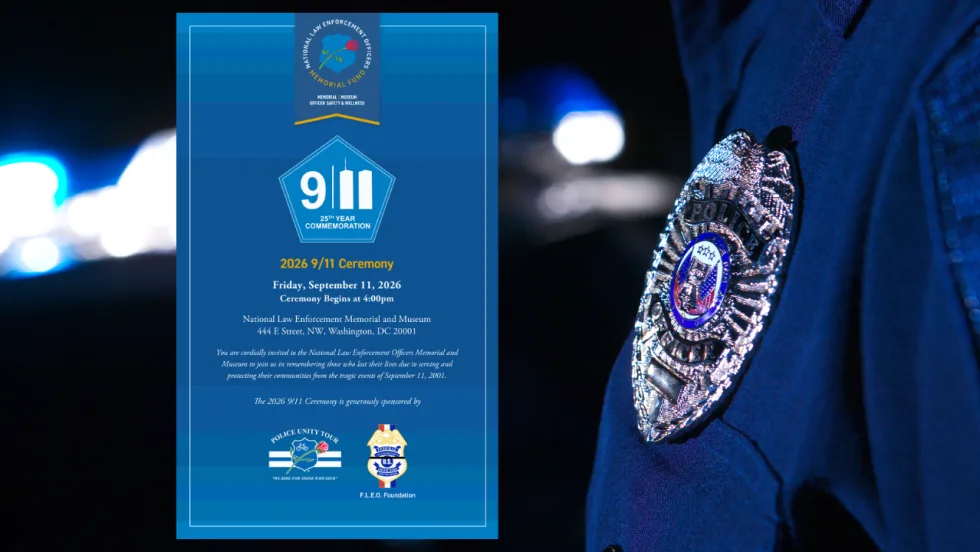
National Law Enforcement Memorial and Museum Hosting 9/11 25th-Year Commemoration Ceremony
The National Law Enforcement Memorial and Museum is hosting a 9/11 25th Year Commemoration Ceremony on Sept. 11 at 4 p.m.
Read More →
National Law Enforcement Officers Memorial Fund Announces June 2026 Officers of the Month
The National Law Enforcement Officers Memorial Fund (NLEOMF) named 15 officers of the Chico Police Department (California) as the Officers of the Month for June 2026 for their roles in responding to an active-shooter incident at a public library.
Read More →
Team Wendy App Creates New Digital Hub for Helmet Owners
The Team Wendy Community App provides one location for warranty registration, size-fit tools, product updates, and community connection. For helmet owners, the new app creates a simpler path to the information and tools that matter most.
Read More →