



Nowhere to Hide From License Plate Recognition
It's now common for even a small agency to have at least one car equipped with ALPR to automatically alert when it gets a match. But both mobile and fixed camera systems are gaining traction with all types of law enforcement agencies.

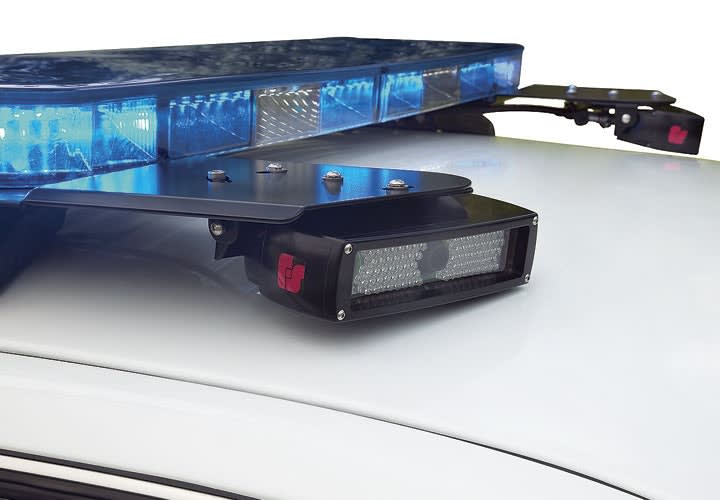
Photo: PIPS Technology
It's hard to believe that automated license plate recognition systems (ALPR) have been around for less than a decade. These wonders of technology decipher the letters and numbers on plates from every state and match them against hotlists selected by a law enforcement agency. With the ability to scan around 1,800 plates per minute, if a plate that's in a system's hotlist passes by, an ALPR system is going to detect it.
It's now common for even a small agency to have at least one car equipped with ALPR to automatically alert when it gets a match. But both mobile and fixed camera systems are gaining traction with all types of law enforcement agencies. That's because they can be used for different targeted strategies and all without an officer having to manually key in the license plates or call them in to dispatch.
Mobile v. Fixed
When it comes down to it, license plate recognition systems serve the same basic function, whether moving in a car or stationary on a pole or building. But their positioning determines how they can be used.
"One of the major benefits [of a mobile system is] Instead of being fixed at an intersection or along an interstate, officers can choose where to collect license plate data and collect thousands of plates an hour," says Bryan Sturgill of PIPS Technology. However, stationary cameras can be useful for long-term projects that don't require constant manual monitoring. "A fixed system doesn't have to be installed or assigned in a specific vehicle," explains Sturgill. "It can be strategically located in a high-crime area or something of that nature."
These different benefits come into play when determining how to utilize license plate recognition. No longer just for identifying stolen cars, mobile and stationary cameras play important roles in maintaining order and solving major crimes.
"A single camera mobile ALPR system can be used for anything from essentially revenue collection to drug enforcement, stolen cars, and historical data collection," says Dave Carson, technical services manager for CitySync. "With fixed LPR, it keeps a brief record of who passed by, and if an event happened last night, you can see who drove in during that time."
Clearly, a solution that incorporates both mobile and fixed cameras yields the most effective results in investigating crimes, and allows for the most flexibility in overall application. But the ideal is not always possible, at least at the outset. "Once they get a mobile system or two, they tend to start asking about fixed cameras," Carson adds.
Immediate Interdiction
One of the major benefits of ALPR systems is that officers can immediately apprehend offenders when a certain license plate is recognized. This is made possible by the use of hotlists.
A police department can determine which lists it wants to maintain to check plates against. When a match is found in any database, an alert will in most cases visually and audibly notify an officer or other person monitoring the system.
NCIC is the most recognized such hotlist, but it's by no means the only one that can be used. There are hotlists of license plates associated with arrest warrants, sex offenders, and even people who haven't paid their taxes in some states. In fact, databases can be specially customized for how an agency wants to use its ALPR system. "They can create their own local databases so they can look for local subjects or perpetrators that may not be in a national database," says Sturgill of PIPS Technology.
ALPR can also be used for geo-fencing of sex offenders. In this case, an alert would only sound if the license plate of a registered sex offender were detected within 500 yards of a school or playground. If the license plate were detected in an area that is legally allowable under the law, no alert would pop up.[PAGEBREAK]
Databases can also be used to find missing persons. One of the newest ways law enforcement agencies are using hotlists and ALPR is for Silver alerts. Similar to AMBER alerts used to notify the public of abducted children, a Silver alert is used to broadcast information about missing adults. It was originally established to help find seniors with Alzheimer's disease, hence the name, but Silver alerts can be used for any adults that might need help finding their way home.
Just before Christmas, a sheriff's office that uses ELSAG North America's ALPR systems was notified that a woman suffering from extreme depression had gone missing, and they were afraid something had happened to her. She had left in her car, so the sheriff's office reached out to all the agencies in the four surrounding counties to utilize their license plate readers to look for her license plate.
"They were able to find her license plate, which then led to finding her," says ELSAG's Nate Maloney. "They brought her to the hospital and had her checked out, and she was able to go home and was able to enjoy Christmas with her family because the LPR led them to her."
Investigation
As mentioned earlier, ALPR can greatly assist in investigations. These systems don't just process the plates that generate hits, but all of the plates that have been captured by a camera and decoded. It's all a matter of how the information is utilized. "It's become a great investigative tool because the data can be stored in databases and searched against for however long the police agency decides to store that data," says Sturgill.
Identifying the location of suspects in a crime based on where their registered license plates were detected has solved many a case. But there are other uses as well.
One agency uses its ALPR equipment in concert with Shot Spotter, an acoustical device that detects the direction of gunfire. When Shot Spotter detects gunfire and identifies where it is coming from, the ALPR cameras are automatically turned toward that direction so they can identify any vehicles that may be fleeing from that scene. This collaborative system has helped the agency solve a homicide.
Convoy analysis is another inspired use of ALPR technology. If there is a rash of auto thefts, law enforcement can use correlating data to find potential suspects. "If we're going to steal a truck, I have to drive you somewhere, you steal the vehicle, and then we both drive home," explains CitySync's Carson. "Using ALPR data from several locations, chances are the same car following the same guy over a period of time is somehow related to the case."
On its own, license plate recognition systems identify plates, check against hotlists, and store data. How law enforcement agencies want to utilize these abilities is up to them. "It's almost unlimited what you want the ALPR software to look for," says Commander Jason Williams of the Bellwood (Ill.) Police Department. And his agency has only scratched the surface thus far.
Revenue Generation
In addition to solving crimes, license plate recognition systems can bring in money. Officers with the Bellwood Police Department routinely use two mobile ALPR systems from ELSAG to enforce fining for parking tickets, and have been pleased with the results.
One car has two cameras that are angled in such a way that they can scan plates of cars parked on both sides of the street as the patrol vehicle drives by. The other has two additional cameras positioned so they can scan plates on vehicles parked perpendicular to the cruiser in lots. These cars maintain hotlists of license plates registered to people who have reached a certain threshold of unpaid parking fines.
If an alert sounds that a plate is recognized as "boot eligible," the officer stops the car, puts a "boot" on the vehicle's wheel to prevent it from moving, and keeps patrolling. Beyond a certain threshold of parking fines, the officer might also have the vehicle towed, but those offenders are on a different hotlist.
Some states link vehicle registration to tax records, so if someone owes taxes, police can "boot" or tow his or her vehicle. Law enforcement will only remove the boot or return the car after the violator has paid his or her taxes. "In New Haven, Conn., in a 12-month period, they collected almost $13 million in back taxes from people who had outstanding debt," says
ELSAG's Maloney.
Most agencies don't use ALPR to generate revenue, and Bellwood PD is no different. From the outset, the plan has been for the department to start using license plate recognition to crack down on people refusing to pay parking tickets before moving on to other targets. "We want to expand to looking for traffic violators who have suspended driver's licenses and people who are wanted, but I understand you can also use that in stationary systems," says Williams. "We currently have red light violation cameras in town, and putting this software into those cameras would help us."
While most agencies' LPR capabilities are limited by cost concerns, that may not always be the case, even for smaller departments. "It's an evolving technology," says Sturgill. "I think at one point it will probably be as common as radar is in a police unit."
For More Information:
CitySync
ELSAG North America
NDI Recognition Systems
PIPS Technology
Vigilant Video
More Technology

A police agency's guide to data-driven fleet management
Costs are rising and the public expects more transparency into how their tax dollars are spent. This e-book shows how police agencies can use fleet data to take control of fleet expenses while improving officer safety and demonstrating fiscal responsibility to the communities they serve.
Read More →
AI and analytics for law enforcement: Turning data into insights
Law enforcement agencies are managing more video, sensor data and digital evidence than ever before. Discover how AI and analytics can help turn that data into actionable insights that strengthen situational awareness, accelerate investigations and support more informed decisions.
Read More →
Vasco Electronics Adds Automatic Language Detection to Vasco Translator Q1
Vasco Electronics’ software update introduces hands-free language switching and expanded offline translation across 45 language pairs, empowering law enforcement, healthcare, and front-office enterprise teams
Read More →

North Miami Police Department Deploys Mark43
The North Miami Police Department has deployed Mark43 as part of its Five-Year Strategic Plan that represents its collective vision and goals for a more proactive police department, anchored by a core commitment to leveraging modern technology to enhance efficiency and public safety.
Read More →
Cellebrite Genesis for Enterprise Now Generally Available
Made available to the public sector in June, Cellebrite Genesis is serving a growing mix of national, regional, and local agencies worldwide, including some of the largest regional and metropolitan police departments. It is now available for enterprise organizations.
Read More →
2026 Vision FirstNet Users Summit to Host Emerging Leaders Training on Grassroots Advocacy for Public Safety
“Emerging Leaders Training: Understanding the Importance of Grassroots Advocacy for Public Safety," a session during the 2026 Vision FirstNet Users Summit, will offer a roadmap for unified advocacy at the federal level.
Read More →
Motorola Solutions Completes Acquisition of D-Fend Solutions
Motorola Solutions has acquired D-Fend Solutions, an industry leader in counter-drone technology. This deal provides public safety and enterprise customers with access to advanced counter-unmanned aerial systems.
Read More →
ZeroEyes, Advantech & Camden Police Partner to Bring AI Gun Detection Technology to Delaware School District
ZeroEyes has partnered with Advantech and the Camden Police Department to deploy ZeroEyes’ AI gun detection and intelligent situational awareness platform at Delaware’s Caesar Rodney School District (CRSD).
Read More →
Leonardo U.S. Cyber & Security Solutions Introduces SignalTrace, the Next Evolution in Electronic Signature Detection Technology
SignalTrace reflects years of product refinement and a clearer expression of the technology’s purpose of recognizing and correlating electronic signatures in publicly broadcast wireless signals to reveal patterns, relationships, and trends that might otherwise go undetected.
Read More →
Pimloc Launches Secure File Sharing to Streamline Release of Redacted Video
Pimloc’s Secure File Sharing lets organizations deliver redacted video, audio, and documents through expiring, passcode-protected links, accelerating delivery while reducing security, compliance, and chain-of-custody risks.
Read More →